



Weekly Market Commentary

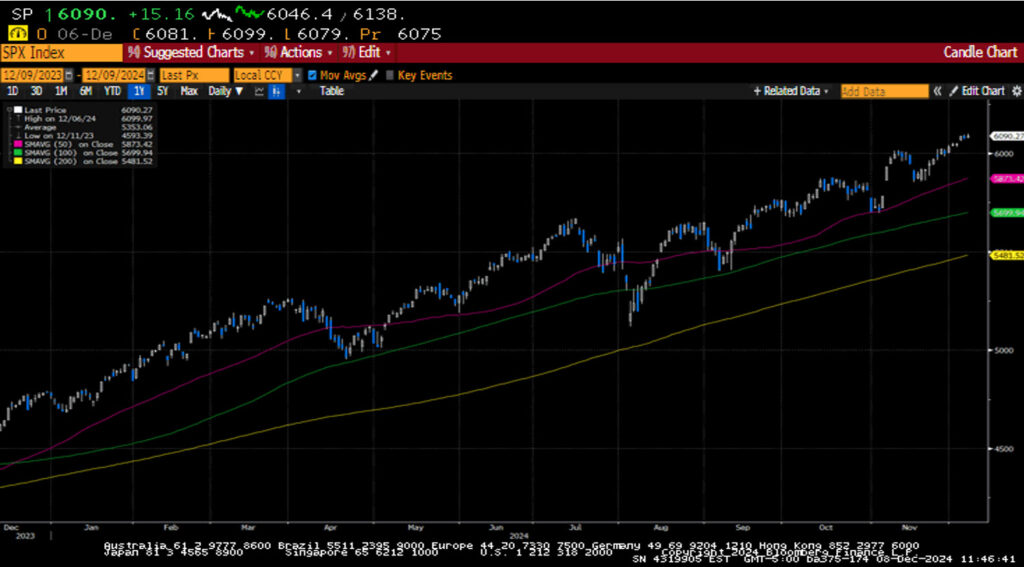
The S&P 500 forged another set of all-time highs as investors embraced the idea of an economy running at a pace appropriate for the Fed to consider further rate cuts. Leadership in the market toggled back to the mega-cap technology issues, with the communication services, information technology, and consumer discretionary sectors leading the way.  Salesforce.com’s 3rd quarter results reminded the street of the enormous opportunity in AI with an encouraging outlook from the software provider.  President-elect Trump continued to define his administration and policy with the nomination of Kash Patel as FBI director and warning BRIC nations of dismantling the US dollar as the world’s reserve currency.  Trump also insisted that the hostages in Gaza be released just as the ceasefire between Israel and Hezbollah appeared to be falling apart.
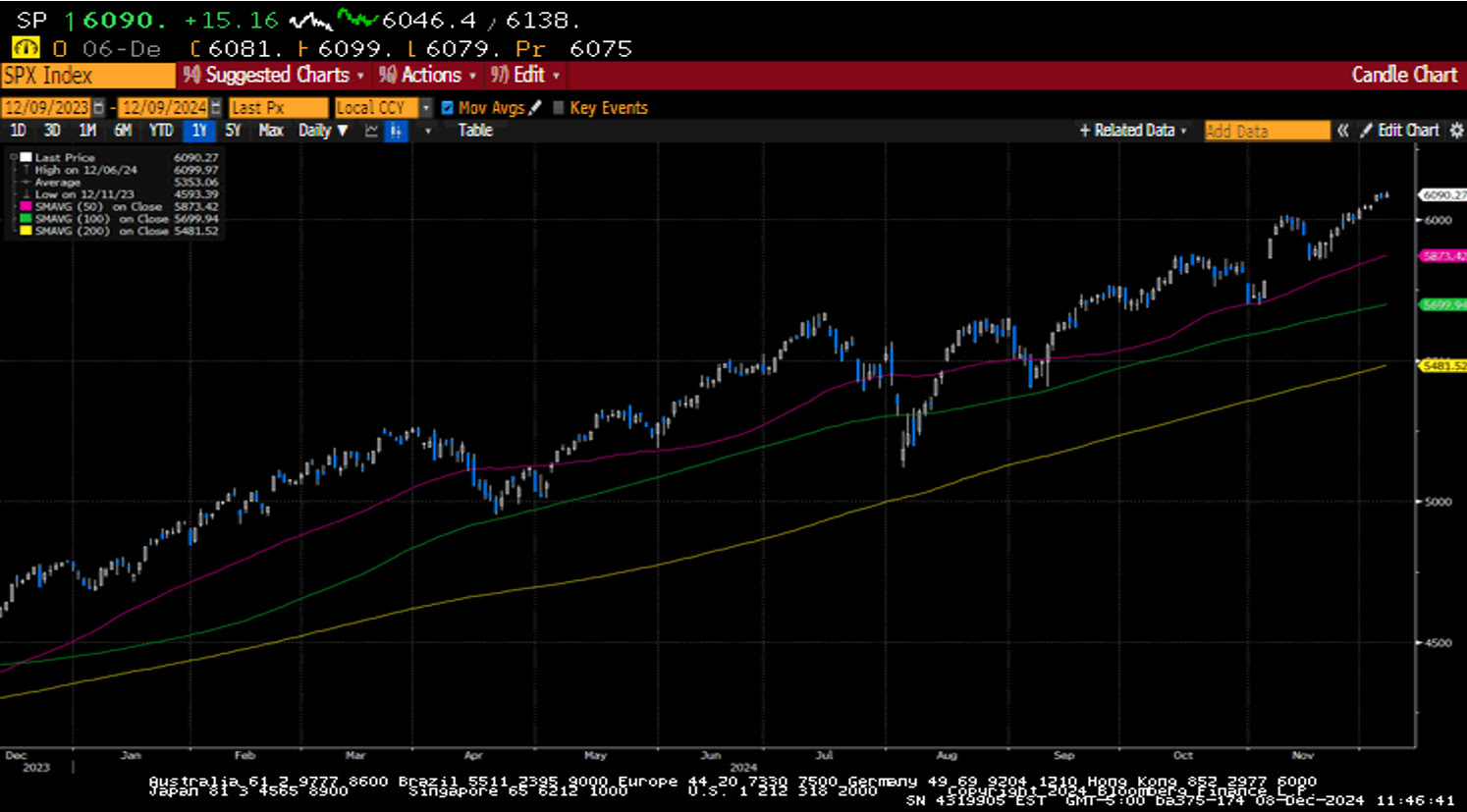
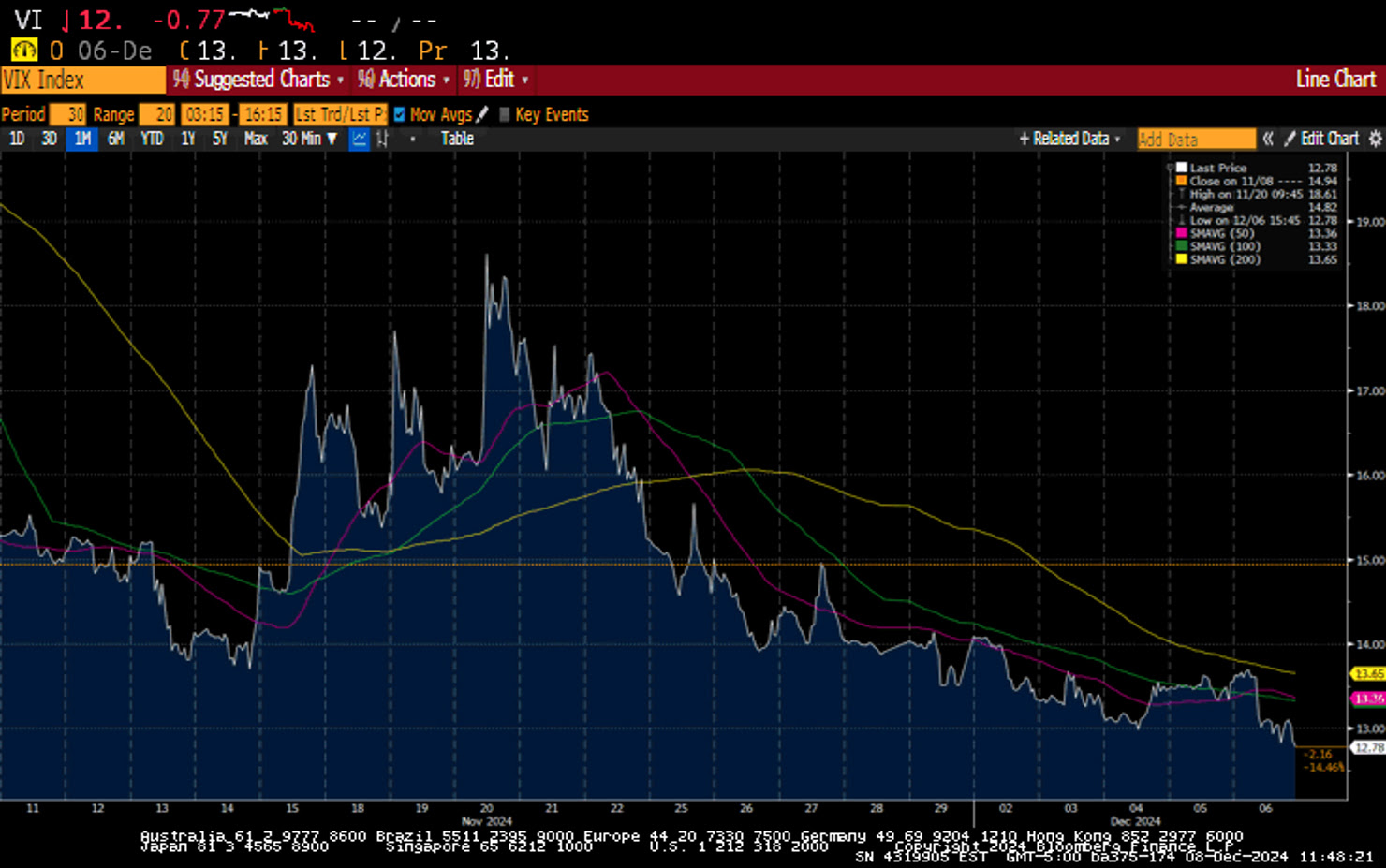
The S&P 500 gained 1% and is now up 27.7% for the year.  The Dow closed lower by 0.6%; the NASDAQ outperformed, returning 3.3% and the Russell 2000 fell by 1.1%.  US Treasuries ended the week higher across the curve as the 2-year yield fell by six basis points to 4.10%, and the 10-year yield fell by three basis points to 4.15%.  Oil prices fell by $1.28 or 1.9% to $67.17 as OPEC + stayed the course with their production outlook.  Gold prices fell fractionally to close at $2658.90.  Copper prices rose by $0.06 to $4.20 per Lb.  Bitcoin regained the $100k mark before closing at $99,400 on Friday.  The US dollar index gained 0.3% and closed at 106.09.  Notably, the VIX, a measure of market volatility, closed at 12.72, down 37% from just before the US Presidential election.
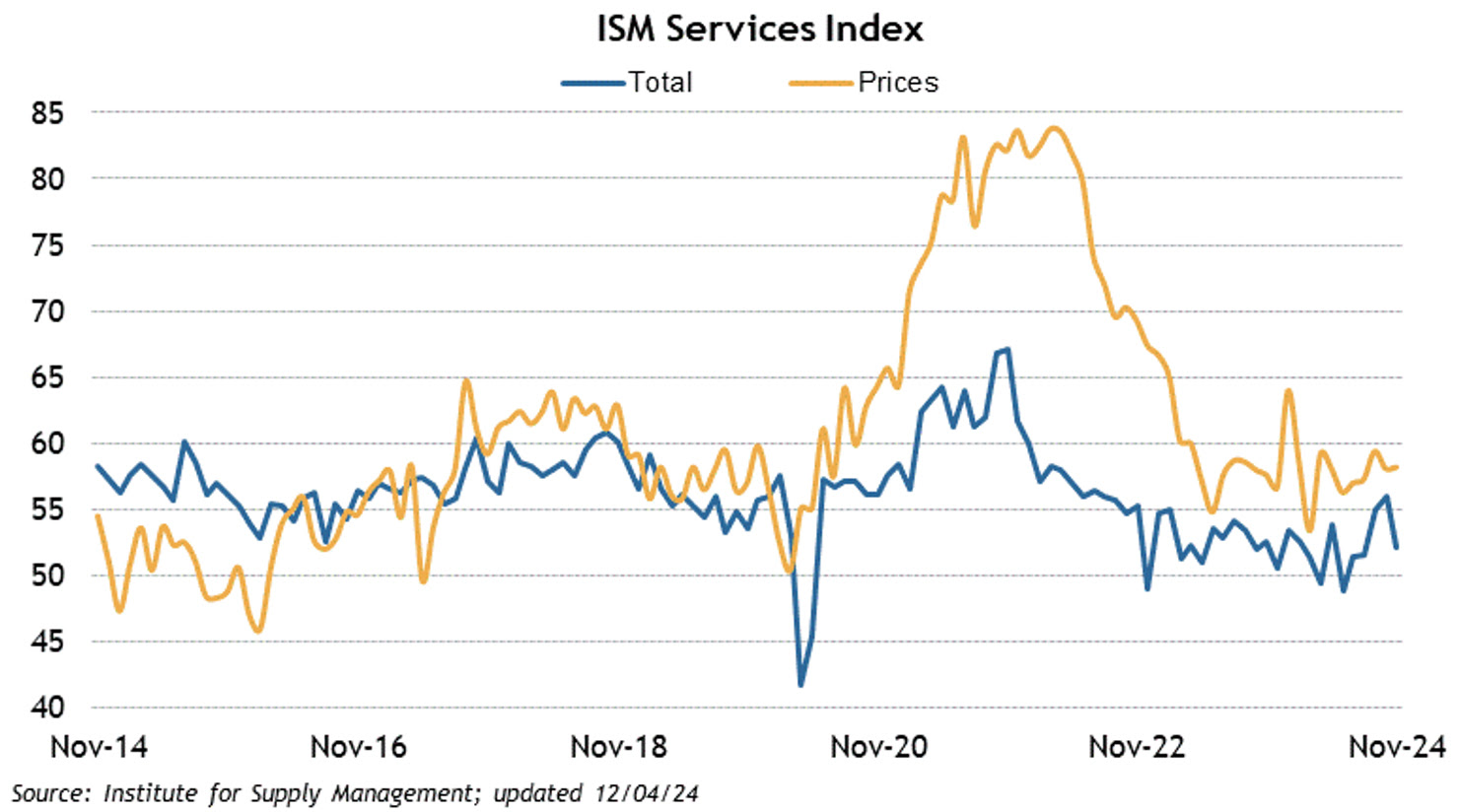
The Economic calendar showcased the November Employment Situation Report, which showed a bounce back in payrolls.  Non-farm payrolls increased by 227k versus the street consensus of 220k.  Private payrolls increased by 194k versus the consensus estimate of 190k.  The Unemployment rate ticked higher by 0.1% to 4.2%.  Average Hourly earnings came in at 0.4% above the previous print of 0.3%.  The data aligned with expectations and strengthened the argument that the Federal Reserve will cut their policy rate by twenty-five basis points at their December 18th meeting.  ADP employment figures, Initial Claims, and Continuing Claims continued to show a resilient labor market.  ISM Manufacturing came in at 48.4, above the prior reading of 46.5, but still showed that part of the economy was in contraction.  ISM Non-Manufacturing came in at 52.1, which was much weaker than the prior reading of 56.  Finally, a preliminary look at the University of Michigan’s Consumer Sentiment Index saw a nice uptick to 74 from the previous reading of 71.8.

Investment advisory services offered through Foundations Investment Advisors, LLC (“FIA”), an SEC registered investment adviser. FIA’s Darren Leavitt authors this commentary which may include information and statistical data obtained from and/or prepared by third party sources that FIA deems reliable but in no way does FIA guarantee the accuracy or completeness.  All such third party information and statistical data contained herein is subject to change without notice.  Nothing herein constitutes legal, tax or investment advice or any recommendation that any security, portfolio of securities, or investment strategy is suitable for any specific person.  Personal investment advice can only be rendered after the engagement of FIA for services, execution of required documentation, including receipt of required disclosures.  All investments involve risk and past performance is no guarantee of future results. For registration information on FIA, please go to https://adviserinfo.sec.gov/ and search by our firm name or by our CRD #175083. Advisory services are only offered to clients or prospective clients where FIA and its representatives are properly licensed or exempted.
Share:

View the Latest Commentaries:

Weekly Market Commentary

Markets ended the week mixed as investors assessed the implications of the US economic isolation of Iran, the fallout of increased tariffs on Canada, Nvidia Q2 earnings results, and the Fed Chairman’s speech at the Kansas City Federal Reserve’s Economic Symposium in Jackson Hole. Oh yeah, we were also treated to a slightly hotter print of the Fed’s preferred inflation measure, the PCE. On Monday, Treasury Secretary Bessent laid out a plan to isolate economic activity with Iran.  The plan, dubbed Economic D-day, promised economic punishment to any country doing business with Iran and suggested that, in the coming days, there will be announcements and actions taken against several entities that have worked alongside Iran to evade economic sanctions.  The US and Iran both said they would not return to the MOU signed in June, as negotiations have stalled.  Oil traded lower this week on reports that 10 million barrels

Weekly Market Commentary

US equity markets took a step back last week in what turned out to be a very busy week.  Increased yields on the long end of the curve prompted Treasury Secretary Scott Bessent to double buybacks of 10- to 30-year US Treasuries in an effort to temper the rise in rates.  The move was met with a rally in both bonds and stocks; however, it was short-lived, with much of the gains being given back within a day of the announcement.  A global debasement narrative has emerged as the US deficit topped $40 trillion.  The US Dollar sold off to levels not seen since May, while precious metals and Bitcoin prices soared.  Interestingly, the correlation between Gold and Bitcoin is the highest since Covid, following massive liquidity injections by global governments.  It’s notable that several other developed markets are facing similar pressure on their sovereign debt, including Japan, the UK,

Weekly Market Commentary

The S&P 500 forged a new all-time high as investors recalibrated interest-rate-hike expectations after an in-line print of the Consumer Price Index and a cooler-than-expected print of the Producer Price Index.  The probability of a rate hike in September fell to 32% from 55% a week ago. Interestingly, the short end of the US curve advanced while longer-dated Treasuries declined over the week amid concerns about the widening US deficit.  Treasury auctions this week were met with tepid demand and saw the 10-year and 30-year priced at yields not seen since 2007 and 2001, respectively. Oil prices rose as the US-Iran war continues while negotiations appear to be at an impasse.   The US signaled it would continue its blockade of Iranian ports to inflict economic pressure while Iran and the Houthis continued to attack cargo ships in the Strait of Hormuz and the Red Sea.  Second-quarter earnings continued to roll

Weekly Market Commentary

Giddy up!  US equity markets ripped higher in the first week of August as 2nd quarter earnings continued to impress.  According to FactSet, 88% of the S&P 500 have reported earnings, of which 86% have beaten Earnings Per Share estimates, while Earnings Per Share have grown by an impressive 50.4%.   76% of companies that have reported have beaten on revenues, with revenues growing by 15% in the 2nd quarter.  Standout companies this week included: Palantir, Caterpillar, MP Materials, Cloudflare, SpaceX, AMD, and Twilio. Tensions in the Middle East persisted as negotiations to partially open up the Strait of Hormuz between Iran and Oman continued.  Oil prices fell for the third consecutive week as rhetoric suggested a deal was close.  That deal has been elusive, to say the least, and concerns about the particulars remain.  Is the US even engaged in negotiations, will the passage of the Strait require a toll, will all