Markets ended the week mixed as investors assessed the implications of the US economic isolation of Iran, the fallout of increased tariffs on Canada, Nvidia Q2 earnings results, and the Fed Chairman’s speech at the Kansas City Federal Reserve’s Economic Symposium in Jackson Hole. Oh yeah, we were also treated to a slightly hotter print of the Fed’s preferred inflation measure, the PCE.
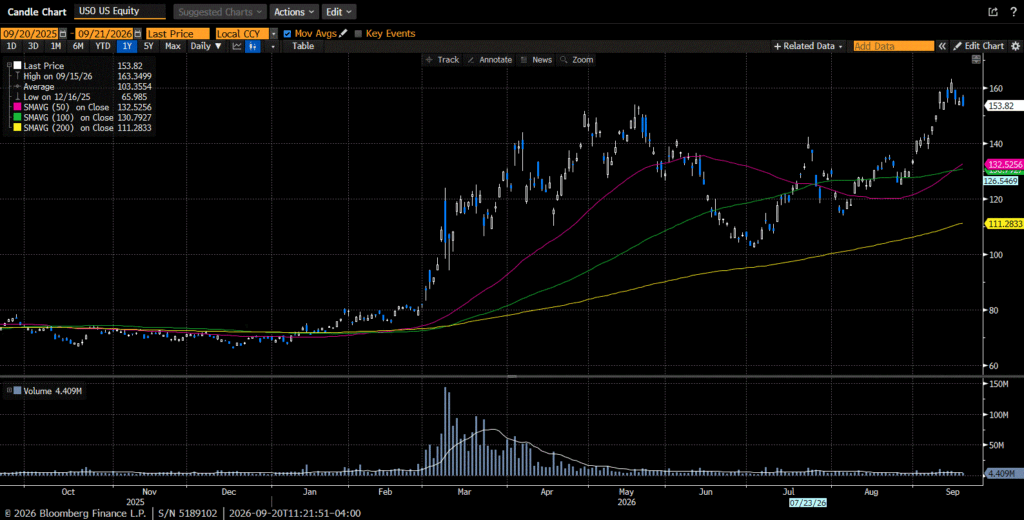
On Monday, Treasury Secretary Bessent laid out a plan to isolate economic activity with Iran. The plan, dubbed Economic D-day, promised economic punishment to any country doing business with Iran and suggested that, in the coming days, there will be announcements and actions taken against several entities that have worked alongside Iran to evade economic sanctions. The US and Iran both said they would not return to the MOU signed in June, as negotiations have stalled. Oil traded lower this week on reports that 10 million barrels a day of oil is being shipped through the Strait of Hormuz, about half of what it was before the start of the year. Additionally, the US ordered diplomats to return from several Middle Eastern countries, easing concerns about further escalation.
The US introduced new tariffs of 50% on $20 billion-$28 billion in Canadian imports and threatened more in 2027. Canada responded with dollar-for-dollar tariffs on hundreds of US products as negotiations failed last weekend. Negotiations look unlikely in the near term, as both sides have ratcheted up sharp criticism of each other. In retaliation for Canada’s tariffs placed on US goods, Trump signed an order to rename Lake Ontario to Lake America.
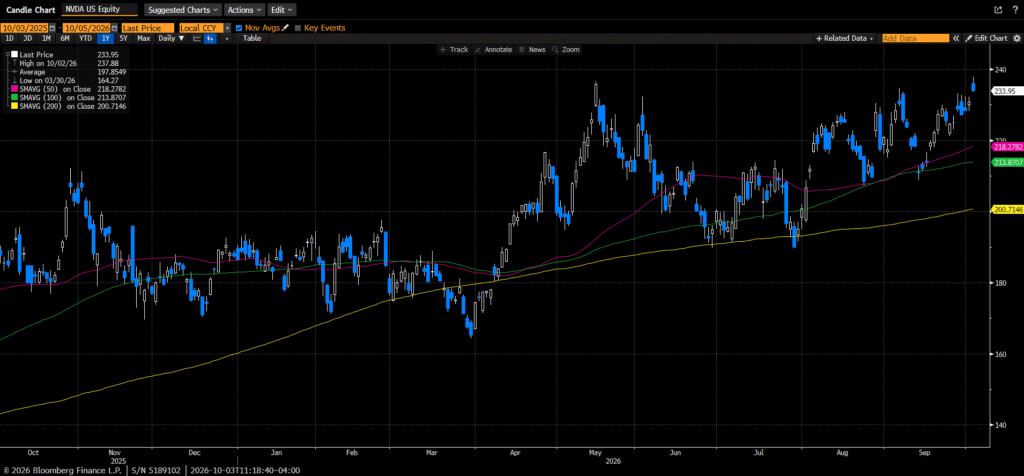
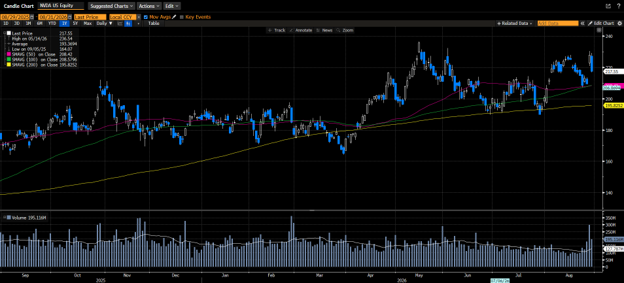
Nvidia, the world’s largest company, posted solid Q2 earnings and projected 70% revenue growth in the coming year. Shares rose by 9% after the announcement, increasing its market cap by $442 billion. The company also announced the acquisition of Hugging Face, an AI community and platform that functions like an open-source area for AI developers, for $13 billion. Interestingly, the massive move in Nvidia’s price came after seven straight days of losses and did very little to help the semiconductor sector this week, which fell 2.3% on the week.

Fed Chairman Warsh gave his first speech at the KC Fed’s Economic Symposium and seems to have pulled it off mightily. There have been several criticisms of the new Chairman after his Q&A session from the July FOMC meeting. He faced the criticisms head-on, and while he did not give an outright answer on what, specifically, he is looking at when making monetary policy decisions, he did provide a framework for his decision-making. The Chairman did come off as hawkish and portrayed an economy that is fundamentally strong, with consumer spending remaining strong, labor markets near full employment, corporate investment and earnings expectations high, and financial conditions not appearing restrictive. The Chair addressed AI by posing several questions that are right now unanswered but were well thought out, and answers are being sought by one of the task forces he has put in place. The probability of a rate hike in September jumped to 61% from 36% prior to his speech.
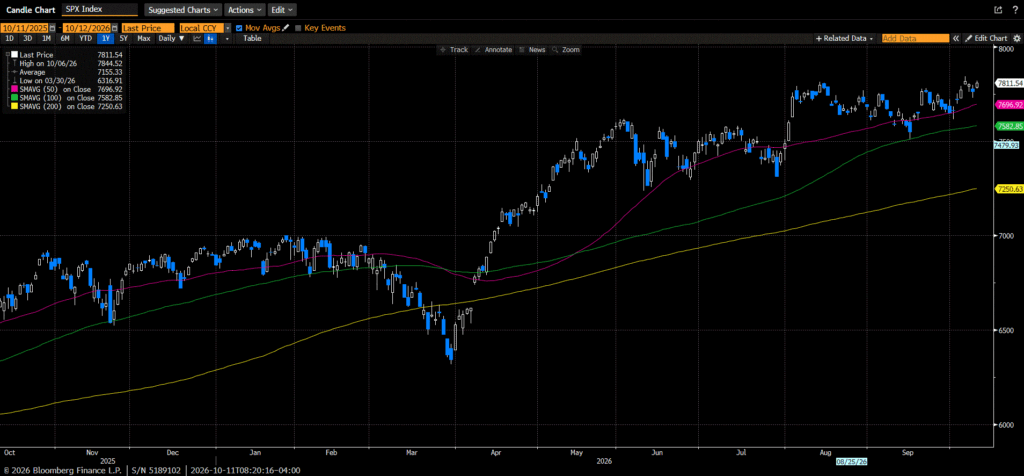
The S&P 500 gained 0.5%, the Dow rose 0.55%, the NASDAQ added 0.85%, and the Russell 2000 gave back 1.46%. There was a clear divergence in performance this week, with mega-cap names outperforming while mid-cap and small-cap stocks lagged. The Communication Services, Financials, and Software sectors ended the week higher, while Semiconductors, Real Estate, Energy, and Healthcare underperformed. The US Treasury curve flattened on the back of the Fed Chairman’s hawkish speech at Jackson Hole. The 2-year yield climbed twelve basis points to 4.35%, with the entire move coming on Friday. The 10-year yield fell by two basis points to 4.72%, while the 30-year yield fell by seven basis points to 5.21%, likely a nod to the Fed Chair’s increased credibility. Oil prices fell 4.23% to $83.38 a barrel. Gold prices declined by 3.24% to $4,528.40 per Oz. Silver prices lost 2.41% to $67.79 per Oz. Copper prices rose by nine cents to $6.66 per Lb. Bitcoin’s price increased by $900 to $77,700 but traded off its highs for the week, which eclipsed $80,000. The US Dollar gained 0.9% to close at 99.16, while the Yen/US Dollar cross traded back above 160.

The Fed’s preferred measure of inflation, the PCE, came in slightly higher than expected on the headline number at 0.2%; the street was looking for an increase of 0.1%. On a year-over-year basis, the reading increased by 3.7%, slightly above the previous reading of 3.6%. The core reading increased by 0.2% in line with expectations, while the year-over-year figure came in at 3.3%, unchanged from the previous month. Personal Income increased by 0.4%, above the consensus estimate of 0.3%. Personal Spending increased by 0.2%, above the consensus estimate of 0.1%. A second look at Q2 GDP came in at 1.5%, unchanged from the initial reading. Consumer Confidence fell to 89.4 from 90.2, while the University of Michigan Consumer Sentiment reading came in at 51.7, up from 51 in the prior month. New Home sales came in at 607k versus the estimated 606k. Initial Jobless Claims fell by 6k to 203k, while Continuing Claims decreased by 18k to 1778k. In the coming week, we will get a look at the Employment Situation report, which is expected to show a 12k increase in payrolls. Additionally, we will get a read on EU inflation and China PMIs.

Investment advisory services offered through Foundations Investment Advisors, LLC (“FIA”), an SEC registered investment adviser. FIA’s Darren Leavitt authors this commentary which may include information and statistical data obtained from and/or prepared by third party sources that FIA deems reliable but in no way does FIA guarantee the accuracy or completeness. All such third party information and statistical data contained herein is subject to change without notice. Nothing herein constitutes legal, tax or investment advice or any recommendation that any security, portfolio of securities, or investment strategy is suitable for any specific person. Personal investment advice can only be rendered after the engagement of FIA for services, execution of required documentation, including receipt of required disclosures. All investments involve risk and past performance is no guarantee of future results. For registration information on FIA, please go to https://adviserinfo.sec.gov/ and search by our firm name or by our CRD #175083. Advisory services are only offered to clients or prospective clients where FIA and its representatives are properly licensed or exempted.