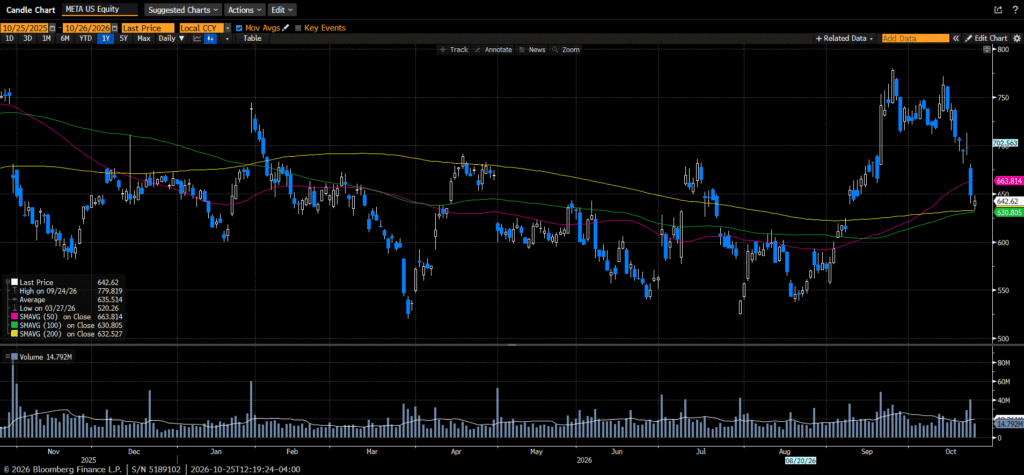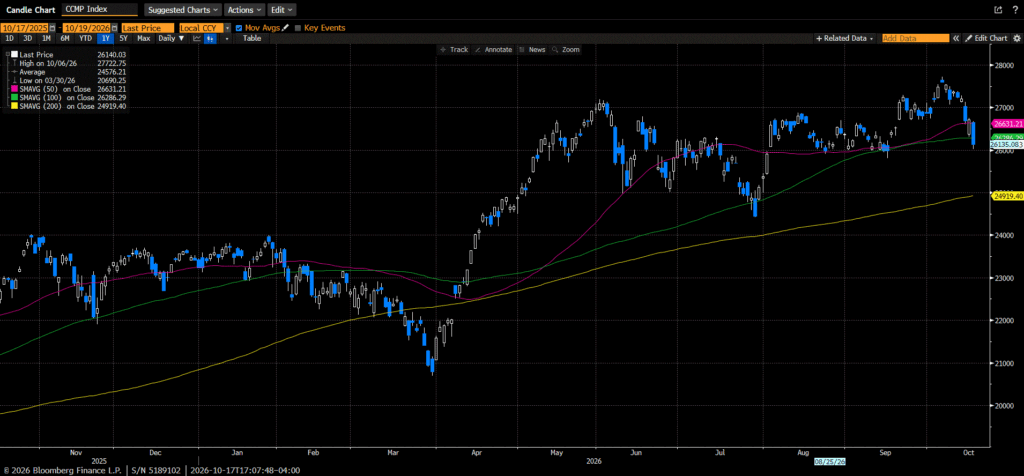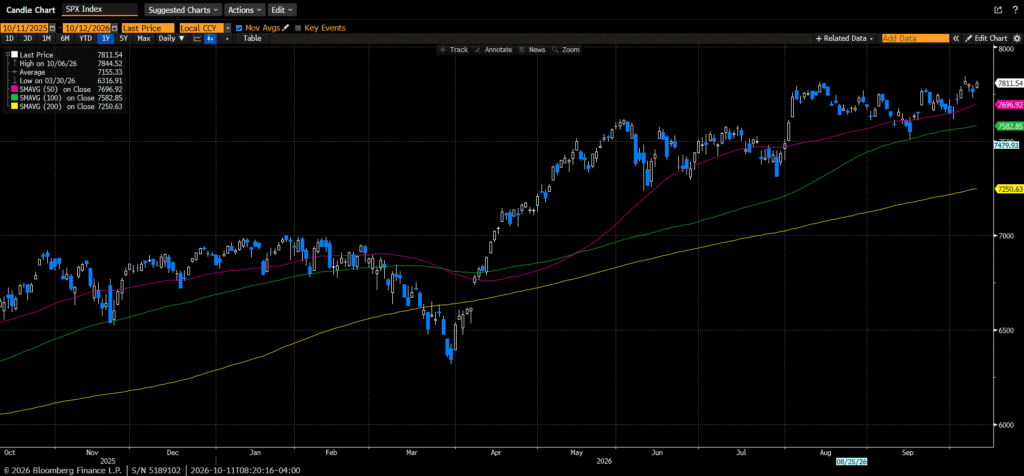

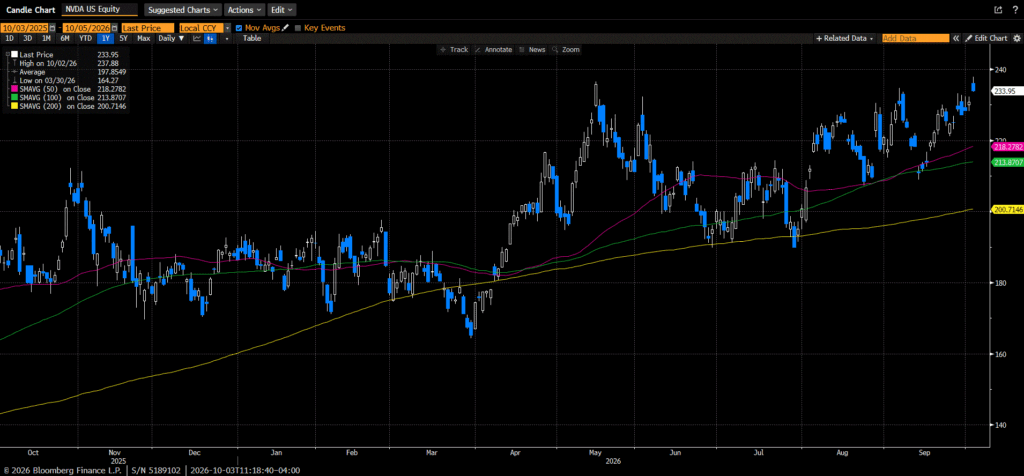
As we move from the third quarter into the fourth, investors have a lot to consider in this crazy market. US equities finished the week mixed in volatile trade. A standstill in negotiations between the US and Iran pushed oil prices higher early in the week, but the realization that oil moving through the Strait of Hormuz is now at pre-war levels, along with news that the G7 would release 100 million gallons of oil and diesel from reserves, pushed oil prices lower. This comes as the Pentagon is considering deploying 10,000 more troops and an additional aircraft carrier to the Gulf. Elevated oil prices have kept inflation concerns front and center, but a cooler-than-expected PCE report, a weaker-than-anticipated Employment Situation report, and dovish remarks from Fed President Williams and Vice Chair Jefferson moved the probability of a rate hike in October from over 70% to less than 25%. Interestingly, this did very little to curb the sale of US Treasuries, where yields soared to levels not seen in nearly two decades. Notably, French sovereign debt got clobbered this week, with spreads against the German Bund reaching 150 basis points. The speed and magnitude of this move warrant caution, as it could ripple through other markets. Micron’s earnings were solid and helped bolster the Tech and Mega-cap issues. Anthropic announced it would likely go public with an IPO before the Thanksgiving holiday, while OpenAI said it would raise an additional $30 billion and remain private until it addresses concerns about AI guardrails. President Trump invited several AI executives to the White House to discuss AI innovation and protections for the technology. The leaders signed a “morally binding agreement” to self-police and help create safety standards. President Trump also signed an order that will make all Federal references to artificial intelligence “Super Intelligence.”

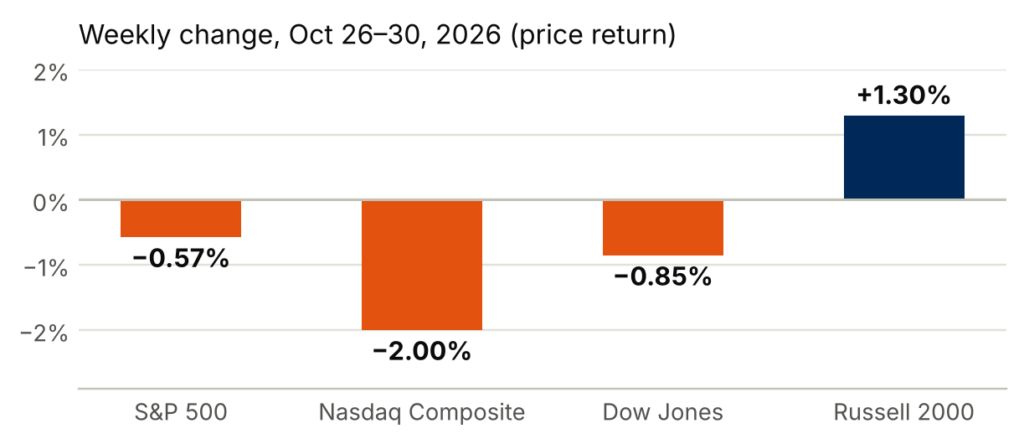
The S&P 500 lost 0.25%, the Dow fell 1.25%, the NASDAQ rose by 0.46%, and the Russell 2000 gave back 0.11%. Technology and Mega-cap issues led the market this week, while Healthcare, Financials, and the equally weighted S&P 500 index lagged. Yields rose across the US curve this week as rates moved to levels not seen since 2002. The 2-year yield rose four basis points to 4.82% and went up fifty-five basis points in September. The 10-year yield increased by ten basis points to 5.28% and went up fifty-six basis points in September. The US Aggregate Bond Index is off 2.73% year to date, falling 2.61% in September. Oil prices fell 1.16% to $91.10 a barrel in volatile trading. Gold prices retreated 3.65% or $157.90, closing the week at $4,162.60 per ounce. Silver prices plunged 6.71% to $60.42 per ounce. Copper prices fell by 3.24% to $6.55 per Lb. Bitcoin’s price increased by $800 to $84,800. Of note, the US Dollar rose 0.72% to 101.92, while the Euro fell to a 16-month low against the Greenback.

The week brought a full slate of economic data showing cooler inflation and weaker job creation in the US. Headline PCE increased by 0.3%, less than the expected increase of 0.4%. On a year-over-year basis, PCE increased 3.4%, unchanged from July. The Core reading rose 0.2%, below the expected 0.3% increase. Year-over-year, the Core figure rose 3%, unchanged from July. Personal Spending rose 0.9%, better than the consensus estimate of 0.7%. Personal Income rose 0.2%, below the expected 0.4% increase. Non-Farm Payrolls were well below expectations at 29k; the street was looking for an increase of 90k. Private Payrolls increased by 46k, less than the consensus estimate of 100k. The Unemployment Rate increased to 4.2% from 4.1%. Average Hourly Earnings increased by just 0.1%, below the 0.3% estimate. The Average Work Week increased to 34.4 hours from 34.3 hours. Job openings fell to 7.079M from 7.335M. ADP Payrolls increased by 90k versus the estimated 58k. Initial Jobless Claims fell 1k to 197k, while Continuing Claims fell by 11k to 1701k. The third and final revision to Q2 GDP increased to 2.2% from 1.5%. ISM Manufacturing remained in expansion at 54.5% but fell slightly from the previous reading of 54.6%. Finally, September Consumer Confidence fell to its lowest level since 2014, to 81.9.

Investment advisory services offered through Foundations Investment Advisors, LLC (“FIA”), an SEC registered investment adviser. FIA’s Darren Leavitt authors this commentary which may include information and statistical data obtained from and/or prepared by third party sources that FIA deems reliable but in no way does FIA guarantee the accuracy or completeness. All such third party information and statistical data contained herein is subject to change without notice. Nothing herein constitutes legal, tax or investment advice or any recommendation that any security, portfolio of securities, or investment strategy is suitable for any specific person. Personal investment advice can only be rendered after the engagement of FIA for services, execution of required documentation, including receipt of required disclosures. All investments involve risk and past performance is no guarantee of future results. For registration information on FIA, please go to https://adviserinfo.sec.gov/ and search by our firm name or by our CRD #175083. Advisory services are only offered to clients or prospective clients where FIA and its representatives are properly licensed or exempted.