Weekly Market Commentary

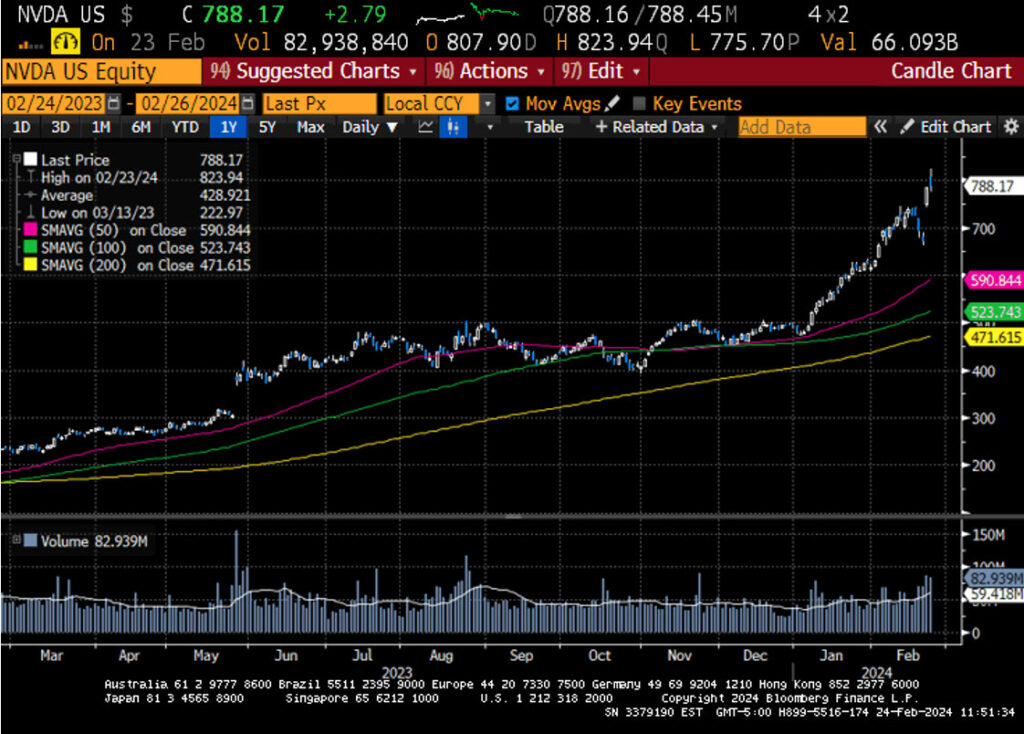
The S&P 500 and the Dow Industrial Average forged new all-time highs despite investors taking profits early in the holiday-shortened week.  Semiconductor stalwart NVidia’s fourth-quarter earnings results induced a massive rally in the stock and brought the rest of the market along with it.  The Company meaningfully beat street expectations and raised guidance above the current consensus.  The move on Thursday tacked on over 200 billion in market capitalization and catapulted the company’s value to north of $2 trillion.  The markets also digested the news that Capital One would takeover Discover for $35.3 billion.

The S&P 500 gained 1.7%, the Dow rose 1.3%, the NASDAQ added 1.4%, and the Russell 2000 lagged, losing 0.8%.  Trade in US Treasuries favored longer-tenured paper.  The 2-year yield increased by seven basis points to 4.72%, while the 10-year yield fell by four basis points to 4.26%.  Fed rhetoric for the week pushed back on a near-term rate cut and suggested cuts later in the year as inflation concerns persist.  The probability of a rate hike in March and May is quite low, while a twenty-five basis point cut in June runs just under 70%.

West Texas Intermediate Crude prices fell 2.5% this week or $1.92 to 76.52 a barrel.  The pullback in prices comes as negotiations for a cease-fire in Gaza take place in Paris.  Gold prices increased by $24.10 to $2048.20 an Oz.  Copper prices rose by $0.05 to $3.88 per Lb. Bitcoin was trading just above the $51,000 mark.  The Dollar index fell by 0.3% to 103.94.

Economic news was fairly light this week but did show a continued tight labor market.  Initial Jobless Claims came in down 12k to 201K as Continuing Claims fell by 63k to 1.826M. Existing Home sales continued to be soft but the January figure came in line with estimates of 4M units.  Mortgage Applications fell by 10.6% as the 30-year mortgage rate eclipsed 7%.  A preliminary look at the S&P Global Service PMI showed a decline in Services activity to 51.3 from 52.5.  The FOMC minutes from the January meeting were consistent with what Fed Chairman Powell conveyed in his most meeting remarks.

Investment advisory services offered through Foundations Investment Advisors, LLC (“FIA”), an SEC registered investment adviser. FIA’s Darren Leavitt authors this commentary which may include information and statistical data obtained from and/or prepared by third party sources that FIA deems reliable but in no way does FIA guarantee the accuracy or completeness.  All such third party information and statistical data contained herein is subject to change without notice.  Nothing herein constitutes legal, tax or investment advice or any recommendation that any security, portfolio of securities, or investment strategy is suitable for any specific person.  Personal investment advice can only be rendered after the engagement of FIA for services, execution of required documentation, including receipt of required disclosures.  All investments involve risk and past performance is no guarantee of future results. For registration information on FIA, please go to https://adviserinfo.sec.gov/ and search by our firm name or by our CRD #175083. Advisory services are only offered to clients or prospective clients where FIA and its representatives are properly licensed or exempted.
Share:

View the Latest Commentaries:

Weekly Market Commentary

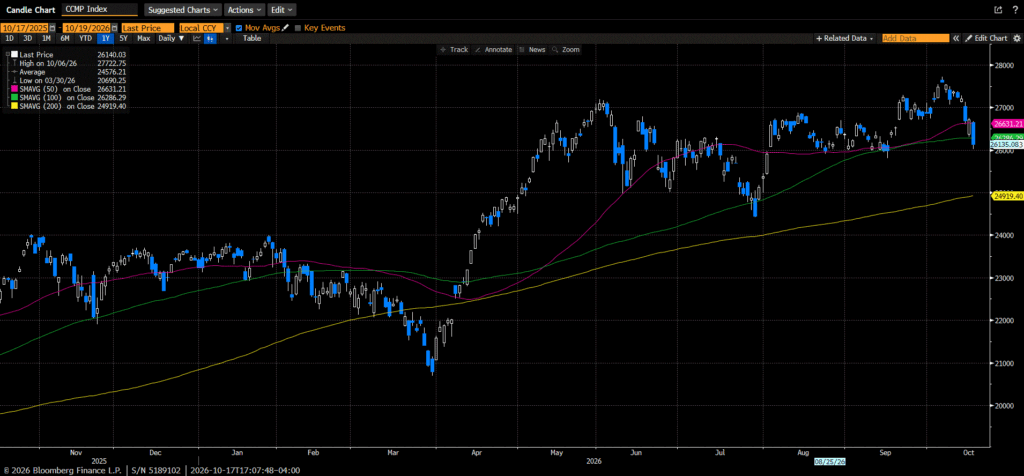
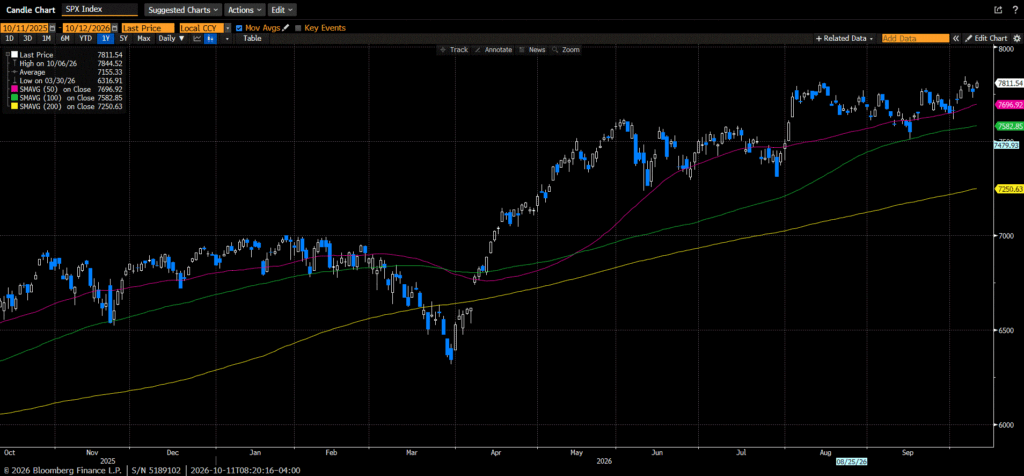
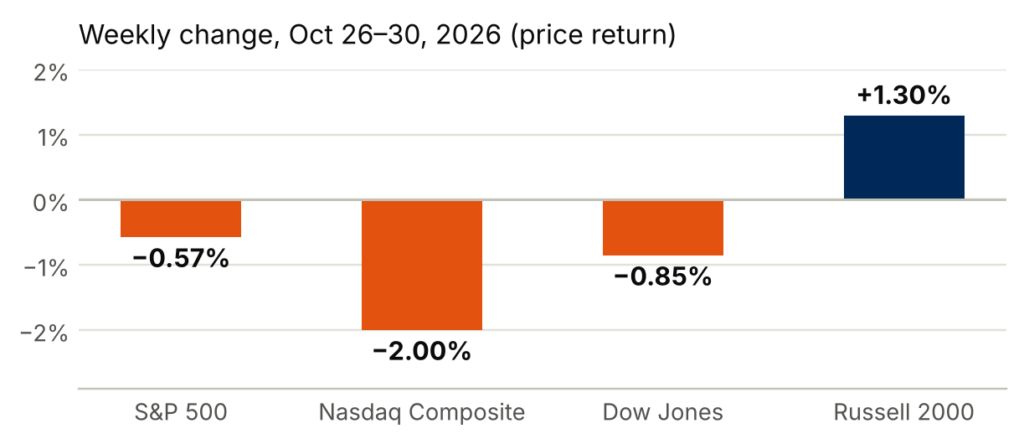
U.S. stocks climbed through Wednesday, then gave it all back. The S&P 500 slipped 0.6% and the Nasdaq fell 2.0%, each for a third straight weekly decline, and the Dow lost 0.9%. Small caps held up, with the Russell 2000 up 1.3%. The turn came after Alphabet and Amazon reported results that renewed doubts about the payoff from AI spending, and Intel’s warning sent its shares down nearly 29% on Friday. The Nasdaq fell 2.9% on Friday, its worst day since June 5. The Fed held, with two dissents for a hike. The policy rate stays at 3.75%–4.00% (10–2 vote). Traders price roughly a 76%–85% chance of a quarter-point hike on December 9. Big Tech spending drew a harsh verdict. Alphabet had its worst day in more than 20 years; Amazon’s trailing free cash flow turned to a record $42.4 billion outflow. Microsoft, helped by 48% Azure growth, held up.

Weekly Market Commentary

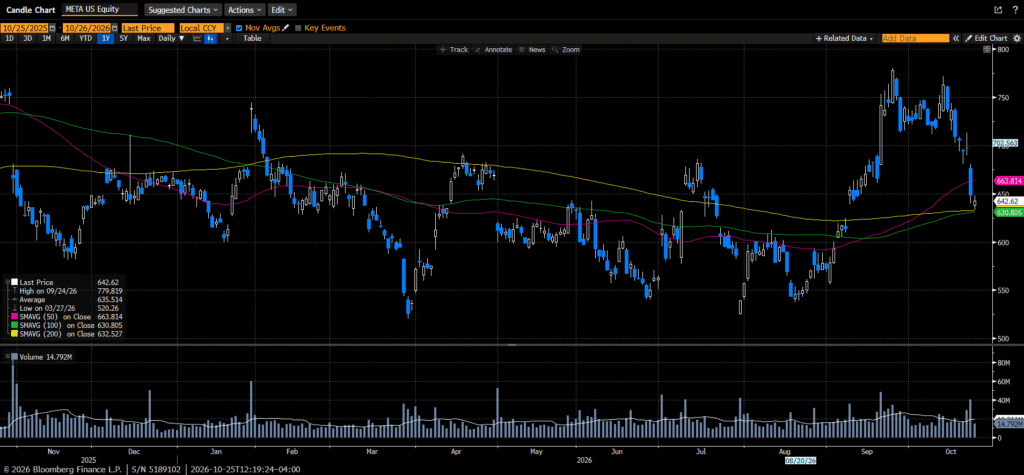
It was another volatile week on Wall Street, with US indices ending the week with mixed results.  Ongoing concerns about AI financing and its return on investment continued after Meta announced its 3rd-quarter results.  The company beat estimates and offered solid guidance.  However, its higher AI capital expenditures, lower margins, and negative free cash flow fueled a sell-off in AI infrastructure names.   Investors rotated into energy, staples, healthcare, and interest rate-sensitive sectors such as small-caps, real estate, and utilities.  According to FactSet, we are about a quarter of the way through 3rd-quarter earnings.  83% of the companies that reported have beaten earnings expectations, while 66% have beaten revenue expectations.  Earnings Per Share growth for the quarter is currently an impressive 29%.  Microsoft, Google, and Amazon are set to report earnings this week. Increased hostilities between the Houthis and Saudi Arabia, along with what appears to be an inevitable escalation in

Weekly Market Commentary

It was a chaotic week on Wall Street as investors tried to interpret mixed Q3 financial results, a spike in oil prices, sharp swings in yields across the curve, hotter-than-expected inflation data, dovish tones from central bankers, and renewed concerns about the AI infrastructure buildout, its use of credit, and the timing of when or if there will be a return on investment.  Q3 earnings started in earnest, with several large banks reporting.  JP Morgan, Morgan Stanley, Goldman Sachs, and Citi Bank reported solid results, while Bank of America and Wells Fargo reported disappointing results.  Equity trading drove bank outperformance this quarter, while fixed income results lagged.  Solid results from Taiwan Semiconductor were met with selling as the Semiconductor sector continued to come under pressure.  The Philadelphia Semiconductor index has declined eight consecutive days, a setup not seen since 2008.  Part of the losses were attributed to an advancement in

Weekly Market Commentary

U.S. financial markets logged weekly gains as Wall Street shook off tech sector volatility and focused on stabilizing energy prices. Despite severe global bond market pressure, the S&P 500 rose 1.15% and hit an all-time high this week; the Dow Jones Industrial Average added 0.93%, and the Nasdaq Composite climbed 0.64%, hovering near all-time records.  The Russell 2000 fell by 0.9%.  Yields across the US yield curve fell after forging new highs for the year.  The 2-year note fell three basis points to 4.79%, while the 10-year yield fell four basis points to close at 5.24%.  Oil prices increased by just under 1% to close the week at $91.92 a barrel.  Gold prices rose 1.3%, or $53.60, to $4216.20 per ounce.  Silver prices increased 1% to $61.05 per ounce.  Copper rose fourteen cents to $6.69 per Lb.  Bitcoin’s price fell 2.35% to $82,800.  VIX, a volatility measure, fell 3% to