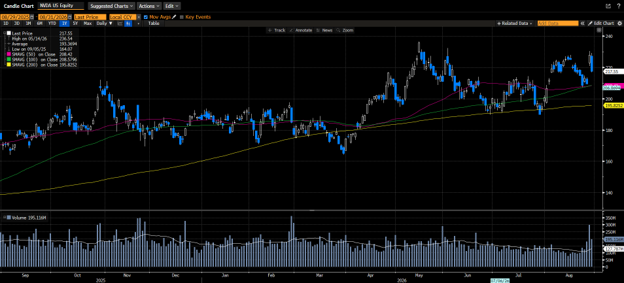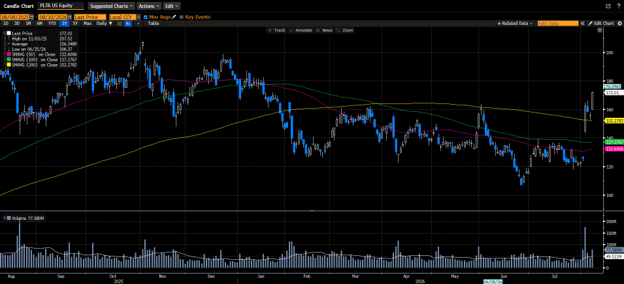



Global markets continued to rally in hopes of an extended ceasefire and Friday’s reopening of the Strait of Hormuz. However, the rally will be tested on Monday after Iran shut down the Strait of Hormuz on Saturday, with the ceasefire ending on Tuesday. Negotiations between the US and Iran are scheduled for this coming Monday in Islamabad. A 10-day ceasefire between Israel and Lebanon was also announced last week and continues to hold. Conflict in the Middle East will continue to dominate markets, but a solid start to Q1 earnings also helped propel markets higher last week. Technology shares continued to provide leadership after a weak start to the year. Several AI partnership announcements, coupled with solid Q1 results from Taiwan Semiconductor, catalyzed the AI trade. Additionally, several banks announced better-than-expected results, although the reaction from the street was mixed. We will receive another full dose of earnings this week with Tesla, Boeing, United Healthcare, Vertiv, Lam Research, and SK Hynix as highlights. Also of interest will be the confirmation hearing for Fed Chairman nominee Kevin Warsh, scheduled for Tuesday.

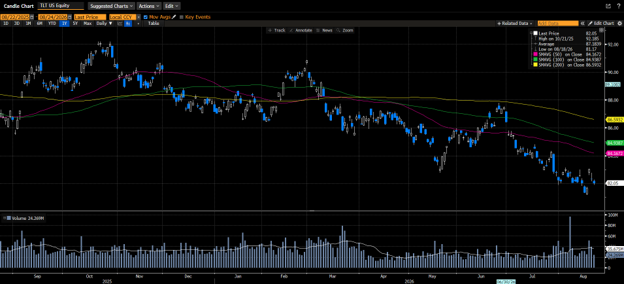
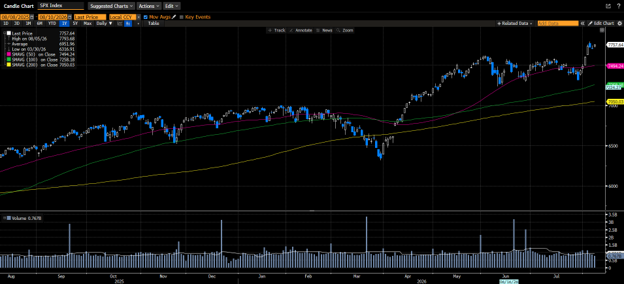
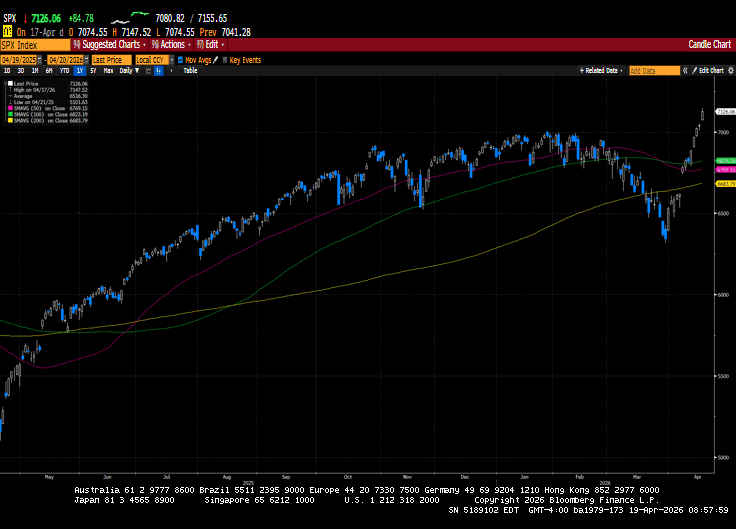
The S&P 500 traded above 7000 for the first time, adding 4.5% on the week. The NASDAQ extended its rally to thirteen straight days and forged a new all-time high, gaining 6.8% on the week. The Dow rose 3.2%, and the Russell 2000 inked a 5.6% gain. Of note, the Japanese equity market also posted an all-time high, and emerging markets broke out to a new high. US Treasuries were bid up across the curve. The 2-year yield declined by ten basis points to 3.70%, while the 10-year yield fell by seven basis points to 4.25%. Oil prices plunged on the reopening of the Strait of Hormuz. WTI prices declined by 12.7%, closing at $84.22 a barrel. Gold prices increased by $93.20 or 1.9% to $4,880.50 per ounce. Silver prices advanced by 6% to $80.93 per ounce. Copper prices rose by $0.23 to $6.11 per Lb. Bitcoin’s price increased by 5.8% on the week to close Friday afternoon at $77,300, but has since fallen back to $75,000 amid heightened tensions between the US and Iran. The US Dollar Index fell by 0.7% to 98.01.

Emerging Markets ETF IEMG 4/17/2026
A weaker-than-expected March Producer Price Index was the highlight of this week’s economic calendar. Headline PPI came in at 0.5% versus the consensus estimate of 1.2%. Core PPI came in at 0.1% versus expectations of 0.4%. On a year-over-year basis, the headline print was up 4% versus 3.4% in February, while the Core reading was up 3.8%, unchanged from the prior reading. Initial Jobless Claims were lower by 11k to 207k, while Continuing Claims increased by 31k to 1818k.

Investment advisory services offered through Foundations Investment Advisors, LLC (“FIA”), an SEC registered investment adviser. FIA’s Darren Leavitt authors this commentary which may include information and statistical data obtained from and/or prepared by third party sources that FIA deems reliable but in no way does FIA guarantee the accuracy or completeness. All such third party information and statistical data contained herein is subject to change without notice. Nothing herein constitutes legal, tax or investment advice or any recommendation that any security, portfolio of securities, or investment strategy is suitable for any specific person. Personal investment advice can only be rendered after the engagement of FIA for services, execution of required documentation, including receipt of required disclosures. All investments involve risk and past performance is no guarantee of future results. For registration information on FIA, please go to https://adviserinfo.sec.gov/ and search by our firm name or by our CRD #175083. Advisory services are only offered to clients or prospective clients where FIA and its representatives are properly licensed or exempted.