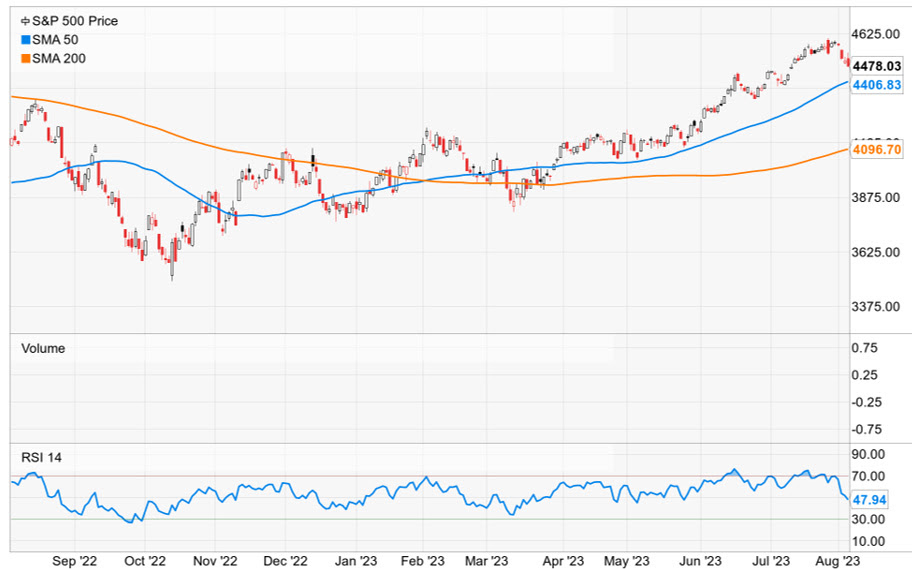
Global equity markets fell last week as investors digested a full dose of Q2 earnings reports, a packed economic calendar, more central bank policy decisions, and Fitch’s surprise downgrade of US sovereign debt.
Q2 earnings continued to generally surprise to the upside. Almost 85% of the S&P 500 companies have reported their results. For the week, behemoths Apple and Amazon reported. Amazon reported a great quarter, especially in its cloud services division. The company gained 8.3% after the report, propelling the consumer discretionary sector higher. On the other hand, Apple’s report disappointed the street. Lackluster sales of iPhones and concern about the future growth of hardware pressured the stock. Apple fell 4.8% after their report. Caterpillar announced a solid quarter, noting that some of its supply chains have normalized.
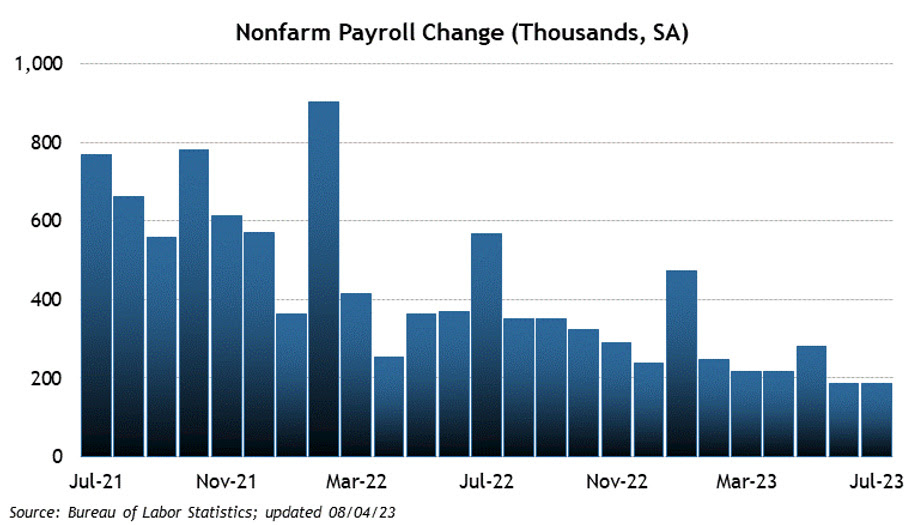
The economic calendar was equally as busy as the earnings calendar. On Friday, the Employment Situation report showed an increase of 187k Non-Farm payrolls, less than the expected 200k and well below the figures we have seen in the post-COVID economy. It’s worth reminding ourselves that this is still a strong report and continues to show a resilient labor market. Private Payrolls increased by 172k as the Unemployment rate ticked to 3.5% from 3.6%. Average hourly earnings ticked higher by 0.4%; the street consensus estimate was for a gain of 0.3%. The Average hourly work week fell by 0.1% to 34.3. Initial claims for the week came in at 227k while continuing claims increased to 1700k. ISM Manufacturing continued to show contraction while services declined but remained in expansion mode. A preliminary look at Q2 productivity showed an impressive increase of 3.7% as Unit Labor Costs increased by 1.6%, less than the consensus estimate of 3%.
The downgrade of the US Sovereign by Fitch was an interesting call and opens the door for further sovereign debt downgrades. The downgrade from AAA to AA+ was based on “fiscal deterioration,” where large amounts of debt continue to mount while budget governance has become a political stalemate.
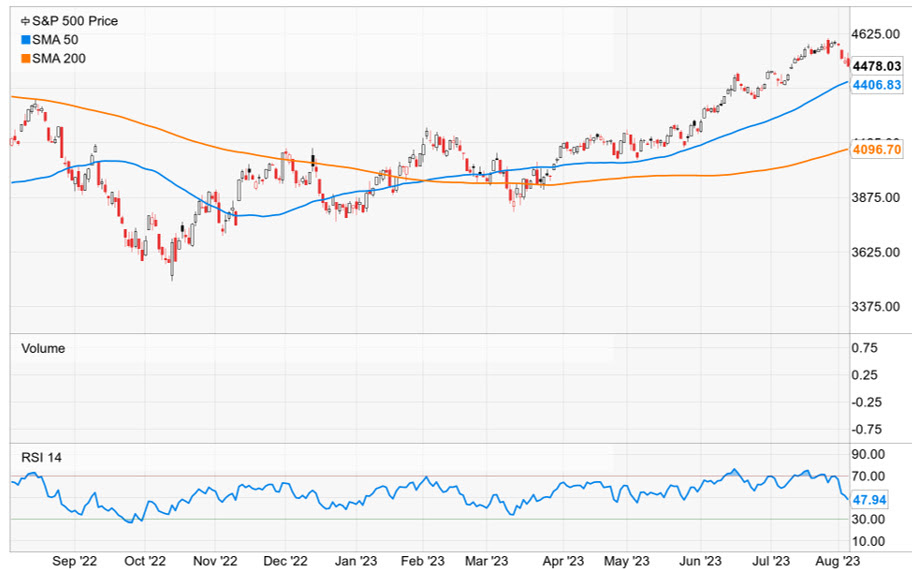
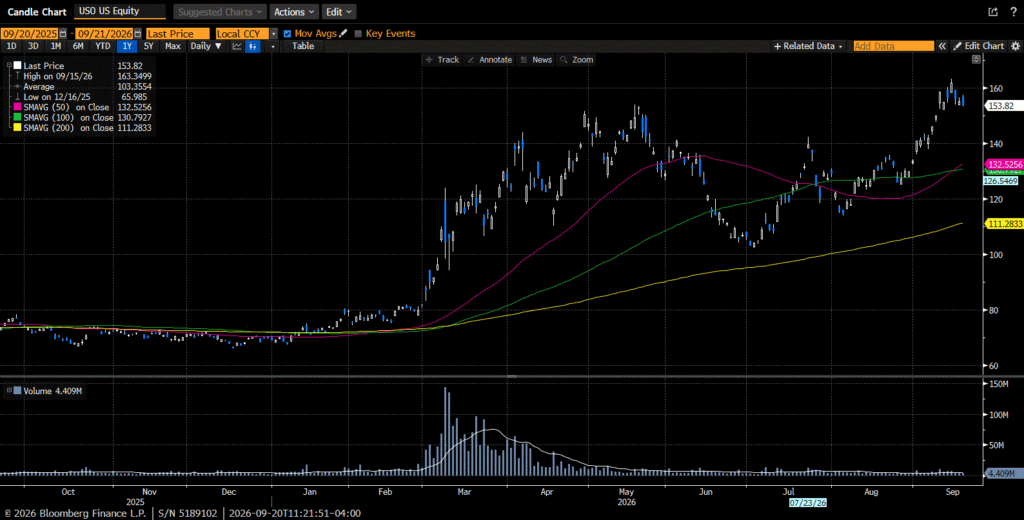
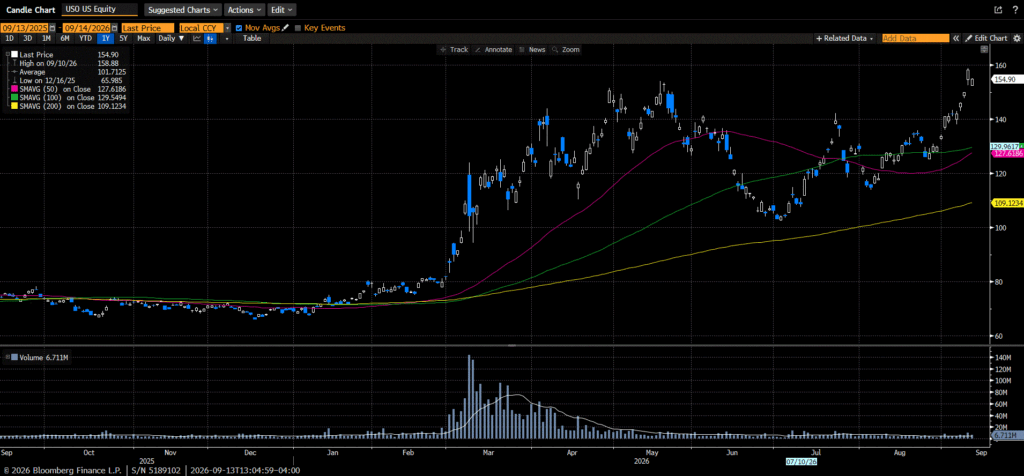
The S&P 500 shed 2.3%, the Dow gave back 1.1%, the NASDAQ fell by 2.8%, and the Russell 2000 sold off by 1.2%. US Treasury action was mixed across the curve and, for the first time in a long time, produced a steepening of the yield curve. The 2-10 spread declined from over 100 to 72 basis points. The 2-year yield fell by twelve basis points to 4.78%, while the 10-year yield increased by nine basis points. Fitch’s downgrade, coupled with better the expected economic data, helped push the curve’s longer end higher. Oil prices increased by $2.24 to close at $82.78. Gold prices advanced by $16.70 to $1977 an Oz. Copper prices fell by $0.04 to 3.86 a lb.
Investment advisory services offered through Foundations Investment Advisors, LLC (“FIA”), an SEC registered investment adviser. FIA’s Darren Leavitt authors this commentary which may include information and statistical data obtained from and/or prepared by third party sources that FIA deems reliable but in no way does FIA guarantee the accuracy or completeness. All such third party information and statistical data contained herein is subject to change without notice. Nothing herein constitutes legal, tax or investment advice or any recommendation that any security, portfolio of securities, or investment strategy is suitable for any specific person. Personal investment advice can only be rendered after the engagement of FIA for services, execution of required documentation, including receipt of required disclosures. All investments involve risk and past performance is no guarantee of future results. For registration information on FIA, please go to https://adviserinfo.sec.gov/ and search by our firm name or by our CRD #175083. Advisory services are only offered to clients or prospective clients where FIA and its representatives are properly licensed or exempted.