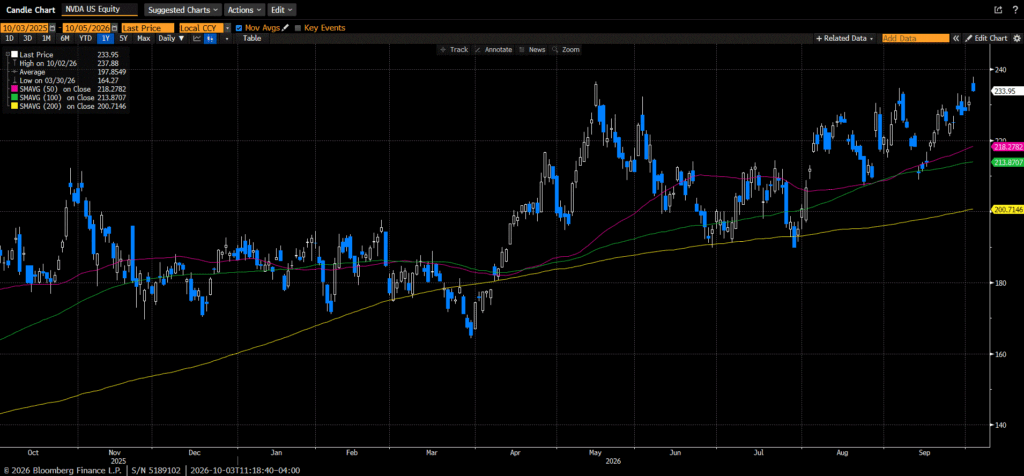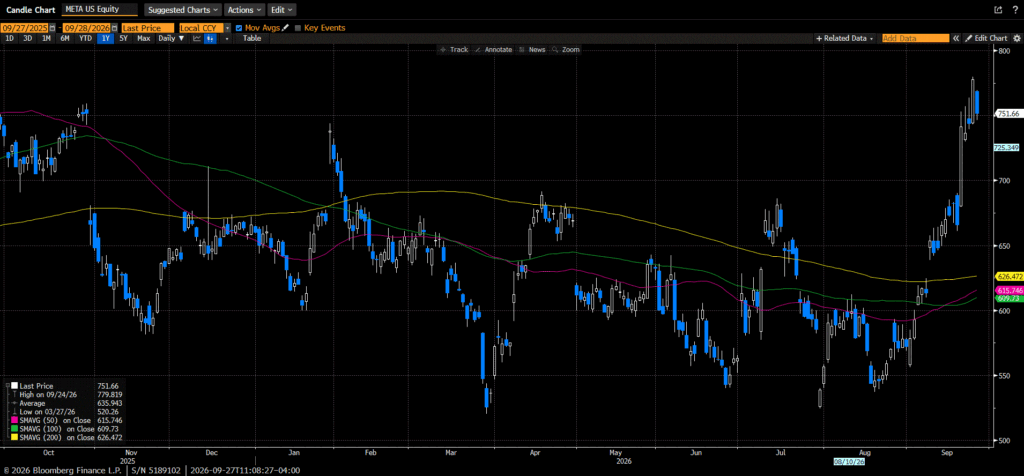

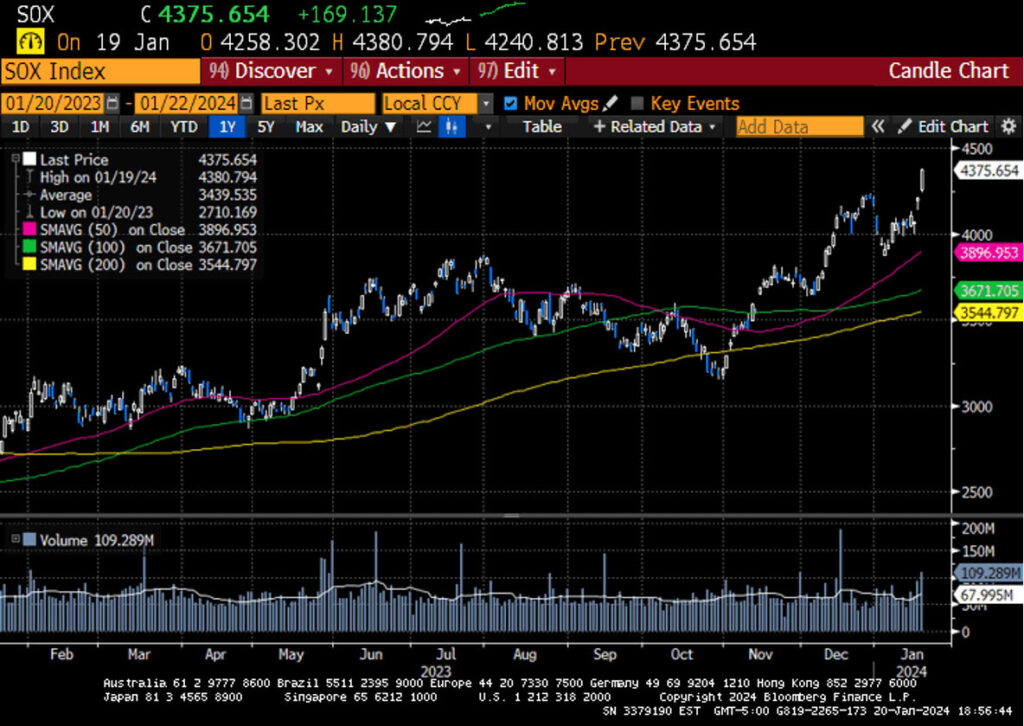
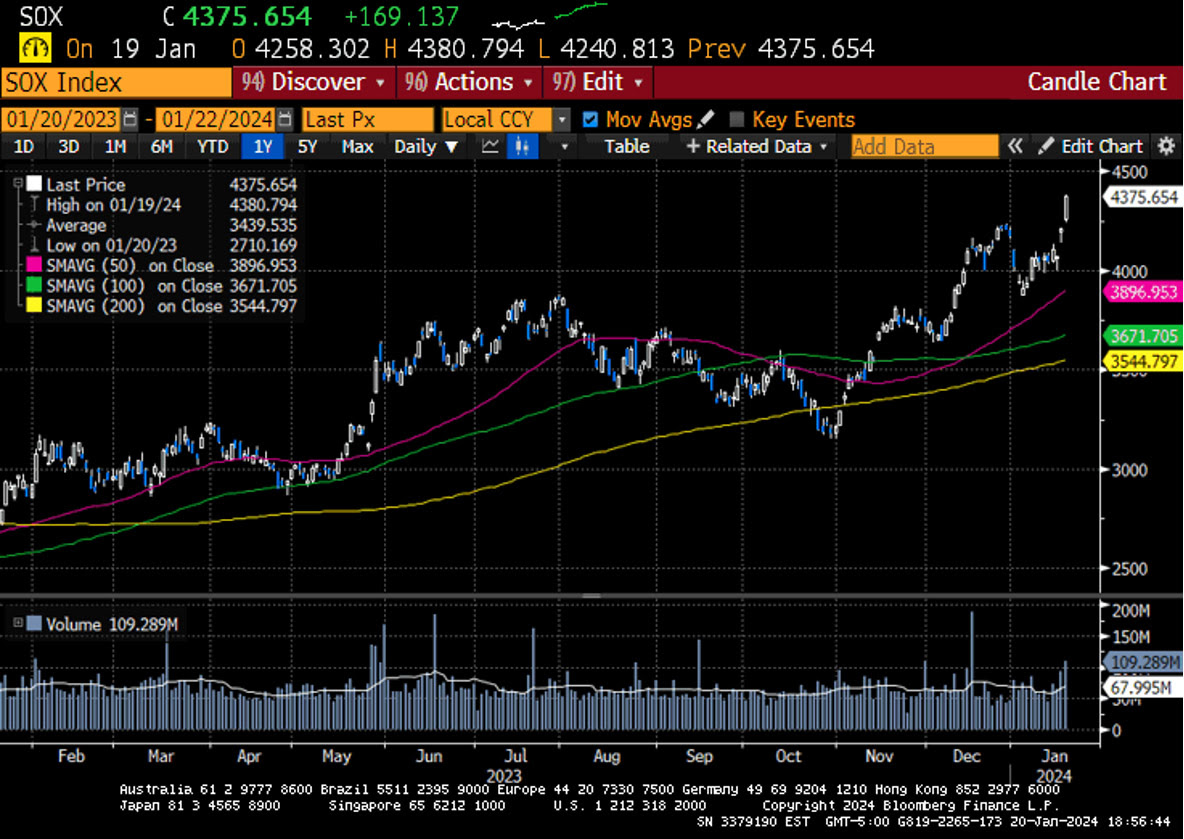
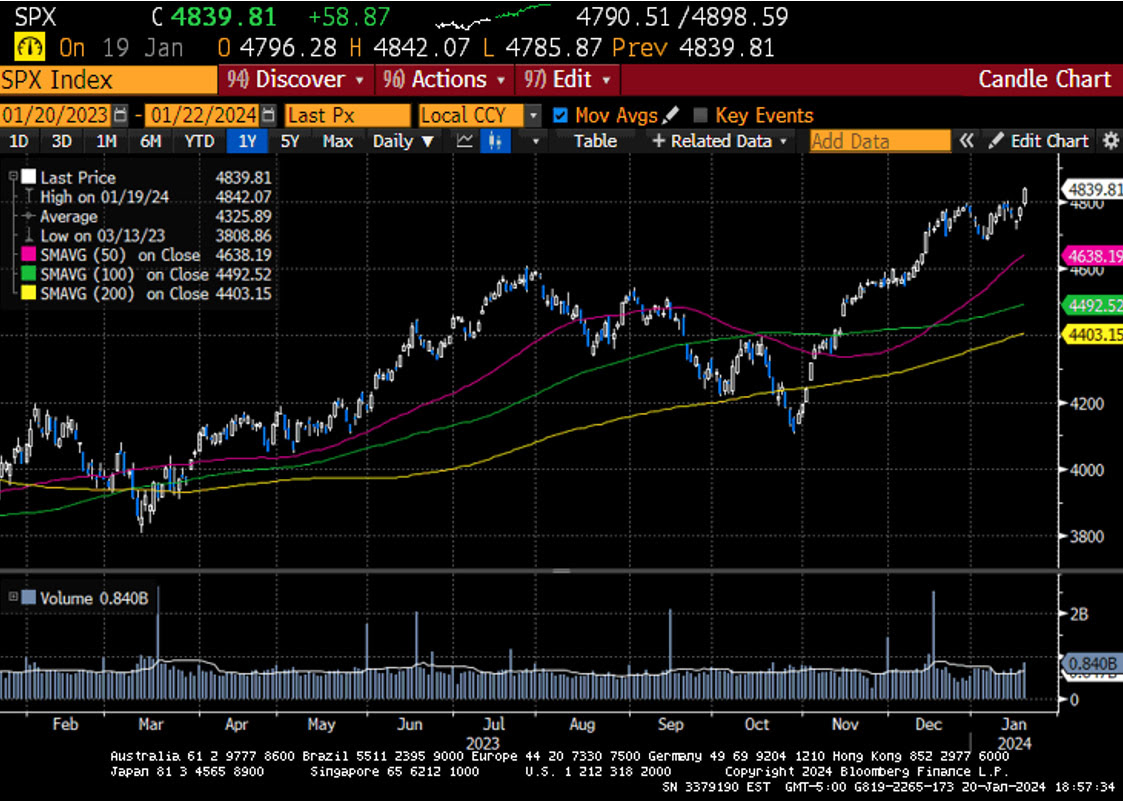
The S&P 500 and Dow Jones Industrial Average hit record highs on Friday despite a reset of monetary policy rate cut expectations. Mega-cap technology issues outperformed with a jump start from the influential semiconductor sector. Taiwan Semiconductor showcased better-than-expected results and provided an upbeat outlook largely on the back of the outlook for more artificial intelligence spend from global corporations. NVidia hit all-new highs after Meta announced that they would spend hundreds of millions on NVidia products. The news propelled the Philadelphia Semiconductor Index to an 8% weekly gain.
The World Economic Forum in Davos, Switzerland, was also in motion last week and generated headlines around AI, the geopolitical environment, climate change, and the global economy. Rhetoric at the event from central bankers pushed back on an imminent need to cut rates and stressed the need to get inflation in check. Robust US economic data reported throughout the week helped bolster the argument to delay rate cuts. US sovereign debt investors heeded the speech-making and data and sold treasuries across the curve. Just last week, the probability of a rate cut by the Federal Reserve in March stood at ~80%. A week later, that probability had been reduced to just over 45%. Higher rates hurt the interest-sensitive sectors of the market while keeping a broader rally in check.
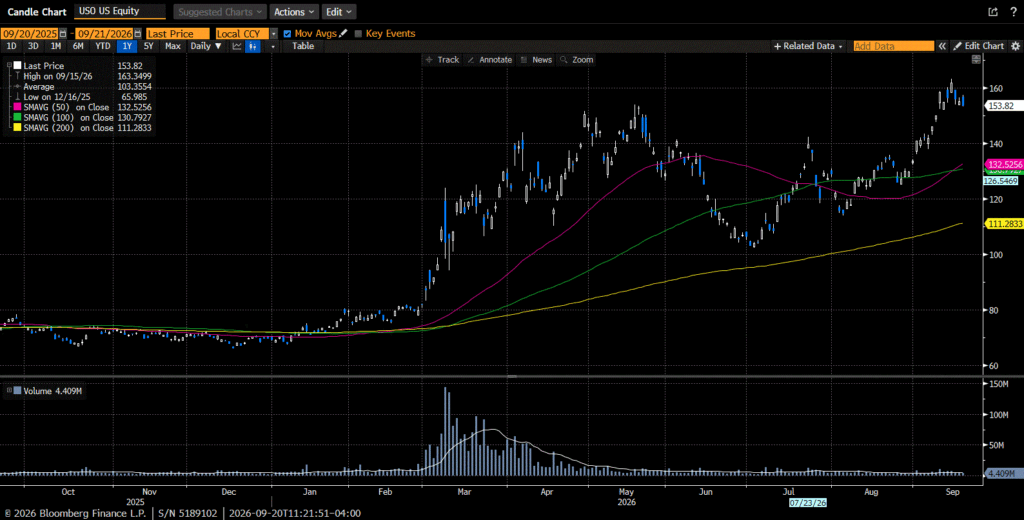
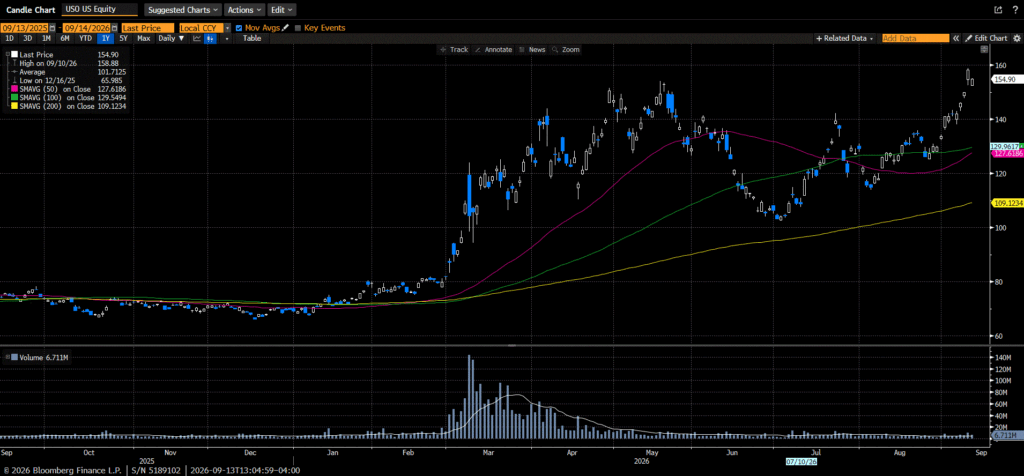
Tensions in the Middle East continued to flare up as the US and UK increased their efforts against the Houthi rebels in the Red Sea. Iran and Pakistan also exchanged missiles, which highlighted the many different conflicts that exist in the region. Additionally, it has been reported that Israel has conducted a strike in Syria that has killed several Iranian Republican Guard leaders.
The US government kicked the can down the road to avoid a government shutdown again while former President Donald Trump ran away with the Iowa Caucus.
The S&P 500 gained 1.2% on the week, the Dow climbed 0.7%, the NASDAQ jumped 2.3%, and the Russell 2000 shed 0.3%. The 2-year yield increased by twenty-six basis points to 4.41% as the 10-year yield rose by twenty basis points to close at 4.15%. Increased tension in the Red Sea provided a floor for oil with WTI prices inching higher by $0.81 to $73.44 a barrel. Gold prices fell 1% or $22.40 to $2029.20 an Oz. Copper prices increased by $0.09 to 3.79 per Lb. Interestingly, Bitcoin and its proxies sold off over the week as investors assessed several new spot Bitcoin ETFs. The US Dollar index climbed 0.9% to 103.22.
US Retail Sales in December were stronger than expected. The headline number came in at 0.6% versus the consensus estimate of 0.5%, supporting the notion that the US consumer is doing just fine. Initial Unemployment Claims came in at 187k, well below expectations, as Continuing Claims fell by 28k to 1.806m. A preliminary look at the University of Michigan’s Consumer Sentiment survey was much stronger than anticipated. The figure came in at 78.8 versus the expected 69.4. The housing market data was mixed. Housing starts were better than expected at 1460k as were Building permits that came in at 1495k. Existing Home Sales came in a bit light at 3.78m.
Investment advisory services offered through Foundations Investment Advisors, LLC (“FIA”), an SEC registered investment adviser. FIA’s Darren Leavitt authors this commentary which may include information and statistical data obtained from and/or prepared by third party sources that FIA deems reliable but in no way does FIA guarantee the accuracy or completeness. All such third party information and statistical data contained herein is subject to change without notice. Nothing herein constitutes legal, tax or investment advice or any recommendation that any security, portfolio of securities, or investment strategy is suitable for any specific person. Personal investment advice can only be rendered after the engagement of FIA for services, execution of required documentation, including receipt of required disclosures. All investments involve risk and past performance is no guarantee of future results. For registration information on FIA, please go to https://adviserinfo.sec.gov/ and search by our firm name or by our CRD #175083. Advisory services are only offered to clients or prospective clients where FIA and its representatives are properly licensed or exempted.