
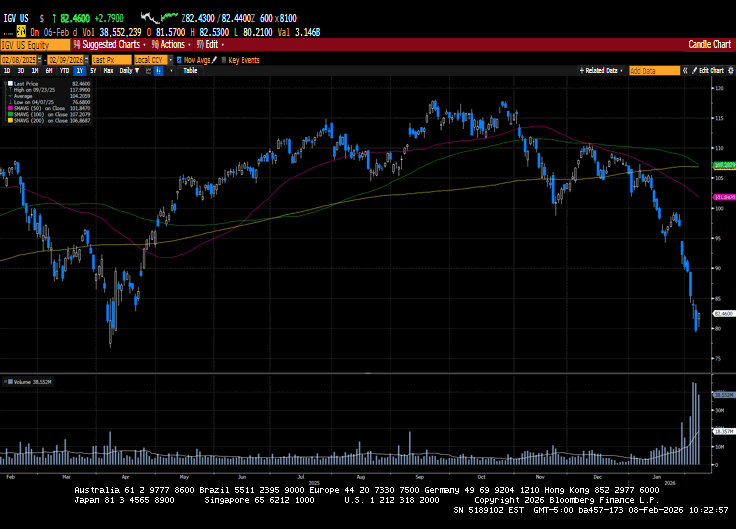
Investors endured a volatile week on Wall Street as 4th quarter earnings continued to roll in. Concerns about massive capital expenditures resurfaced after Amazon and Google announced $200 billion and $185 billion in capex, respectively. This comes after last week’s 2026 capex projections from Meta and Microsoft of $135 billion and $145 billion, respectively. All in, we are talking about $650 billion in capex from just these 4 players. Amazon, Google, and Microsoft sold off in the wake of these announcements. At the same time, investors continued to sell growth in favor of buying value-oriented issues, including mid- and small-cap stocks. 59% of S&P 500 companies have reported earnings so far, and results remain solid. 76% of companies that have reported have beaten the bottom line (EPS), and 73% have beaten revenue. Earnings per share growth stands at 13%, while revenue growth so far is 8.8%. We will get another full dose of earnings this week centered on several consumer staples companies. Earnings drive markets, and the numbers being posted also show a broadening out of companies doing well.
Fears regarding the disruptive nature of AI hit software stocks and several financial services-focused companies. The fears came after Anthropic released new tools aimed at financial analysis and code-writing assistance. OpenAI also released a new version of ChatGPT. We took several calls last week regarding the steep sell-off in growth-oriented issues. Rotation in the market has been underway for several weeks now, with investors moving out of mega-cap growth towards the parts of the market that have lagged over the last couple of years. This is natural and can happen as large institutions rebalance toward their optimal asset allocation. The growth-centric part of the market has been on fire, and while consolidation is normal, we do think that there is still a strong runway for upside in these companies, given the cap-ex backdrop we just described. The Software sector looks oversold to us here, trading at 21X forward 12-month earnings, compared to 100X in 2021. Software is expected to post 19% earnings growth in 2026, so despite the concerns, these numbers suggest we should continue to hold or even buy at these levels. Salesforce.com currently trades at 14X earnings, compared with a historical 46X.

The S&P 500 lost 0.1%; the Dow crossed 50,000 for the first time and hit all-time highs with a 2.5% gain on the week; the NASDAQ fell 1.8%; and the Russell 2000 advanced 2.2%. US Treasuries advanced across the curve, with shorter-tenured paper outperforming. The 2-year yield declined by 3 basis points to 3.50%, while the 10-year yield declined by 3 basis points to 4.21%. West Texas Intermediate crude prices fell by $1.61, or 2.4%, following a de-escalation in tensions between the US and Iran after the two countries agreed to meet in Oman. The meeting was constructive but did not yield an agreement. Trade in precious metals remained volatile. Gold prices increased by 4.4% to close the week at $4,980 per ounce, while silver prices fell by 1.7% to close at $76.90 per ounce. Copper prices fell by 4 cents to $4.88 per Lb. Bitcoin’s price plunged another 17% for the week, trading as low as $60,000 before rebounding to just under $70,000. The US Dollar index increased by 0.5% to close at 97.64.

Dow Jones Industrial Average 2/6/26
The announcement of the BLS Employment Situation Report was delayed by the partial government shutdown and has now been pushed to this coming week. ISM Manufacturing came in much better than anticipated at 52.6, marking the first expansion reading in the last eleven months. ISM Services came in at 53.8, in line with the prior reading. ADP private payrolls increased by 22k versus the estimate of 43k. JOLTS, which monitors job openings in the economy, fell by 386,000 to 6542m. Initial Jobless Claims increased by 22k to 231k, while Continuing Claims increased by 25k to 1844k. A preliminary look at the University of Michigan’s Consumer Sentiment index for February ticked higher to 57.3 from the prior reading of 56.4. This week, we will get a look at Retail Sales, the Consumer Price Index, and, as mentioned before, BLS jobs data.

Investment advisory services offered through Foundations Investment Advisors, LLC (“FIA”), an SEC registered investment adviser. FIA’s Darren Leavitt authors this commentary which may include information and statistical data obtained from and/or prepared by third party sources that FIA deems reliable but in no way does FIA guarantee the accuracy or completeness. All such third party information and statistical data contained herein is subject to change without notice. Nothing herein constitutes legal, tax or investment advice or any recommendation that any security, portfolio of securities, or investment strategy is suitable for any specific person. Personal investment advice can only be rendered after the engagement of FIA for services, execution of required documentation, including receipt of required disclosures. All investments involve risk and past performance is no guarantee of future results. For registration information on FIA, please go to https://adviserinfo.sec.gov/ and search by our firm name or by our CRD #175083. Advisory services are only offered to clients or prospective clients where FIA and its representatives are properly licensed or exempted.