Equity and fixed-income markets sold off for the second consecutive week as the Federal Reserve delivered an expected twenty-five basis-point rate cut but pivoted to a much more hawkish stance for 2025, where the committee now expects only two quarter-point rate cuts. Several committee members cited concerns regarding the new administration’s policies on tariffs and immigration and the policy ramifications on inflation. The pivot moved the Fed away from concerns about the labor market to worry more about their inflation mandate. The summary of economic projections showed an uptick in inflation expectations from 2024 to 2025 and, as I mentioned, the SEP also reduced 2025 rate cuts from four to two quarter-point cuts. Central bank policy elsewhere was pretty benign, with the Bank of England, Bank of Japan, and the Chinese Central Bank (PBOC) all keeping rates unchanged. The Norges Bank and the Bank of Mexico did cut their policy rates.
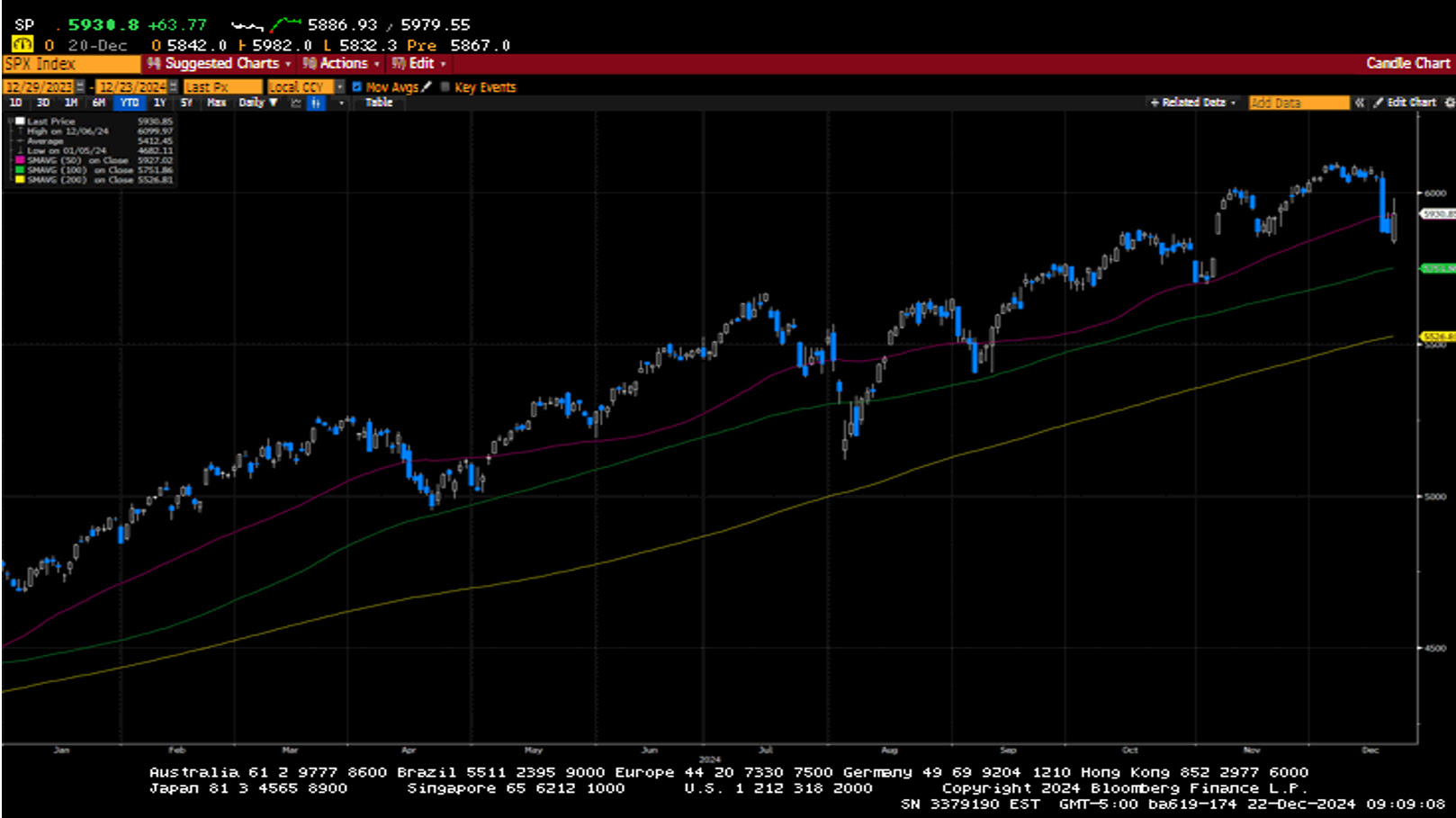
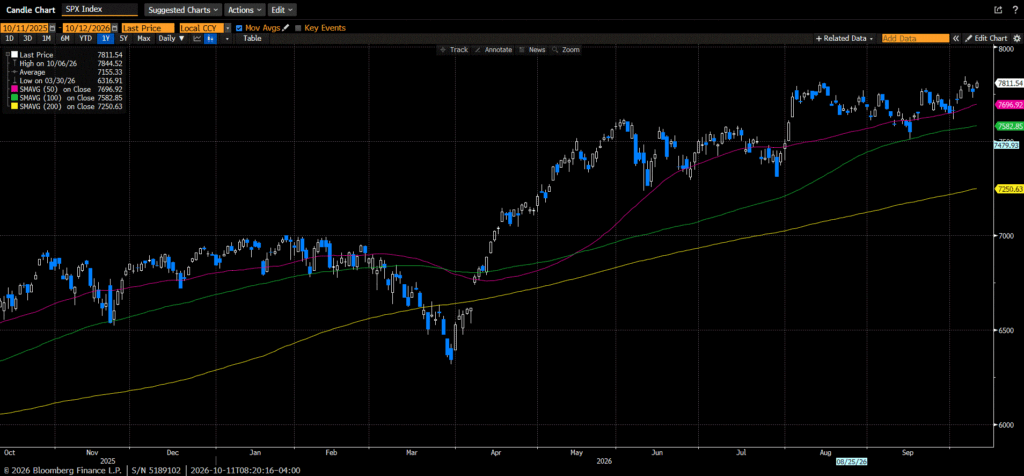
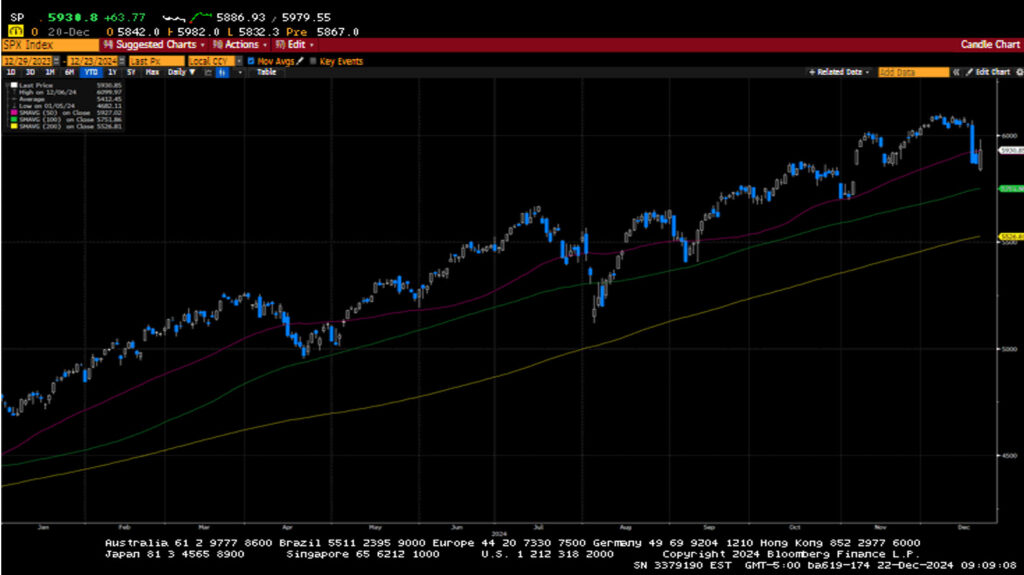
The S&P 500 lost 2%, the Dow was down 2.3%, the NASDAQ fell 1.8%, and the Russell 2000 was slammed, falling 4.5%. I should note that some of the market action witnessed this week was 100% related to a more hawkish Federal Reserve; however, some of this move is likely a natural consolidation of the tremendous move we have seen since the election. This consolidation can be seen as constructive and likely sets up the market for another move higher. Expect more market volatility as the Trump administration outlines its policies, but the backdrop for the US markets still appears constructive. US Treasuries suffered a second week of losses. The 2-year yield increased by seven basis points to 4.31%, while the 10-year yield increased by twelve basis points to 4.52%- the highest level since May.
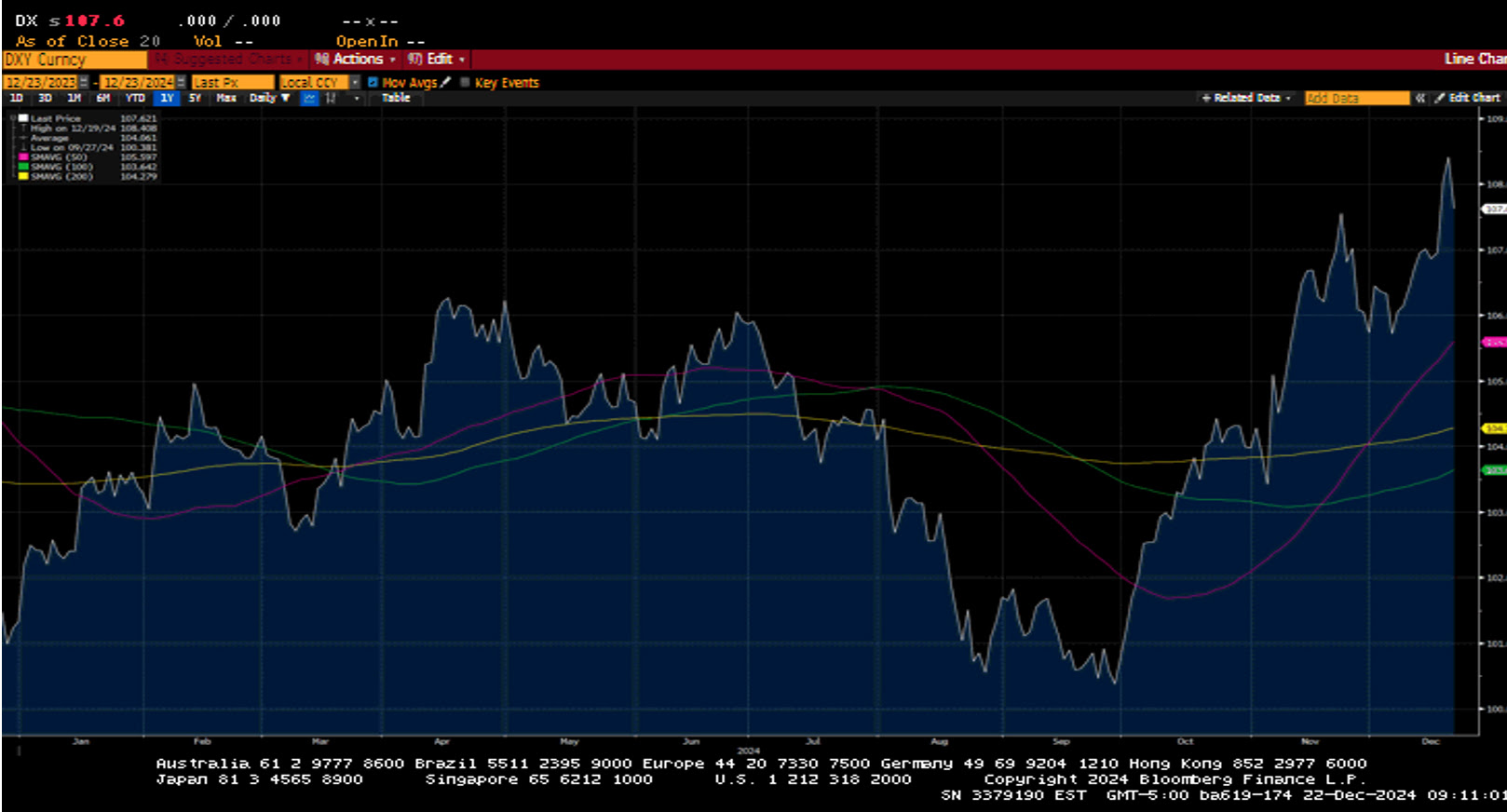
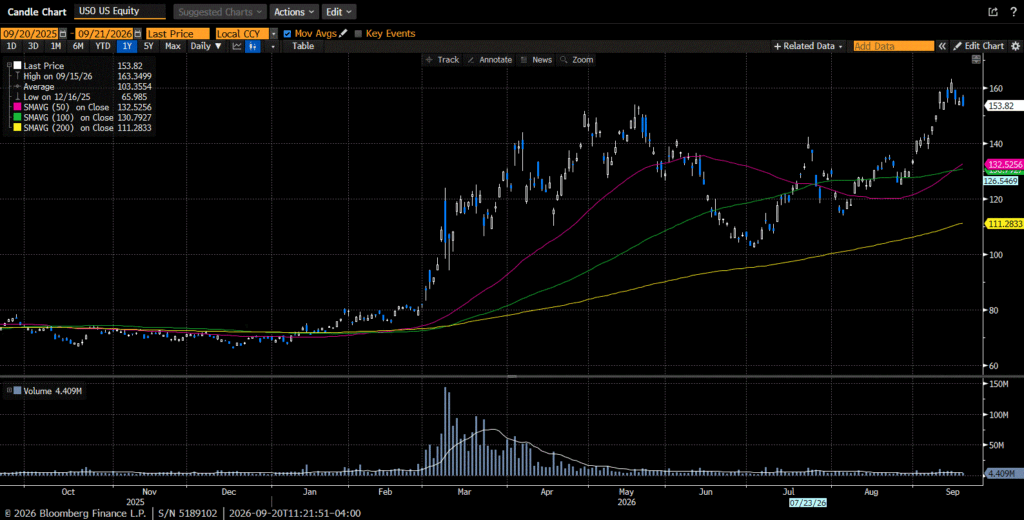
Commodity prices were generally lower while the US Dollar continued to post gains. Oil prices fell 2.6% or $1.86 on weak economic data out of China and the likelihood of weaker demand for crude from that region. Gold prices fell by $32.30 to $2644.40. Copper prices closed at $4.11 per Lb., down nine cents from the prior week. Bitcoin touched $108,000 per coin before selling off to close at $97,200. The Dollar index increased by 0.6% to 107.62.
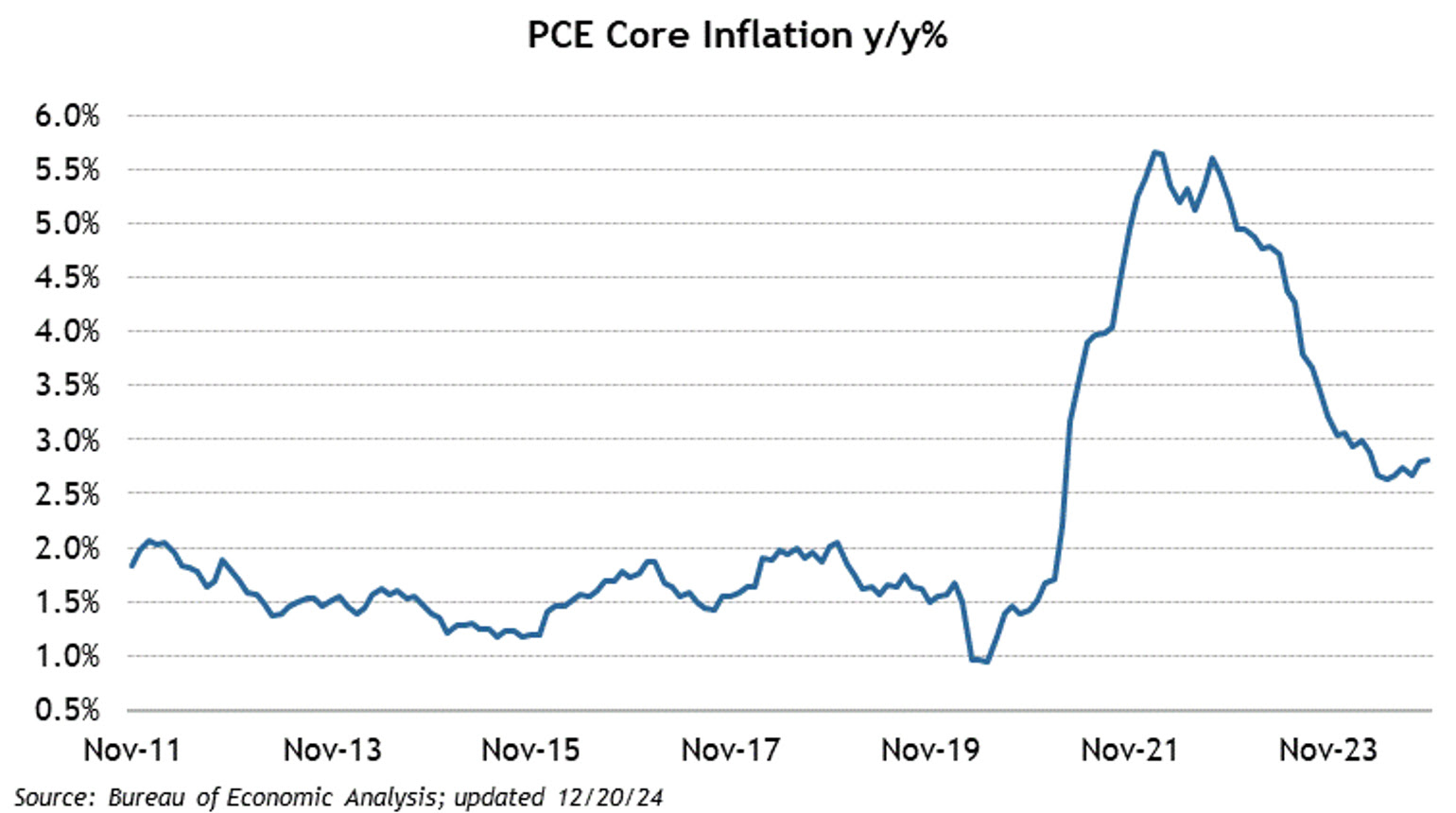
The economic calendar was headlined by the Fed’s preferred measure of inflation, the PCE. The PCE showed an increase of 0.1%, slightly lower than the expected 0.2%. On a year-over-year basis, the PCE increased by 2.4% versus the prior reading of 2.3%. The Core reading also came in at 0.1% month over month and was lower than the anticipated 0.2%. The year-over-year figure came in line with the prior month’s reading of 2.8%. The numbers showed no real improvement in inflation and provided some weight for the concerns articulated by the Fed earlier in the week. Personal Income came in at 0.3% versus the expected 0.4%, while Personal Spending increased by 0.4%, just below the consensus estimate of 0.5%. Retail Sales showed a robust market for autos. The headline number increased by 0.7%, while the ex-auto figure was up just .02%. Housing Starts increased by 1289k while building permits came in at 1505k- a mixed picture for the housing market. The 3rd estimate of Q3 GDP increased to 3.1% from 2.8%, while the GDP Deflator remained at 1.9%. Initial Claims fell by 22k to 220k, as Continuing Claims decreased by 5k to 1874k.
Investment advisory services offered through Foundations Investment Advisors, LLC (“FIA”), an SEC registered investment adviser. FIA’s Darren Leavitt authors this commentary which may include information and statistical data obtained from and/or prepared by third party sources that FIA deems reliable but in no way does FIA guarantee the accuracy or completeness. All such third party information and statistical data contained herein is subject to change without notice. Nothing herein constitutes legal, tax or investment advice or any recommendation that any security, portfolio of securities, or investment strategy is suitable for any specific person. Personal investment advice can only be rendered after the engagement of FIA for services, execution of required documentation, including receipt of required disclosures. All investments involve risk and past performance is no guarantee of future results. For registration information on FIA, please go to https://adviserinfo.sec.gov/ and search by our firm name or by our CRD #175083. Advisory services are only offered to clients or prospective clients where FIA and its representatives are properly licensed or exempted.