
Financial markets traded mixed last week. News on Sunday that President Biden had decided not to pursue reelection and endorse his Vice President Harris induced a reassessment of the political landscape. However, the overall reaction in the market seemed to be already priced in, and the initial moves in the market were relatively muted. Some polls now suggest Harris is even with Trump on her election chances.
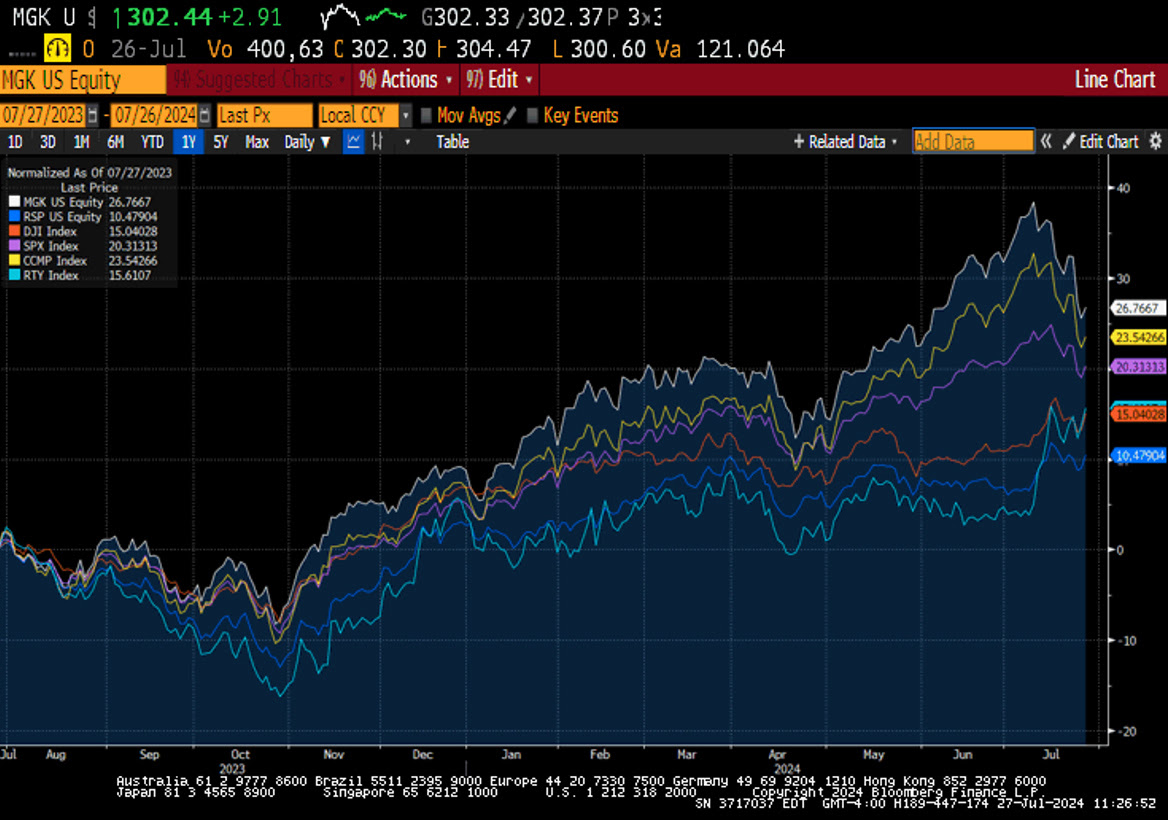
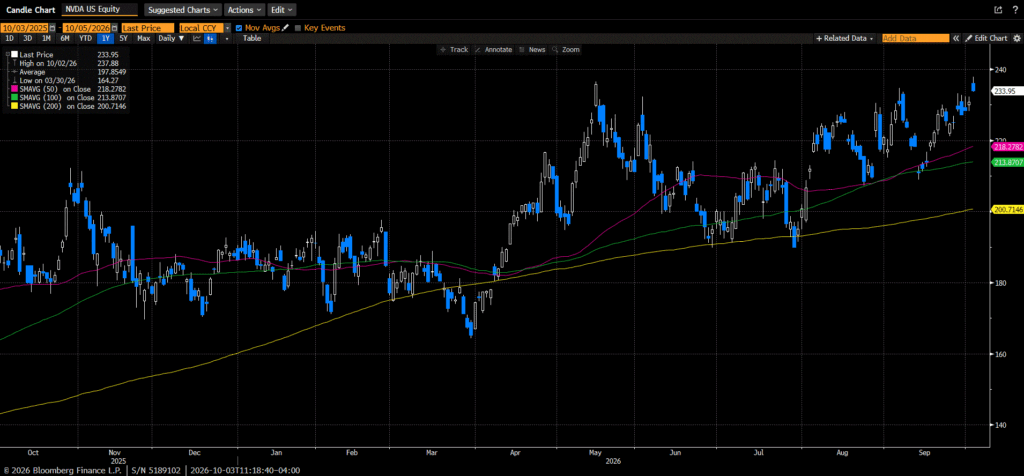
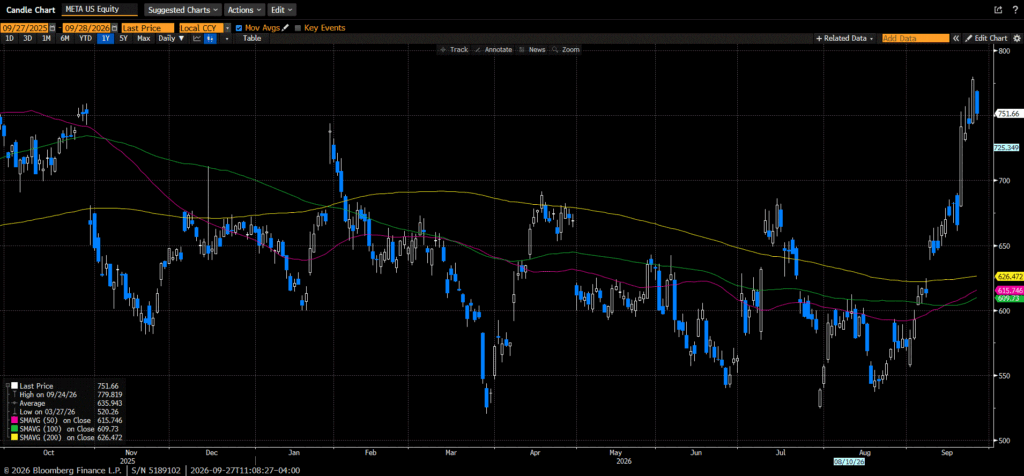
The week was extremely busy, with second-quarter earnings showing mixed results. Google and Tesla set a negative tone for the Magnificent 7. Apple, Meta, and Microsoft will report their Q2 results this week. I thought Google had a fantastic quarter, but investor expectations were extremely high. The street seemed to question higher capital expenditures on AI, which still has quite a few unknowns regarding return on investment. Tesla posted an awful quarter with another decrease in margins, decreased delivery expectations from the prior year, and an affirmation that their Robo-taxi initiative had been postponed until October- interestingly, most of this information was already known. Google shares fell 6% on their report, while Tesla’s shares tumbled 8.1% and helped to send the Mega-cap index down 2.8% on the week. Positive results included IBM, Service Now, MMM, Norfolk Southern, Spotify, and Lockheed Martin. UPS, Honeywell, SAIA, and Ford posted disappointing results.
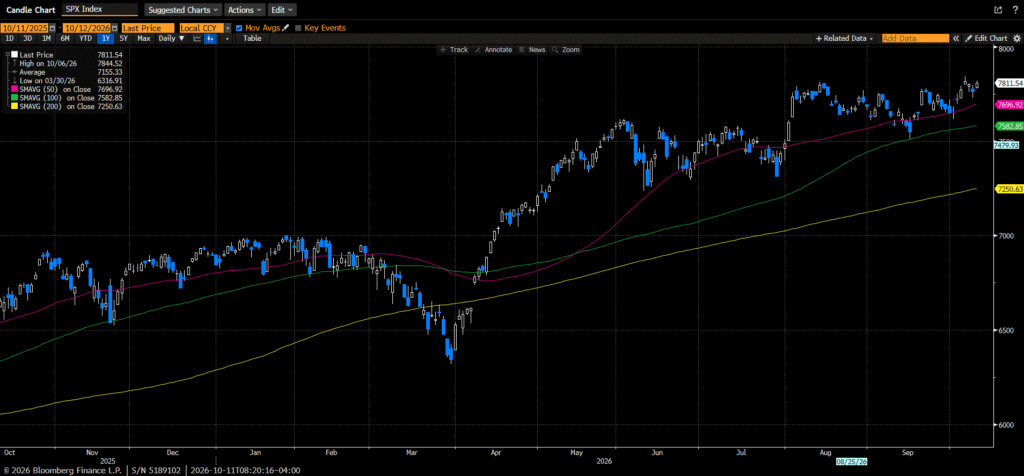
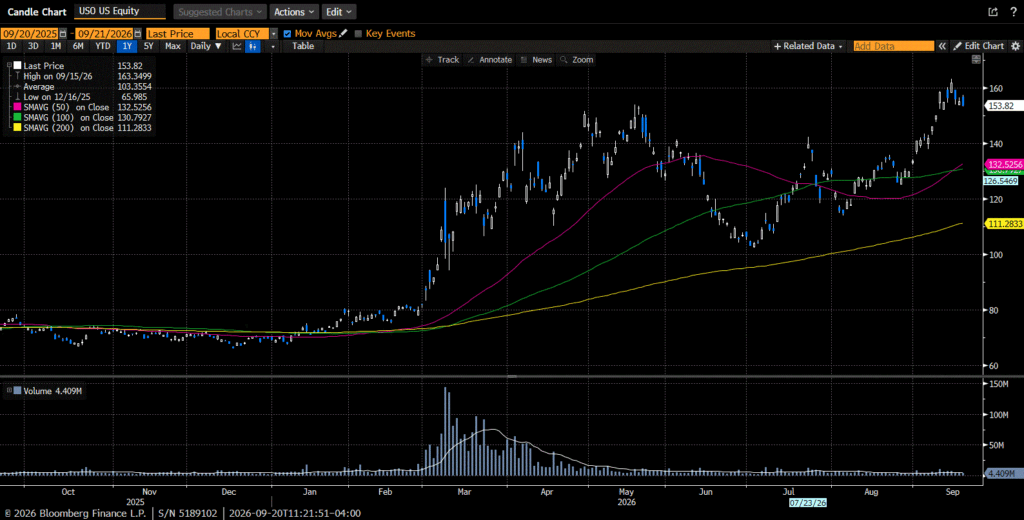
The S&P 500 lost 0.8%, the Dow added 0.7%, the NASDAQ fell by 2.1%, and the Russell 2000 continued to outperform with a 3.5% advance. Yields on the short end of the curve outperformed the longer end with a steepening effect. The 2-10 spread now sits at nineteen basis points. The 2-year yield fell by twelve basis points to 4.39%, while the 10-year yield decreased by four basis points to 4.20%. Oil prices were soft again, losing 2.8% to $77.08 a barrel. Gold prices fell 0.8% to $2381.50 a barrel. Copper prices continued to get crushed, losing 3.1% to $4.11 per pound.
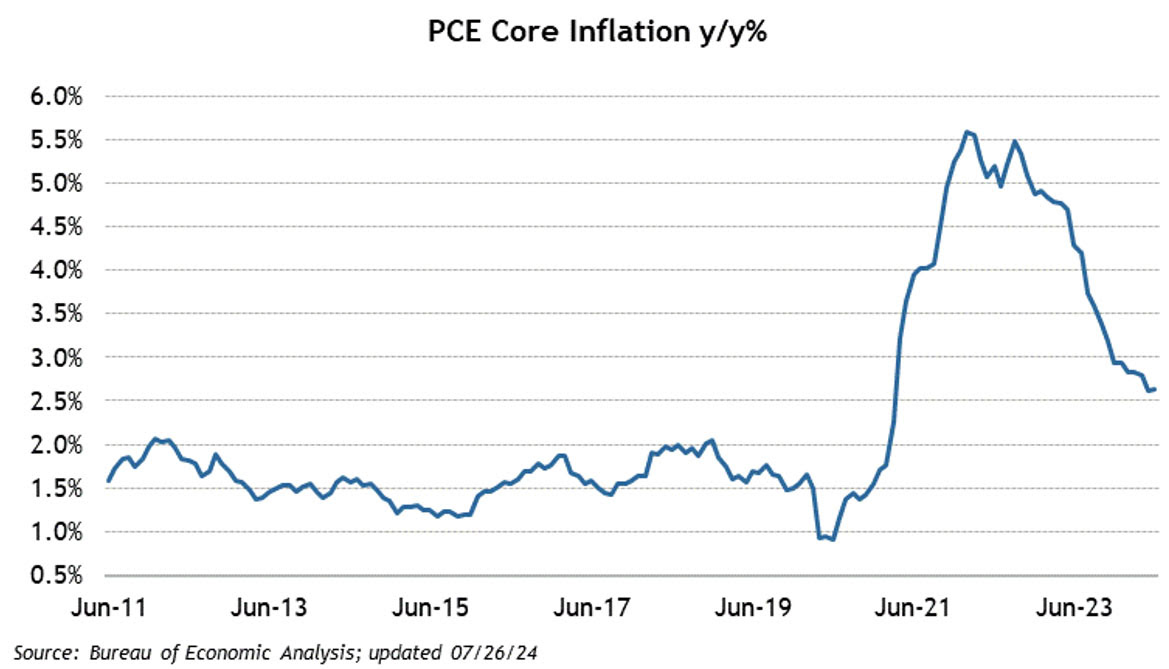
The economic calendar gave no reason for the Federal Reserve to withdraw from an anticipated 25 basis point rate cut in September. A preliminary look at Q2 GDP showed more robust growth than expected, growing at 2.8% versus the consensus estimate of 1.9%. The GDP Deflator also showed progress in pricing, falling to 2.3% versus an estimated 2.6%. Personal Income was lighter than expected at 0.2%, while Personal Spending came in line with expectations at 0.3%. The Fed’s preferred measure of Inflation, the PCE came in line on the headline and core number at 0.1% and 0.2%, respectively. On a year-over-year basis, the Core reading fell to 2.5% in June from 2.6% in May, while the Core reading was unchanged from May at 2.6%. Initial Claims fell by 10k to 235k, and continuing Claims decreased by 9k to 1860k. The final July reading of the University of Michigan’s Consumer Sentiment index came in at 66.4 and reflected continued concerns about Inflation, employment, and uncertainty about the current state of politics.
Investment advisory services offered through Foundations Investment Advisors, LLC (“FIA”), an SEC registered investment adviser. FIA’s Darren Leavitt authors this commentary which may include information and statistical data obtained from and/or prepared by third party sources that FIA deems reliable but in no way does FIA guarantee the accuracy or completeness. All such third party information and statistical data contained herein is subject to change without notice. Nothing herein constitutes legal, tax or investment advice or any recommendation that any security, portfolio of securities, or investment strategy is suitable for any specific person. Personal investment advice can only be rendered after the engagement of FIA for services, execution of required documentation, including receipt of required disclosures. All investments involve risk and past performance is no guarantee of future results. For registration information on FIA, please go to https://adviserinfo.sec.gov/ and search by our firm name or by our CRD #175083. Advisory services are only offered to clients or prospective clients where FIA and its representatives are properly licensed or exempted.