
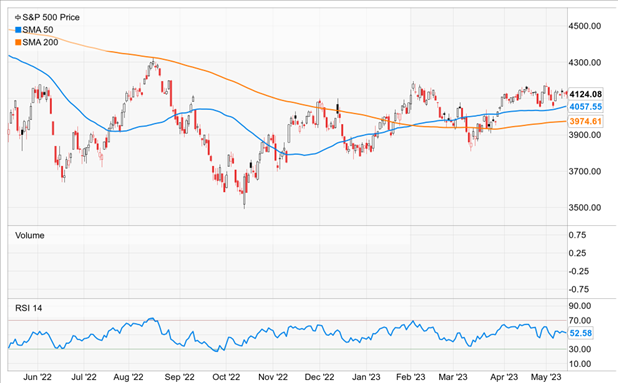
US equity and fixed-income markets continued to trade in a tight range. 4100 proved to be support for the S&P 500, while the US 10-year note yield oscillated around 3.46%. Cyclical issues were under pressure as investors assessed the likelihood of a slower global economy. This week, the Communication Services sector led gains on the back of Google’s 11% advance after a successful developer conference highlighted several new AI initiatives.
Tightening lending standards after several regional bank failures manifested themselves in the Senior Loan Officers Opinion Survey. The survey protracted tightening standards across all loan categories throughout the rest of 2023. Regional banks continued to drag the financial sector as PacWest shares fell 21% after their announcement that their deposits had decreased by 9.5%.
President Biden met with Congressional leaders at the White House to negotiate to raise the debt ceiling. However, no compromise was made, and negotiations were pushed into the coming week. The Congressional Budget Office announced that the government could stay funded through the end of July with the Treasury’s extraordinary measures coupled with recent tax receipts.
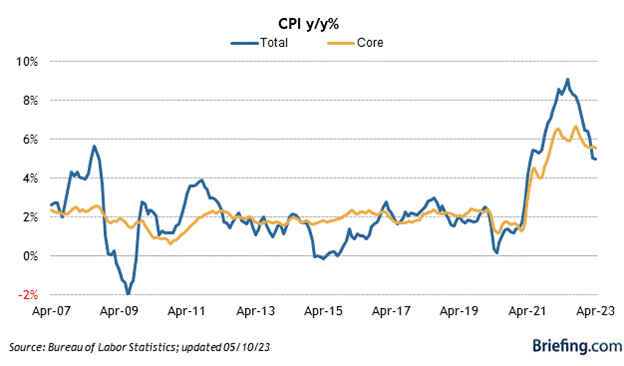
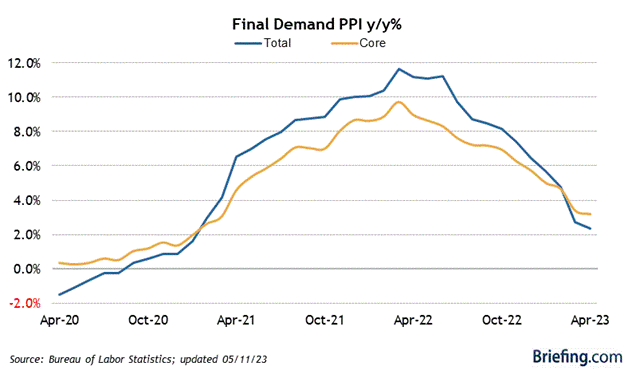
Economic data showed inflation continued to moderate in April. The Consumer price index increased month-over-month by 0.4%, in line with expectations. Year-over-Year CPI was up 4.9% in April, down from 5% in March. The shelter index was the most significant contributor to April’s increase, rising 0.4%. Core CPI which excludes food and energy, rose by 0.4%, slightly above the consensus forecast of 0.3%. Year-over-year, the Core reading came in at 5.5%, down from 5.6% in March. Producer prices also showed inflation coming down. The headline and core number of PPI came in at 0.2% in April, less than the consensus estimates of 0.3%. Year-over-year figures for both measures also showed a modest decline to 2.3% and 3.2%, respectively. Initial jobless claims saw an uptick to 264k while Continuing Claims rose to 1.813 million. Preliminary University of Michigan Consumer sentiment fell to 57.7 from April’s final reading of 63.5 and saw 5-year inflation expectations tick up to 3.2% from 3%, the highest reading since 2011.
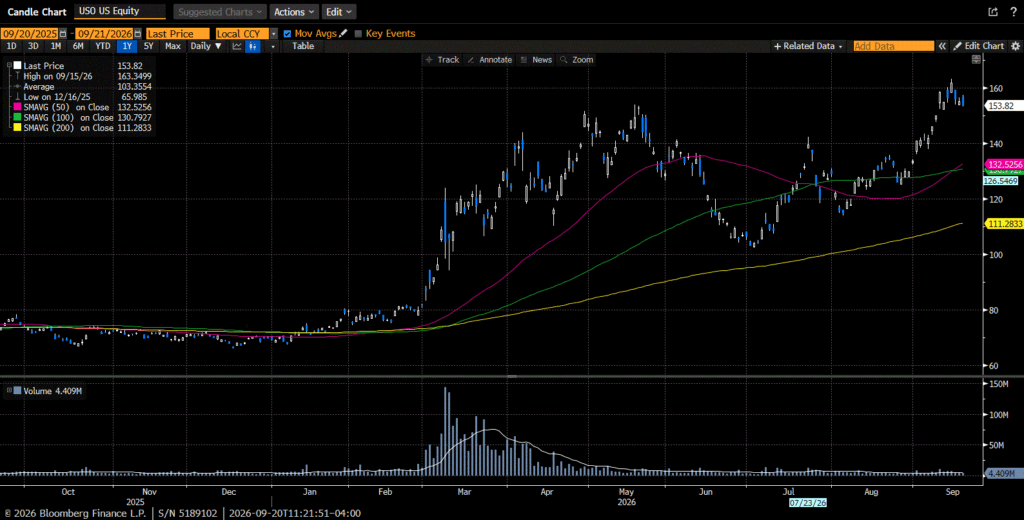
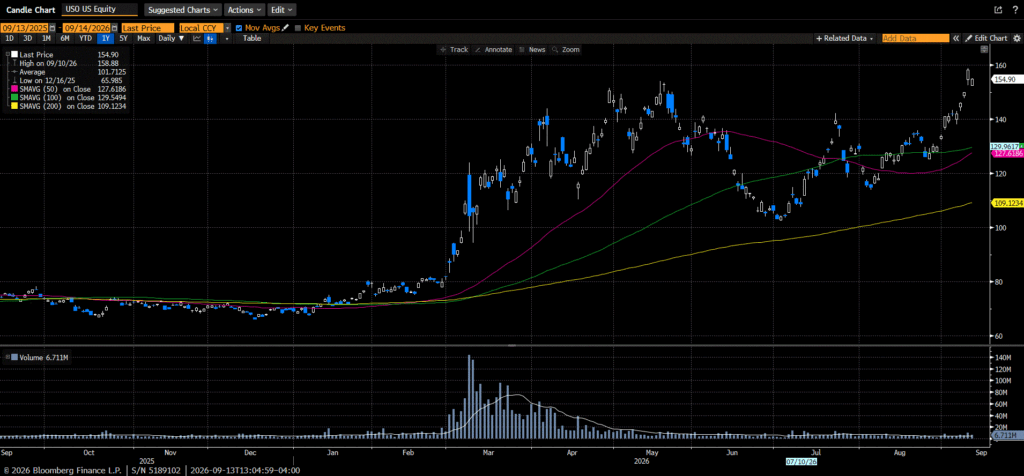
The S&P 500 lost 0.3%, the Dow gave back 1.1%, the NASDAQ increased by 0.4%, and the Russell 2000 shed 1.1%. US Treasuries sold off across the curve. The 2-year note yield increased by seven basis points to 3.98%, while the 10-year yield increased by one basis point to 3.46%. Oil prices struggled, losing $1.36 or 1.9% to close at $70.06 a barrel. Gold prices were little changed, falling $5.90 to 2018.70 an Oz. Copper prices fell by $0.16 or 4% to $3.73 an Lb.
Investment advisory services offered through Foundations Investment Advisors, LLC (“FIA”), an SEC registered investment adviser. FIA’s Darren Leavitt authors this commentary which may include information and statistical data obtained from and/or prepared by third party sources that FIA deems reliable but in no way does FIA guarantee the accuracy or completeness. All such third party information and statistical data contained herein is subject to change without notice. Nothing herein constitutes legal, tax or investment advice or any recommendation that any security, portfolio of securities, or investment strategy is suitable for any specific person. Personal investment advice can only be rendered after the engagement of FIA for services, execution of required documentation, including receipt of required disclosures. All investments involve risk and past performance is no guarantee of future results. For registration information on FIA, please go to https://adviserinfo.sec.gov/ and search by our firm name or by our CRD #175083. Advisory services are only offered to clients or prospective clients where FIA and its representatives are properly licensed or exempted.