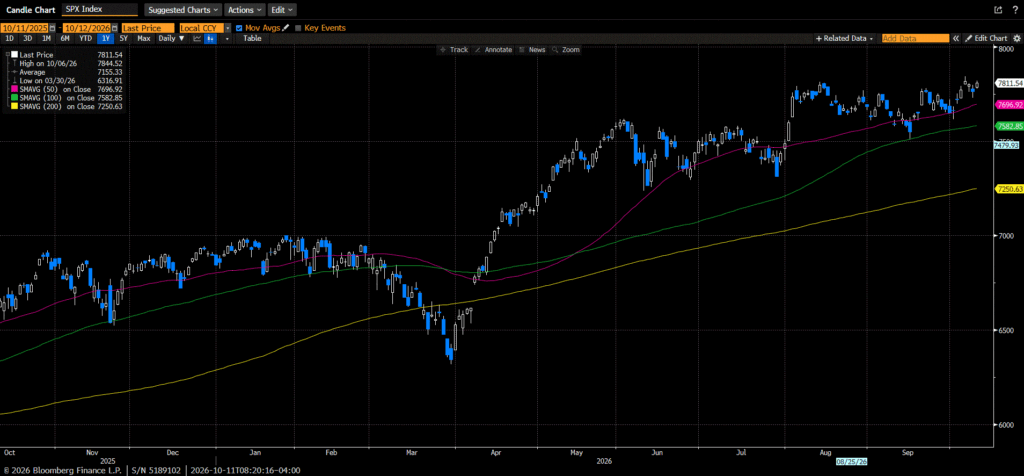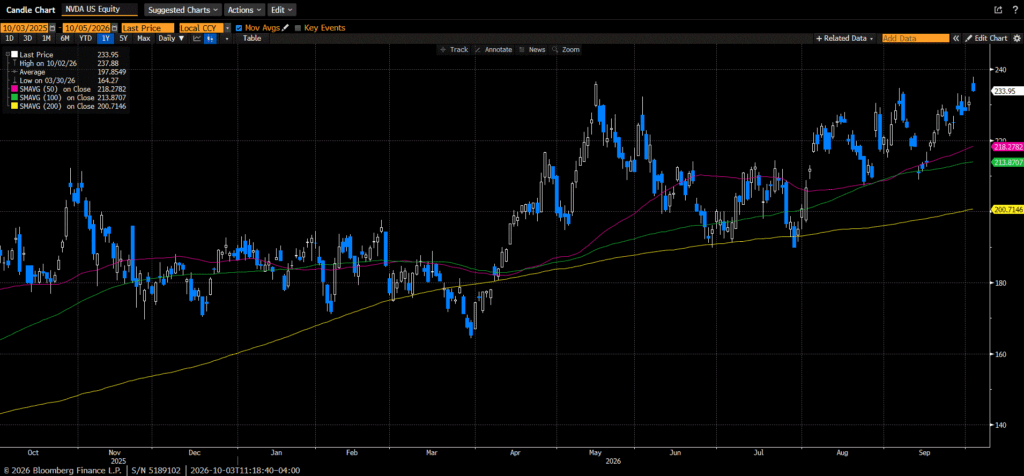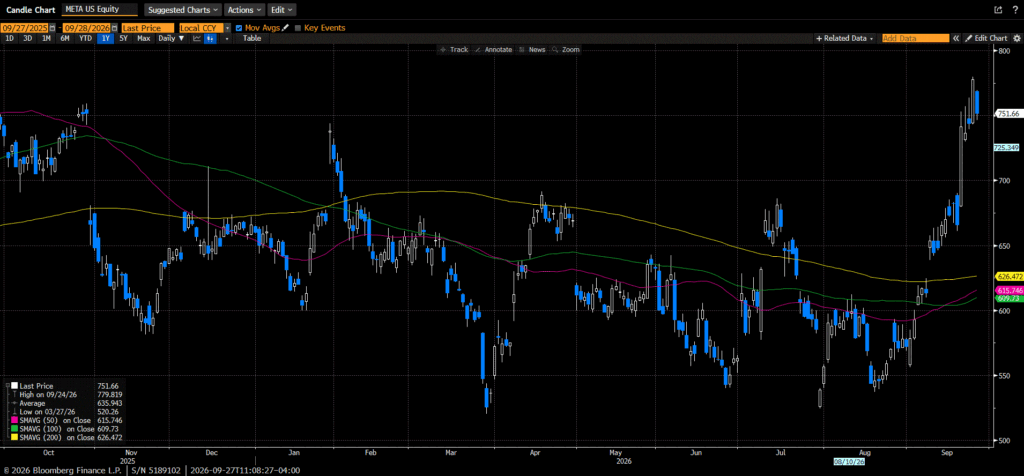

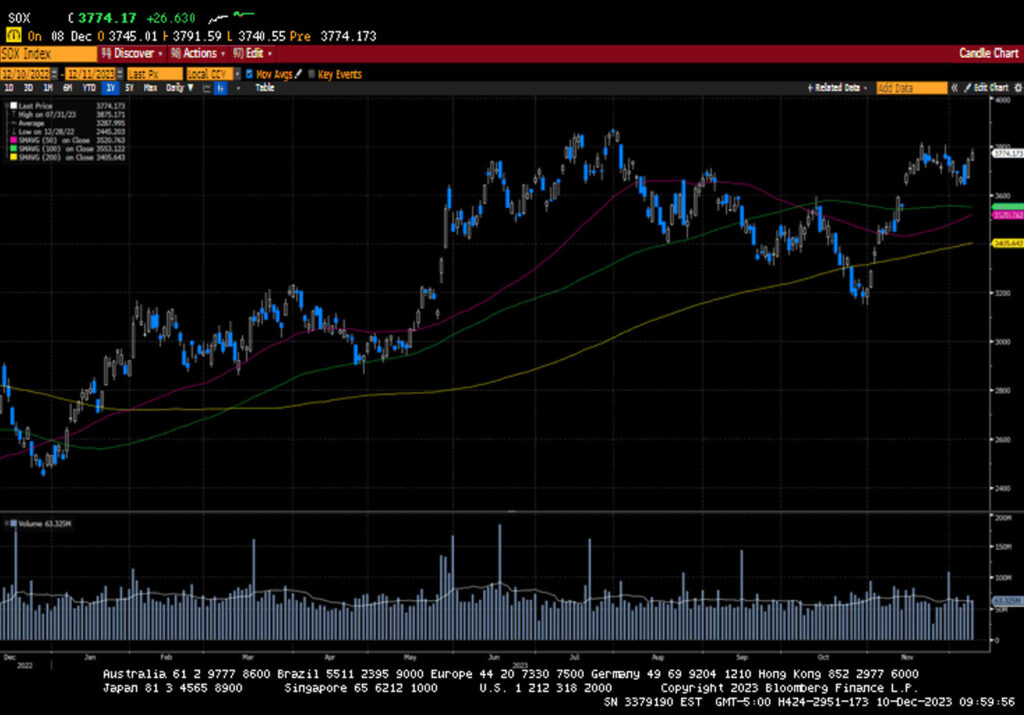
The S&P 500 gained ground for the sixth consecutive week as US economic data continued to support the soft landing narrative. Mega-cap issues provided leadership, while small-caps continued to perform relatively well, showing a broadening out of the equity rally. The introduction of Alphabet’s AI initiative, Gemini, propelled shares higher by 5% on Thursday. Similarly, AMD launched its MI300 product and announced that Meta and Oracle would be new customers and that Microsoft would continue to use their technology. Investors sent AMD stock higher on the notion that AMD is well-positioned to participate in AI growth. The announcement pushed the Philadelphia Semiconductor Index higher on the week.
International markets were mixed this week as Moody’s cut China’s credit outlook from stable to negative. In Japan, BOJ rhetoric suggested again an end to its negative interest rate policy which rallied the Yen but catalyzed a sell-off in Japanese equities. The Israel-Hamas war continued, with Israel claiming to have killed five military leaders of Hamas. The reescalation of the war prompted a proposal by the UN for a ceasefire, but the United States blocked the proposal. The US Senate voted down more funding for Ukraine and Israel as the far right demanded changes to border security policy.
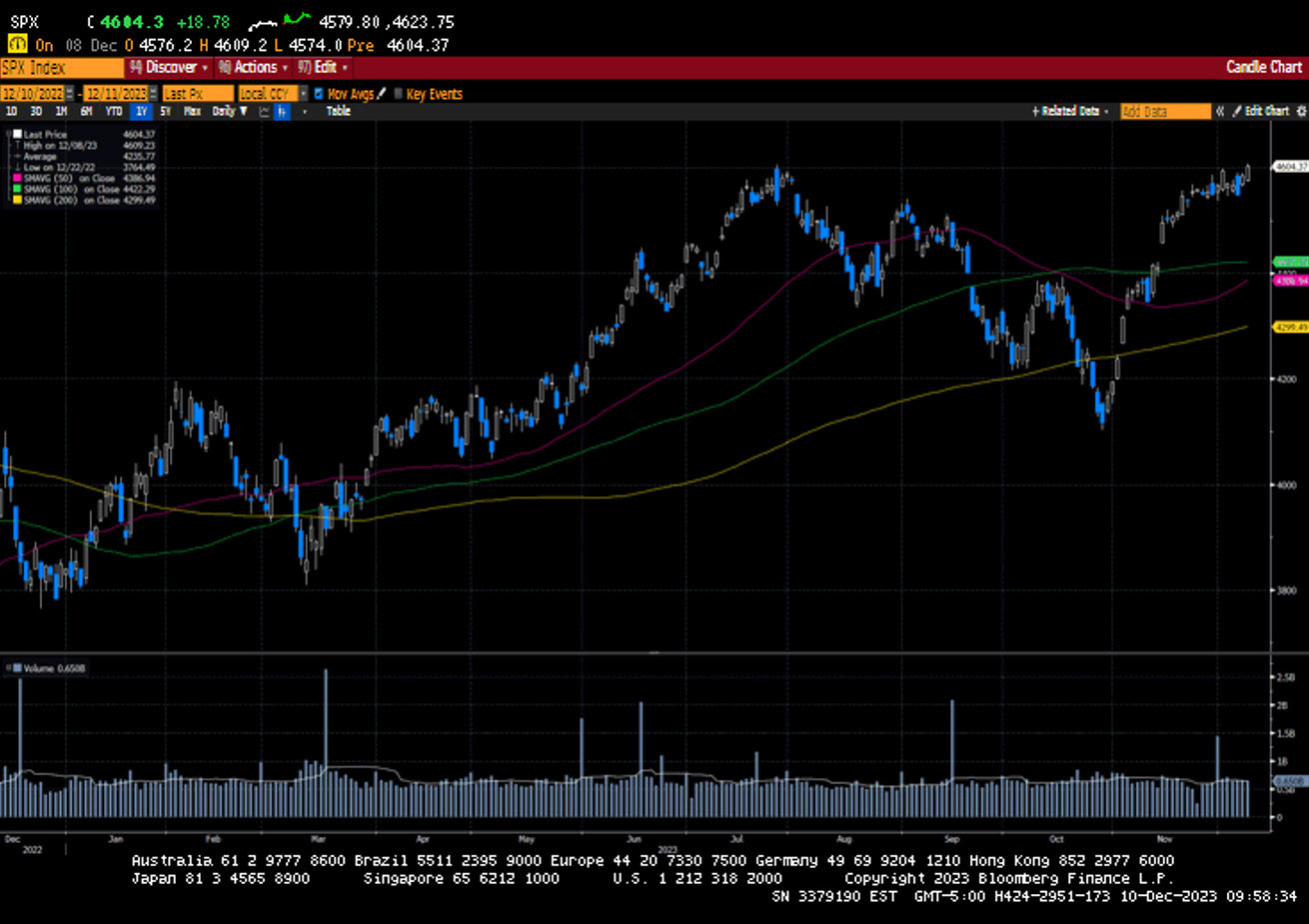
The S&P 500 increased by 0.2% and established a new 52-week high. The index is up 11.8% in six weeks. Mega-caps rose by 0.9%, while the equally weighted S&P 500 was flat for the week. The Dow Jones Industrial Average was also flat for the week. The NASDAQ ticked higher by 0.7%, while the small-cap-focused Russell 2000 continued to lead with a 1% advance.
Price action across the US yield curve was mixed. Shorter-tenured US Treasuries took the brunt of the sell-off that occurred on Friday after a stronger-than-expected Employment Situation Report hastened a rethink of the Fed cutting rates in the first quarter of 2024. For the week, the 2-year yield increased by eighteen basis points to 4.74%, while the 10-year yield increased by two basis points to 4.25%. As yields increase bond prices fall.
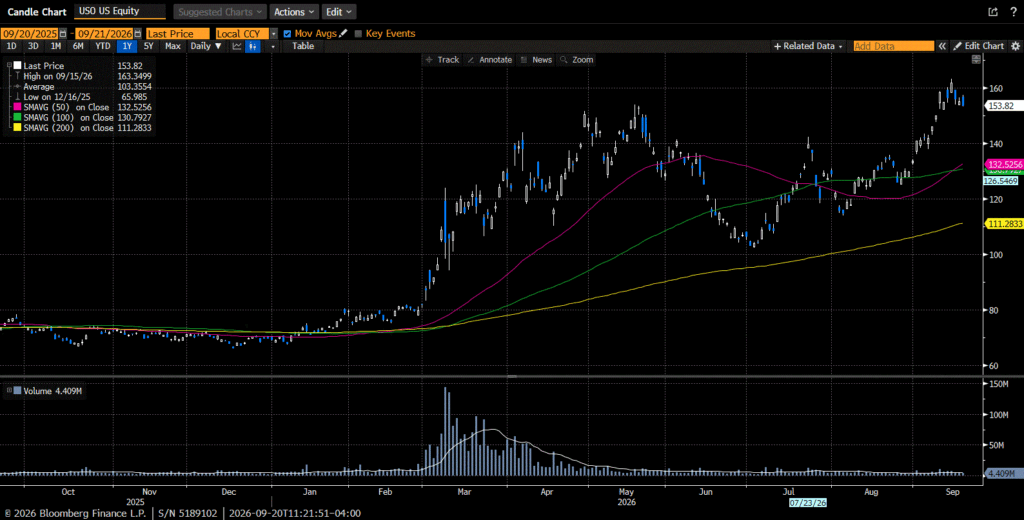
Oil prices continued to fall as concerns about global growth persisted, and questions remained about the compliance of OPEC+’s production cuts. WTI prices decreased by 3.5% or $2.56 to $71.18 a barrel. It’s worth noting that further weakness may be curbed somewhat by the announcement that the US will start to buy back oil for the Strategic Petroleum Reserve. Gold prices fell by $75 to close at $2014.70 an Oz. Copper prices decreased by $0.10 to $3.83 per Lb. A stronger dollar likely influenced commodity prices as the Dollar Index gained 0.8% to close at 104.01.
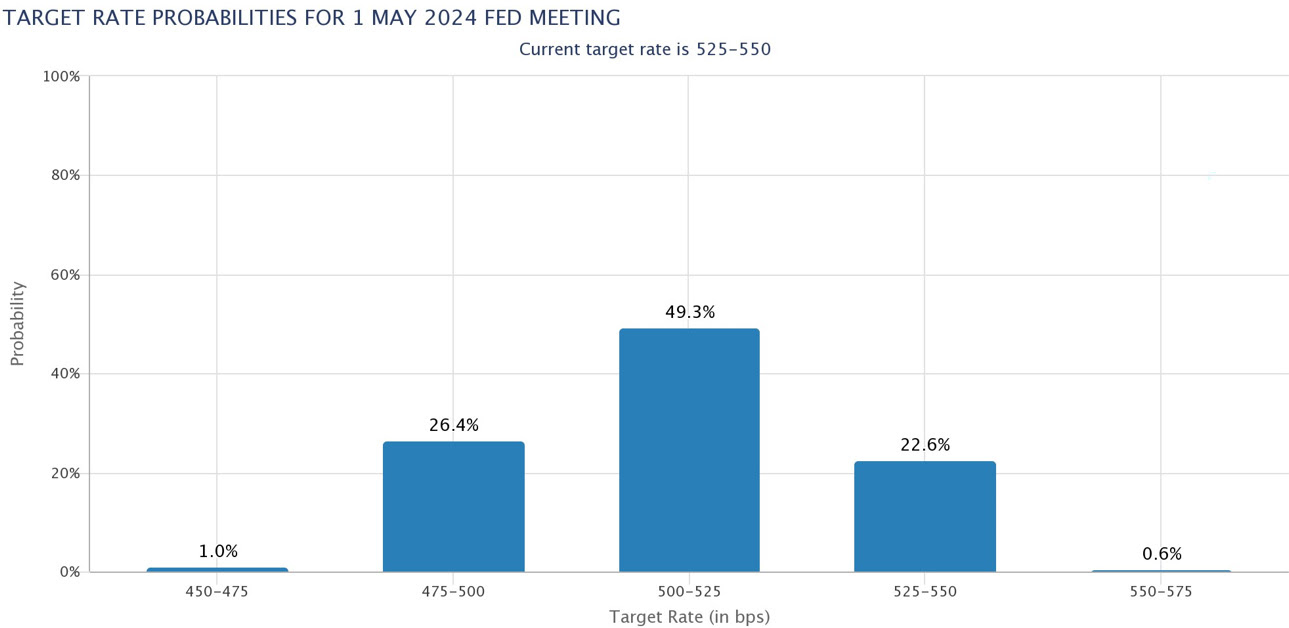
A robust November Employment Situation Report headlined the economic calendar. Non-farm payrolls increased by 199k versus the consensus estimate of 175k and above the October reading of 150k. Private Payrolls increased by 150K- the street was looking for 155K. The Unemployment rate surprised to the downside at 3.7%, a regression from the prior print of 3.9%. Average Hourly Earnings ticked higher by 0.4% the consensus estimate was for an increase of 0.2%. The Average Workweek increased to 34.4 from 34.3. The report pushed back on the Fed cutting rates in the first quarter of 2024, although Fed Funds Futures still assign a 78.6% probability of a May 2024 rate cut. Initial claims were up 1k to 220k, while Continuing Claims fell by 64k to 1.861M. JOLTS data, which shows available job openings, declined to 8.733m- the lowest level since March 2022. ISM Services data showed an uptick in the Service Sector. The reading came in at 52.7 from 51.8 in October. Q3 Productivity increased by 5.2%, above the consensus estimate of 4.8%. Q3 Unit Labor Cost decreased by 1.2%. Finally, the preliminary reading of the University of Michigan’s Consumer Sentiment came in well above consensus at 69.4 as inflation expectations waned.
Investment advisory services offered through Foundations Investment Advisors, LLC (“FIA”), an SEC registered investment adviser. FIA’s Darren Leavitt authors this commentary which may include information and statistical data obtained from and/or prepared by third party sources that FIA deems reliable but in no way does FIA guarantee the accuracy or completeness. All such third party information and statistical data contained herein is subject to change without notice. Nothing herein constitutes legal, tax or investment advice or any recommendation that any security, portfolio of securities, or investment strategy is suitable for any specific person. Personal investment advice can only be rendered after the engagement of FIA for services, execution of required documentation, including receipt of required disclosures. All investments involve risk and past performance is no guarantee of future results. For registration information on FIA, please go to https://adviserinfo.sec.gov/ and search by our firm name or by our CRD #175083. Advisory services are only offered to clients or prospective clients where FIA and its representatives are properly licensed or exempted.