
qqwe
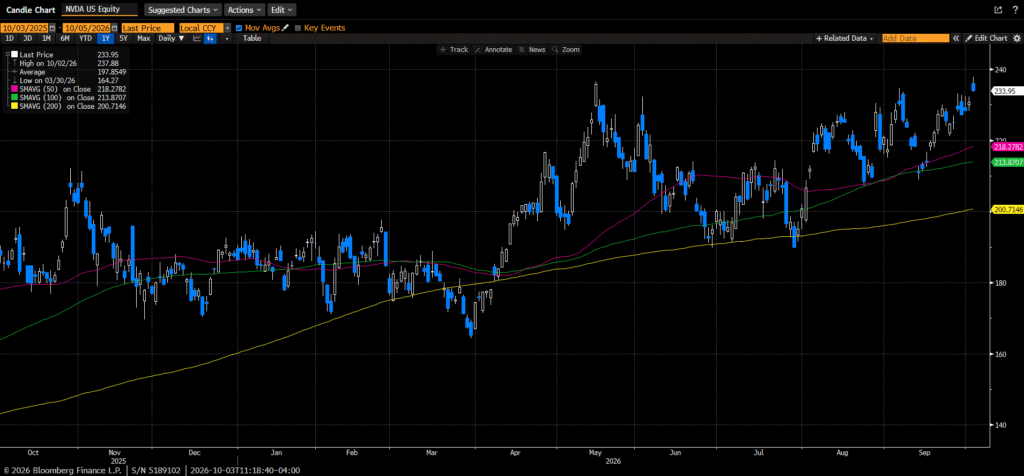
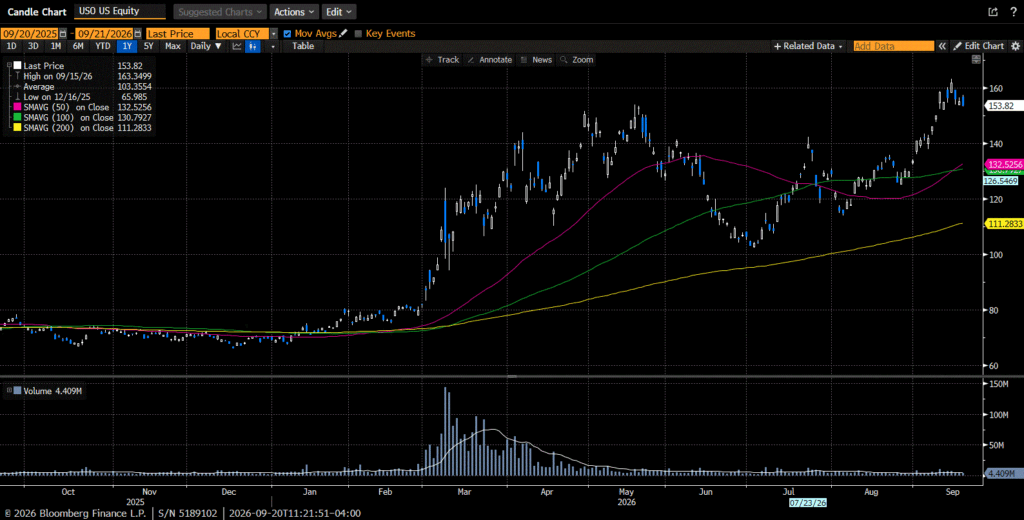
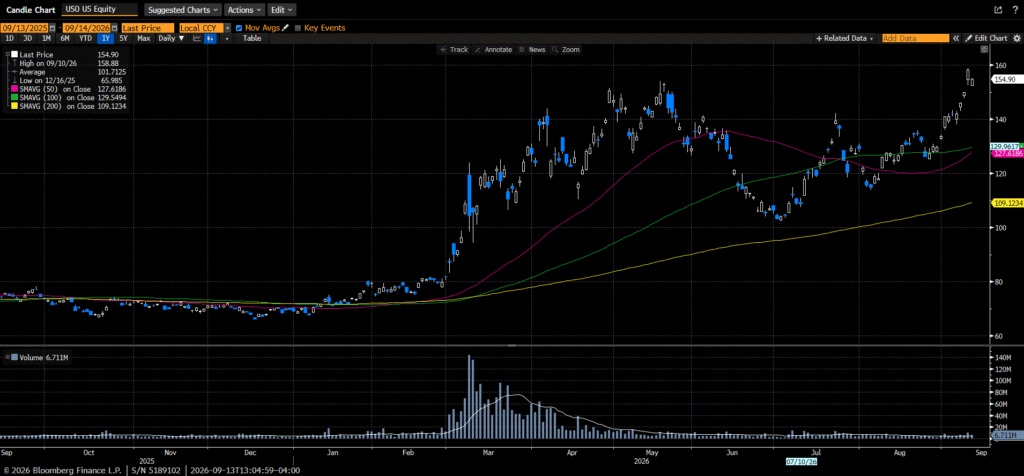
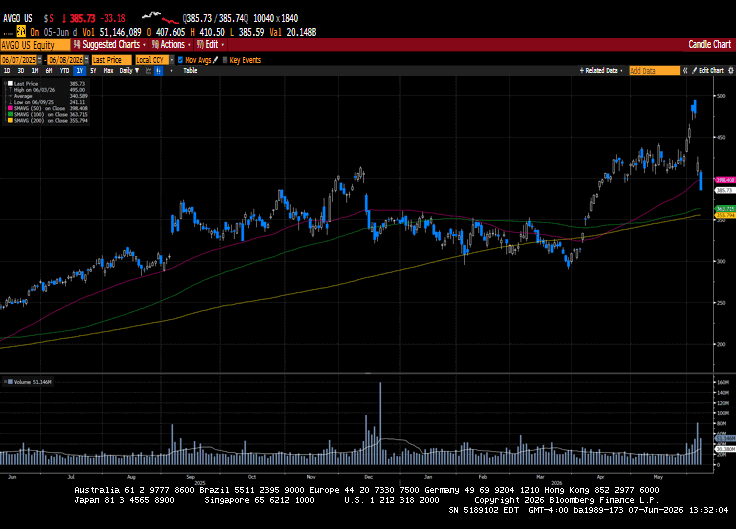
The S&P 500 was unable to make it a 10th straight week of gains as the market pulled back sharply late in the week amid a sense that the AI trade may have gone too far, too fast. Technology issues were absolutely hammered on Thursday and Friday after better-than-expected 1st quarter results from Broadcom, Ciena, and CrowdStrike were met with a massive sell-off. Broadcom’s outlook was stronger than forecast, but the company suggested that the Artificial Intelligence boom will be met with supply chain issues as we move into 2027 and 2028. The supply chain kinks could take various forms, including a lack of energy infrastructure to support high-performance computing and an insufficient supply of rare earth metals needed for manufacturing semiconductors and other technological components. The sharp sell may be followed by further weakness, but the consolidation of the move we have seen from the March lows actually seems healthy for a long-term bull market. We still need to contend with the Iran war, where there has been very little clarity on the progress toward extending the ceasefire and reopening the Strait of Hormuz. There was an uptick in rhetoric around the supply chain issues that will arise if the Strait remains closed for another month. Oil traded higher as tensions appear to be escalating rather than declining. Higher energy costs, coupled with a strong Employment Situation report, sent yields materially higher for the week and strengthened the argument for the Federal Reserve to hike interest rates later this year. It’s now widely expected that the European Central Bank will raise its monetary policy rate in June, while strong inflation data in Japan, along with a weakening Yen, prompted Bank of Japan officials to consider a rate hike at its next meeting.

The S&P 500 lost 2.6%, the Dow shed 0.3%, the NASDAQ declined by 4.7%, and the Russell 2000 gave back 2.9%. The CBOE’s gauge of equity volatility, the VIX, increased by 40% to 21.51. Yields were higher across the curve, but shorter-duration paper was hit harder than longer-dated paper, thus flattening the curve. The 2-year yield rose 16 basis points to 4.16%, while the 10-year yield rose 9 basis points to 4.54%. WTI crude increased by 3.16% or $3.15 to $90.57 per barrel. Gold prices fell by 4.9% to $4367.40 per ounce. Silver prices plunged 8.6% to $69.10 per ounce. Copper prices fell by $0.10 to $6.29 per Lb. Bitcoin’s price fell by 15.54% to $62, 200. The US Dollar index rose by 1.2% to 100.5. The Japanese Yen fell against the US Dollar to 160.16, a level that will likely prompt the BOJ to intervene again in the currency markets.

The economic calendar was skewed to labor market data. JOLTS showed an increase in job openings to 7.618m from 6.887m. ADP private payrolls increased to 122k versus the consensus estimate of 100k. Non-Farm Payrolls increased by 172k vs. the consensus estimate of 96k, while Private Payrolls increased by 120k vs. the estimated 89k. The Unemployment rate stayed at 4.3% as Average Hourly earnings ticked 0.3% higher. The Average Work Week stayed at 34.3 hours. Initial Jobless Claims increased by 13k to 225k, while Continuing Claims fell by 8k to 1777k. Strong labor data raised expectations for a rate hike. There is now a 79% chance of a rate hike in 2026 priced into the markets. ISM Manufacturing and Services were both better than expected at 54 and 54.5, respectively.

Investment advisory services offered through Foundations Investment Advisors, LLC (“FIA”), an SEC registered investment adviser. FIA’s Darren Leavitt authors this commentary which may include information and statistical data obtained from and/or prepared by third party sources that FIA deems reliable but in no way does FIA guarantee the accuracy or completeness. All such third party information and statistical data contained herein is subject to change without notice. Nothing herein constitutes legal, tax or investment advice or any recommendation that any security, portfolio of securities, or investment strategy is suitable for any specific person. Personal investment advice can only be rendered after the engagement of FIA for services, execution of required documentation, including receipt of required disclosures. All investments involve risk and past performance is no guarantee of future results. For registration information on FIA, please go to https://adviserinfo.sec.gov/ and search by our firm name or by our CRD #175083. Advisory services are only offered to clients or prospective clients where FIA and its representatives are properly licensed or exempted.