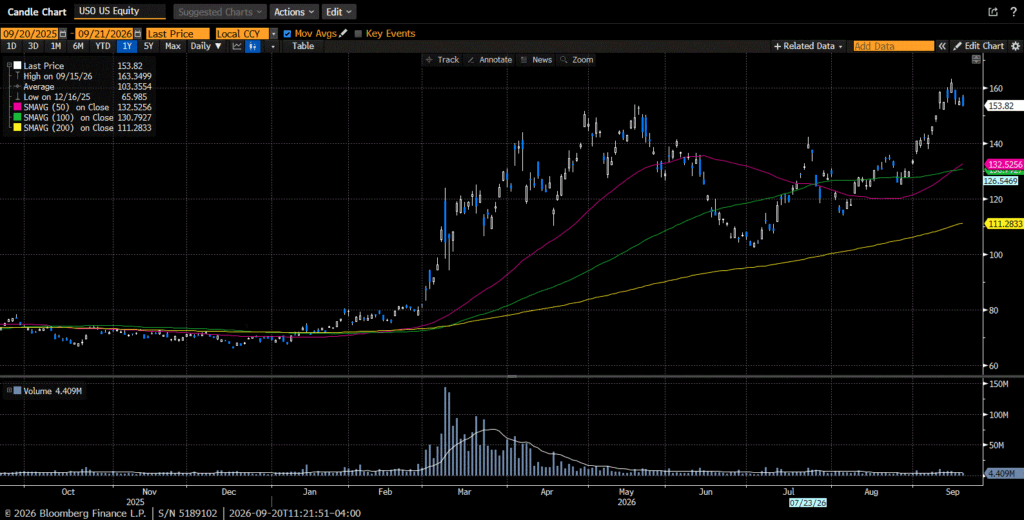

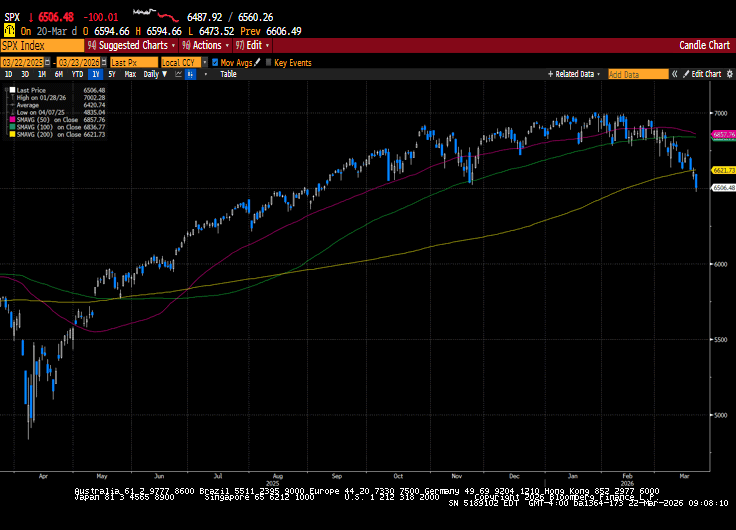
US markets fell for a third consecutive week as investors continued to assess the implications of the Iran conflict. Headlines related to Iran continued to dominate market attention. Energy markets traded higher as the military’s focus shifted to energy infrastructure. The move to hit one of Iran’s largest gas fields was met with Iran targeting Qatar’s largest liquefied natural gas export plants and taking 17% of production offline for an estimated minimum of three years. On Saturday, Trump posted that the US would destroy Iranian energy plants if the Strait of Hormuz was not open in 48 hours. The US has also sent more troops to Iran, with some suggesting that the US aims to take full control of Kharg Island, Iran’s largest energy export hub. Early last week, the US and Israel killed Iran’s Security Chief, Ali Larijani, considered to have been one of the most powerful and influential leaders. His death could complicate any negotiations for a ceasefire and now fractures the regime and may create a power vacuum. Increased energy costs have put central banks in a tough spot when it comes to monetary policy. Last week, the Fed, as expected, left its policy rate in place at 3.50%-3.75%. The Fed’s Summary of Economic Projections still has one rate cut forecast for 2026, but inflation expectations also ticked up. Traders have pushed out the probability of a rate cut to late 2026. Growth expectations have also taken a hit as higher oil prices may curtail demand for other products. The ECB and the Bank of England keep their policy rates in place as well, but both banks indicated they would act on policy if inflation were to tick higher. The Bank of Japan keeps its policy rate at 0.75%, while the Bank of Australia increased its policy rate by twenty-five basis points.

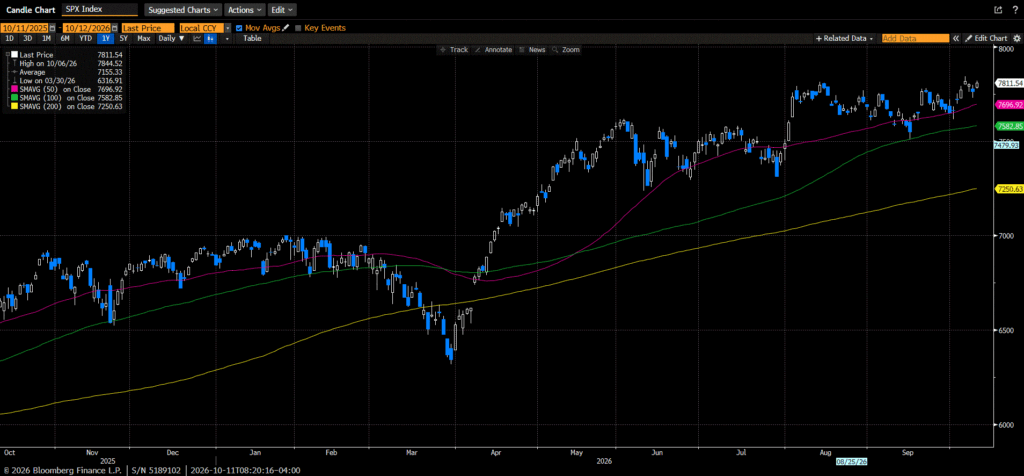
The S&P 500 declined by 1.9%, the Dow shed 2.1%, the Nasdaq fell by 2.1%, and the Russell 2000 gave back 1.7%. US Treasuries were hammered for the third straight week as inflation expectations increased and the notion of Fed rate cuts diminished. The 2-year yield increased by sixteen basis points to 3.89%, while the 10-year yield increased by ten basis points to 4.39%. West Texas Intermediate crude prices fell by $0.44 to $98.12 a barrel. Gold prices tumbled to $4,574.30 per ounce, down 9.6% on the week. Silver prices fell by 13.9% to $69.66 per ounce, while Copper prices fell by 6.7% to $5.37 per Lb. Bitcoin’s price was flat for the week. Notably, traditional safe-haven assets continued to show no ballast against the decline of risk assets.

The economic calendar was relatively quiet from the last couple of weeks, but it did give us a look at producer inflation. Headline PPI came in much hotter than expected at 0.7% versus an estimated 0.3%. The reading was up 3.4% year over year, up from 2.9% in January. The Core reading, which excludes food and energy, came in at 0.5% versus the consensus estimate of 0.4%. On a year-over-year basis, the measure was up 3.9% from 3.6% in January. Price increases were seen in both goods and services, giving the Fed more cover to delay rate cuts. Initial Claims declined by 8k to 205K, while continuing claims increased by 10k to 1857k. New Home sales fell to 587k from the prior reading of 712k.

Investment advisory services offered through Foundations Investment Advisors, LLC (“FIA”), an SEC registered investment adviser. FIA’s Darren Leavitt authors this commentary which may include information and statistical data obtained from and/or prepared by third party sources that FIA deems reliable but in no way does FIA guarantee the accuracy or completeness. All such third party information and statistical data contained herein is subject to change without notice. Nothing herein constitutes legal, tax or investment advice or any recommendation that any security, portfolio of securities, or investment strategy is suitable for any specific person. Personal investment advice can only be rendered after the engagement of FIA for services, execution of required documentation, including receipt of required disclosures. All investments involve risk and past performance is no guarantee of future results. For registration information on FIA, please go to https://adviserinfo.sec.gov/ and search by our firm name or by our CRD #175083. Advisory services are only offered to clients or prospective clients where FIA and its representatives are properly licensed or exempted.