
Weekly Market Commentary

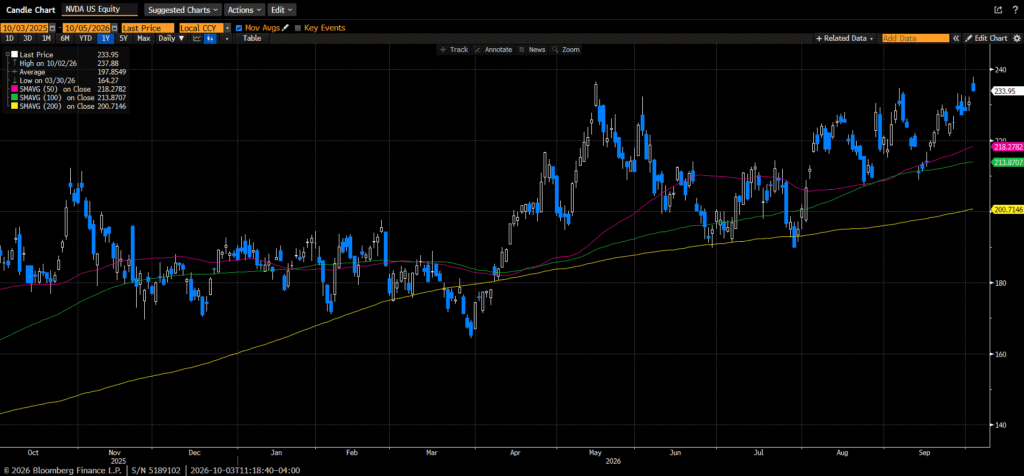
Investors were treated to a week of gains for US indices, while US Treasuries fell significantly across the curve. Early in the week, there was cautious optimism around debt ceiling negotiations as both sides agreed to the need for bipartisan talks. Mega-cap technology continued to lead the market, with Google, Nvidia, Microsoft, and Meta all making new 52-week highs. Newmont’s 19-billion-dollar takeover announcement of Newcrest and Oneok’s 18.8-billion-dollar acquisition of Magellan Midstream fostered positive sentiment. Similarly, the statement that the UK had approved Microsoft’s takeover of Activision aided the tone.

On the other hand, Fed rhetoric pushed back on the notion that the Fed was done with its rate hiking cycle. Dallas Fed President Logan suggested that recent data did not support a pause in June. Chairman Powell echoed his post-FOMC meeting remarks on Friday at a speech in Washington that reiterated the Fed’s mandate of 2% inflation and left the door open to more rate hikes. Investors also had to contend with the announcement on Friday that debt ceiling negotiations had ended without a resolution and the recognition that both sides were still nowhere near an agreement. President Biden amended his plans for the G7 meetings to return to Washington on Sunday, hoping to restart the negotiations on Monday.
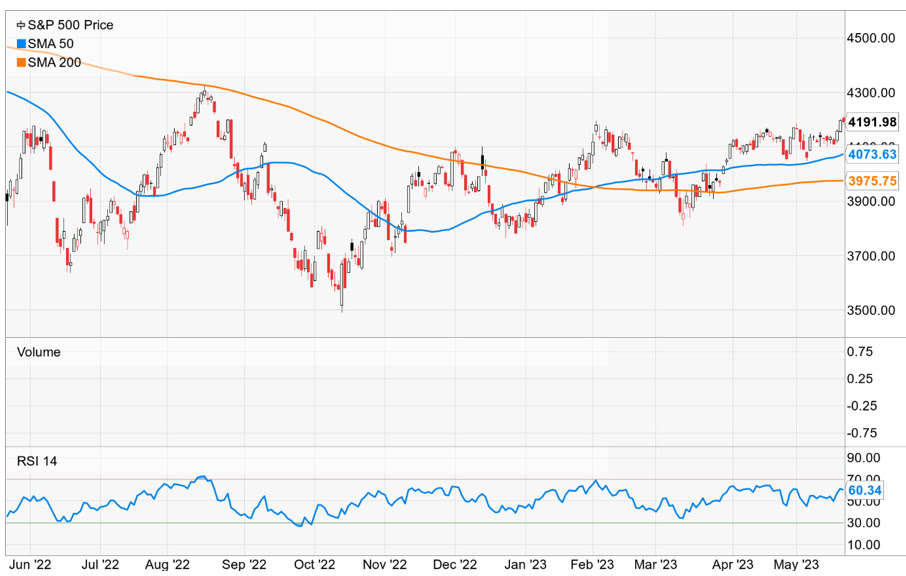
The S&P 500 gained 1.6%, the Dow added 0.4%, the NASDAQ climbed 3%, and the Russell 2000 jumped 1.9%. It was an ugly week for Treasuries as investors contemplated if the Federal Reserve was finished with hiking rates and a debt ceiling compromise could be forged. The 2-year yield increased by twenty-nine basis points to 4.27%, and the 10-year yield rose by twenty-three basis points to 3.69%. Interest-sensitive sectors- Utilities and Real Estate sold off with Treasuries.    Oil prices gained 2.2% or $1.60 to close at $71.76. Gold prices fell by $36.90 to $1981.80 an Oz.  Copper prices closed unchanged for the week at $3.73 a Lb. The US Dollar traded slightly higher on the week.

Investment advisory services offered through Foundations Investment Advisors, LLC (“FIA”), an SEC registered investment adviser. FIA’s Darren Leavitt authors this commentary which may include information and statistical data obtained from and/or prepared by third party sources that FIA deems reliable but in no way does FIA guarantee the accuracy or completeness.  All such third party information and statistical data contained herein is subject to change without notice.  Nothing herein constitutes legal, tax or investment advice or any recommendation that any security, portfolio of securities, or investment strategy is suitable for any specific person.  Personal investment advice can only be rendered after the engagement of FIA for services, execution of required documentation, including receipt of required disclosures.  All investments involve risk and past performance is no guarantee of future results. For registration information on FIA, please go to https://adviserinfo.sec.gov/ and search by our firm name or by our CRD #175083. Advisory services are only offered to clients or prospective clients where FIA and its representatives are properly licensed or exempted.
Share:

View the Latest Commentaries:

Weekly Market Commentary

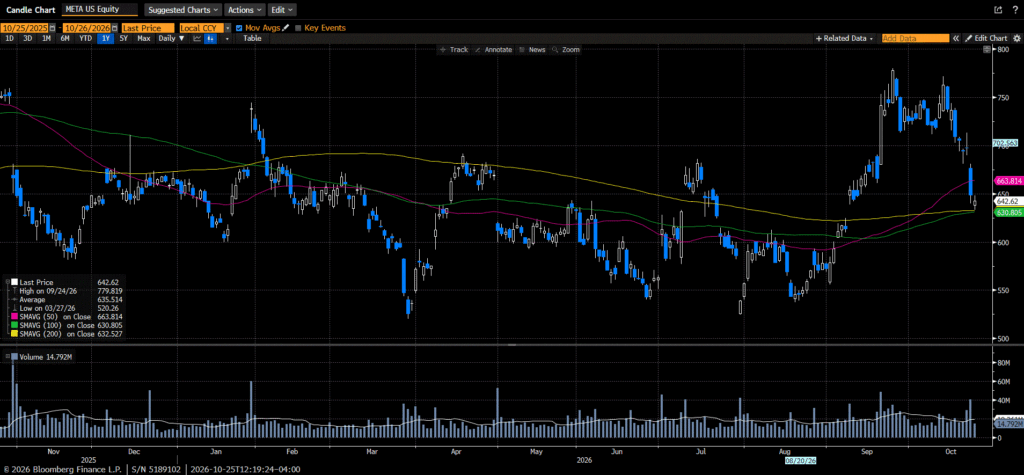
It was another volatile week on Wall Street, with US indices ending the week with mixed results.  Ongoing concerns about AI financing and its return on investment continued after Meta announced its 3rd-quarter results.  The company beat estimates and offered solid guidance.  However, its higher AI capital expenditures, lower margins, and negative free cash flow fueled a sell-off in AI infrastructure names.   Investors rotated into energy, staples, healthcare, and interest rate-sensitive sectors such as small-caps, real estate, and utilities.  According to FactSet, we are about a quarter of the way through 3rd-quarter earnings.  83% of the companies that reported have beaten earnings expectations, while 66% have beaten revenue expectations.  Earnings Per Share growth for the quarter is currently an impressive 29%.  Microsoft, Google, and Amazon are set to report earnings this week. Increased hostilities between the Houthis and Saudi Arabia, along with what appears to be an inevitable escalation in

Weekly Market Commentary

It was a chaotic week on Wall Street as investors tried to interpret mixed Q3 financial results, a spike in oil prices, sharp swings in yields across the curve, hotter-than-expected inflation data, dovish tones from central bankers, and renewed concerns about the AI infrastructure buildout, its use of credit, and the timing of when or if there will be a return on investment.  Q3 earnings started in earnest, with several large banks reporting.  JP Morgan, Morgan Stanley, Goldman Sachs, and Citi Bank reported solid results, while Bank of America and Wells Fargo reported disappointing results.  Equity trading drove bank outperformance this quarter, while fixed income results lagged.  Solid results from Taiwan Semiconductor were met with selling as the Semiconductor sector continued to come under pressure.  The Philadelphia Semiconductor index has declined eight consecutive days, a setup not seen since 2008.  Part of the losses were attributed to an advancement in

Weekly Market Commentary

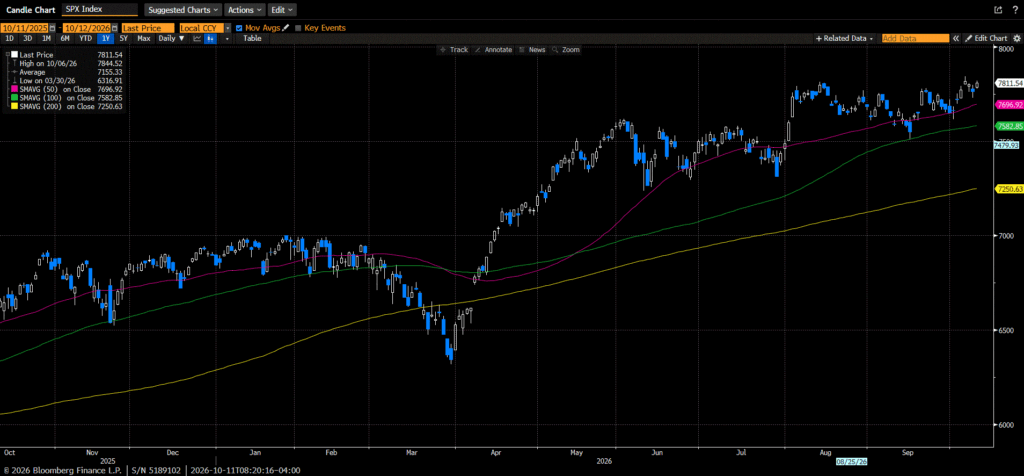
U.S. financial markets logged weekly gains as Wall Street shook off tech sector volatility and focused on stabilizing energy prices. Despite severe global bond market pressure, the S&P 500 rose 1.15% and hit an all-time high this week; the Dow Jones Industrial Average added 0.93%, and the Nasdaq Composite climbed 0.64%, hovering near all-time records.  The Russell 2000 fell by 0.9%.  Yields across the US yield curve fell after forging new highs for the year.  The 2-year note fell three basis points to 4.79%, while the 10-year yield fell four basis points to close at 5.24%.  Oil prices increased by just under 1% to close the week at $91.92 a barrel.  Gold prices rose 1.3%, or $53.60, to $4216.20 per ounce.  Silver prices increased 1% to $61.05 per ounce.  Copper rose fourteen cents to $6.69 per Lb.  Bitcoin’s price fell 2.35% to $82,800.  VIX, a volatility measure, fell 3% to

Weekly Market Commentary

As we move from the third quarter into the fourth, investors have a lot to consider in this crazy market.  US equities finished the week mixed in volatile trade.  A standstill in negotiations between the US and Iran pushed oil prices higher early in the week, but the realization that oil moving through the Strait of Hormuz is now at pre-war levels, along with news that the G7 would release 100 million gallons of oil and diesel from reserves, pushed oil prices lower.  This comes as the Pentagon is considering deploying 10,000 more troops and an additional aircraft carrier to the Gulf.  Elevated oil prices have kept inflation concerns front and center, but a cooler-than-expected PCE report, a weaker-than-anticipated Employment Situation report, and dovish remarks from Fed President Williams and Vice Chair Jefferson moved the probability of a rate hike in October from over 70% to less than 25%.  Interestingly,