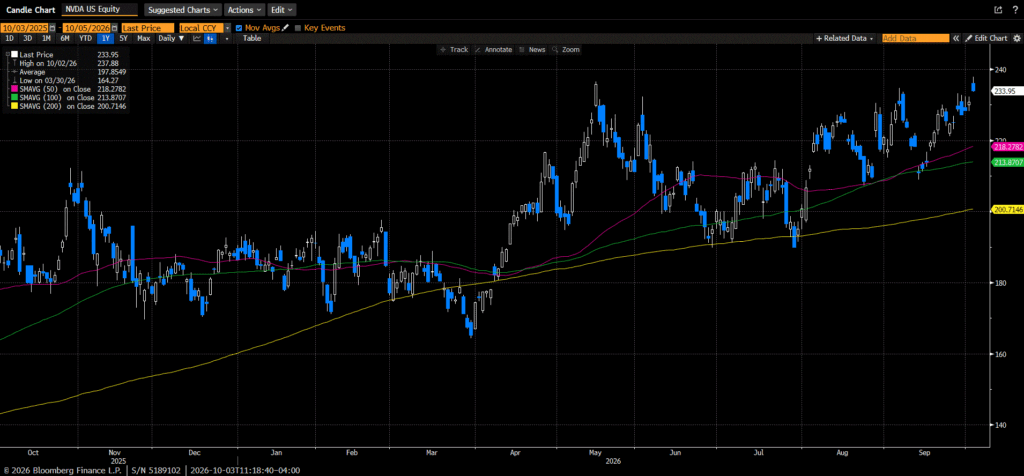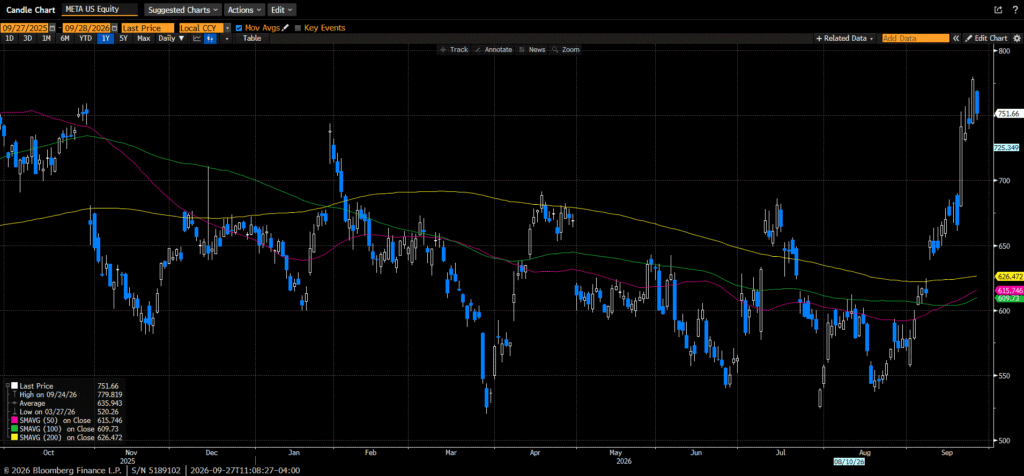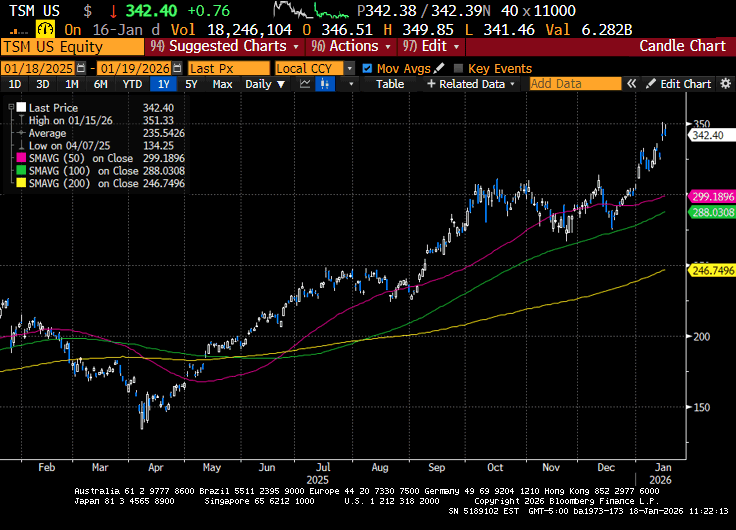
US financial markets ended the week with mixed results as investors assessed the first week of fourth-quarter earnings. Earnings results from the banks initially prompted selling, but this may have been due to President Trump’s call for a 10% cap on credit card interest rates, rather than the actual results. The Affordability narrative is top of mind to many leading into the midterm elections and caps on credit card interest rates, the move to make housing more affordable with banning institutional investors from buying single family homes along with purchases of $200 billion of mortgages dictated by Trump to Freddie Mac and Fannie Mae, and measures to lower energy cost to consumers all aim to please voters. Earnings from Morgan Stanley and Goldman Sachs later in the week induced buying. Taiwan Semiconductor also helped instill confidence in the AI trade, as its results, outlook, and increased cap-ex guidance were better than expected. That said, there has been clear evidence of rotation in markets from Information Technology and mega-caps to cyclical issues, mid-caps, and small-caps. Concern about the Federal Reserve’s independence was also top of mind for many on Wall Street as the Department of Justice launched a criminal investigation into the Federal Reserve and its Chairman, Jerome Powell, regarding the costs of the Federal Reserve’s building renovation. Powell, who has been the subject of President Trump’s criticism over his stance on monetary policy, responded to the investigation with disdain and cited political motives for the DOJ’s move. Several global central bank officials, corporate leaders, and lawmakers also pushed back against the idea of political interference as it relates to the Federal Reserve. President Trump is expected to nominate the next Fed Chairman any day. Kevin Hassett had been considered the most likely candidate until Friday, when Trump said he would like to keep him in his current position as director of the National Economic Council. Kevin Warsh is now seen as the most likely nominee in the prediction markets.

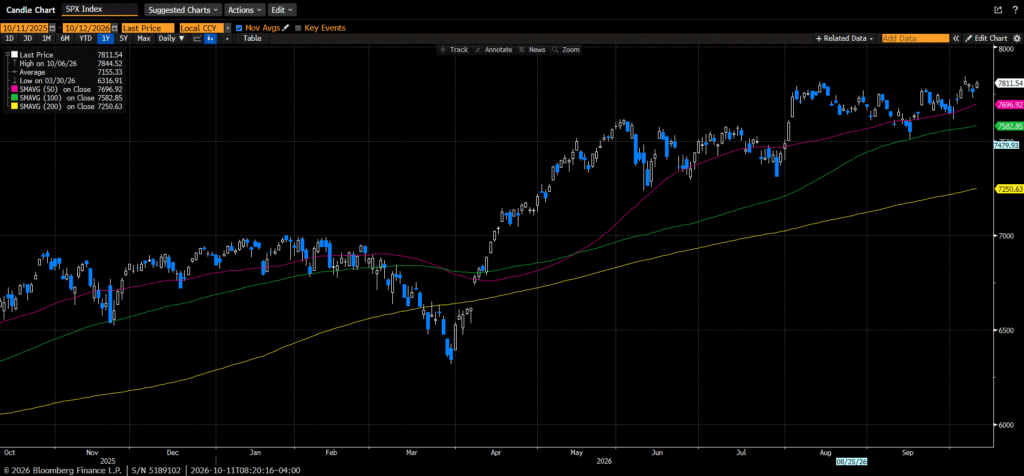
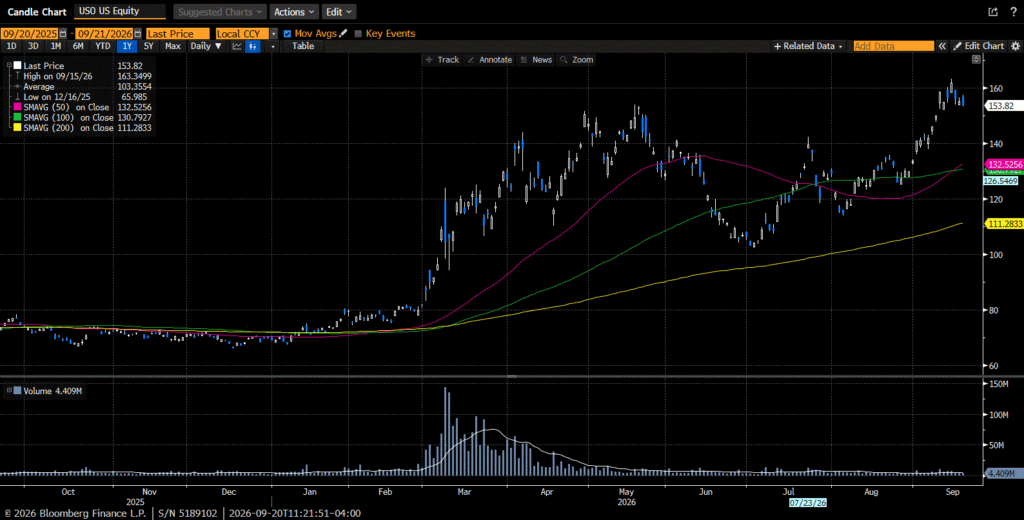
The S&P 500 lost 0.4%, the Dow shed 0.3%, the NASDAQ fell 0.7%, and the Russell 2000 bucked the trend with a gain of 2%. US Treasuries lost ground across the curve. The 2-year yield increased by six basis points to 3.60%, while the 10-year yield also increased by six basis points to 4.23%. Oil prices were up slightly on the week, with WTI closing up $0.24 to $59.34 a barrel. Gold’s price increased by 2% or $94.30 to $4,595.30 per ounce. Silver prices jumped 12.24% to close the week at $88.54 per ounce. Copper’s price fell by $0.07 to $5.83 per Lb. Bitcoin’s price increased by $4900 to $95,300. The US Dollar index increased by 0.2% to 99.38.

S&P 500 1/16/2026
The Consumer Price Index was the focus of this week’s economic calendar and came in as expected. Headline CPI increased by 0.3%, while the year over year figure increased by 2.7%. Core CPI, which excludes food and energy, increased by 0.2% versus an estimated 0.3%. On a year-on-year basis, the core reading increased by2.6%. The Producer Price Index (PPI) came in line with expectations on the headline number at 0.2%, while the core reading was flat, versus an expectation of a 0.2% increase. On a year-over-year basis, both headline and core increased by 3% above the prior readings of 2.8% and 2.9%, respectively. This week’s inflation data gives no reason for the Fed to cut interest rates in the near term. Retail Sales figures were solid, showing that the consumer remains resilient. The headline figure came in at 0.6% versus the consensus estimate of 0.4%. The Ex-Auto figure increased by 0.5% versus an estimated 0.3%. Weekly employment data showed Initial Claims fell by 9k to 198k, while Continuing Claims fell by 19k to 1884k. In the coming week, we will see the Fed’s preferred inflation measure, the PCE, Housing Starts and Permits, and the final January reading of the University of Michigan’s Consumer Sentiment Index.

Investment advisory services offered through Foundations Investment Advisors, LLC (“FIA”), an SEC registered investment adviser. FIA’s Darren Leavitt authors this commentary which may include information and statistical data obtained from and/or prepared by third party sources that FIA deems reliable but in no way does FIA guarantee the accuracy or completeness. All such third party information and statistical data contained herein is subject to change without notice. Nothing herein constitutes legal, tax or investment advice or any recommendation that any security, portfolio of securities, or investment strategy is suitable for any specific person. Personal investment advice can only be rendered after the engagement of FIA for services, execution of required documentation, including receipt of required disclosures. All investments involve risk and past performance is no guarantee of future results. For registration information on FIA, please go to https://adviserinfo.sec.gov/ and search by our firm name or by our CRD #175083. Advisory services are only offered to clients or prospective clients where FIA and its representatives are properly licensed or exempted.