Weekly Market Commentary

Market action was mixed in a holiday-shortened week of trade.  The Santa Clause rally, which runs for the last five trading sessions of the year through the first two trading sessions of the New Year, kicked off with gains from mega-cap technology.  Light trading volumes can exaggerate moves, and one should not take too much from a thinly traded market.  Tuesday’s abbreviated session and Thursday’s session ended flat, while Friday’s session saw a decent pullback in those same mega-cap technology issues.

The S&P 500 gained 0.7%, the Dow added 0.4%, the NASDAQ increased by 0.8%, and the Russell tacked on 0.1%.  US Treasuries sold off across the curve, with longer-tenured issues taking the brunt of the sell-off.  The 2-year yield increased by one basis point to 4.33%, while the 10-year yield increased by nine basis points to 4.62%.  Oil prices increased by 1.5% or $1.10 to close at $70.53 a barrel.  Gold prices fell by $11.20 to $2,633.20.  Copper prices inched higher by two cents to $4.13 per Lb.  Bitcoin traded lower by ~$2,800 to $94,400.  The US Dollar index advanced by 0.42 to close at 108.04.

The economic calendar was quiet. Consumer Confidence missed the mark, coming in at 104.7 versus the street’s estimate of 113.5. The report raised concerns about the outlook for business conditions and income. Initial Claims fell by 1k to 219k; however, Continuing Claims increased by 46k to 1.910M, a three-year high.  New Home sales in November came in at 664k versus the consensus estimate of 670k.

Investment advisory services offered through Foundations Investment Advisors, LLC (“FIA”), an SEC registered investment adviser. FIA’s Darren Leavitt authors this commentary which may include information and statistical data obtained from and/or prepared by third party sources that FIA deems reliable but in no way does FIA guarantee the accuracy or completeness.  All such third party information and statistical data contained herein is subject to change without notice.  Nothing herein constitutes legal, tax or investment advice or any recommendation that any security, portfolio of securities, or investment strategy is suitable for any specific person.  Personal investment advice can only be rendered after the engagement of FIA for services, execution of required documentation, including receipt of required disclosures.  All investments involve risk and past performance is no guarantee of future results. For registration information on FIA, please go to https://adviserinfo.sec.gov/ and search by our firm name or by our CRD #175083. Advisory services are only offered to clients or prospective clients where FIA and its representatives are properly licensed or exempted.
Share:

View the Latest Commentaries:

Weekly Market Commentary

WEEKLY MARKET REPORT · WEEK OF NOV 16–20, 2026 AI rout drives the S&P 500 down 8.6% into a correction and the Nasdaq down 10%; the VIX closes at 35.89 The week in brief The S&P 500 fell 8.61% for the week to 6,910.39, its worst weekly loss in more than 18 months, and closed Friday more than 10% below its Oct. 6 record high, a correction. The Nasdaq Composite lost 10.02% to 22,617.73 and is now down 2.7% for the year, the Dow fell 8.02% (4,200.22 points) to 48,147.33, and the Russell 2000 fell 7.48%. The S&P 500 closed lower every day and has now lost seven sessions in a row. Friday was the sharpest leg: the S&P 500 fell 3.70%, the Nasdaq 5.28%, the Dow 1.93% and the Russell 2000 2.76%. Technology fell 7.27% and Consumer Staples (+0.67%) was the only S&P 500 sector to rise. Nvidia fell

Weekly Market Commentary

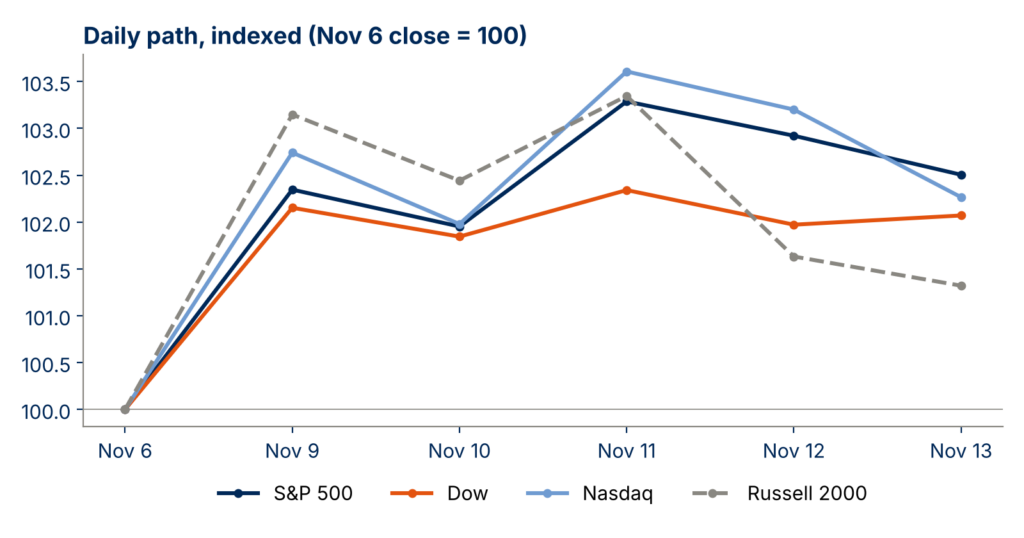
WEEKLY MARKET REPORT · WEEK OF NOV 9–13, 2026 Stocks rally 2.5% for the week as the VIX falls, yet Treasury yields surge and tech slips Friday The week in brief The S&P 500 gained 2.51% for the week to 7,561.67, snapping a four-week losing streak, while the Nasdaq Composite rose 2.27%, the Dow 2.07% (up 1,061.82 points) and the Russell 2000 1.32%. All eleven S&P 500 sectors finished higher, led by Energy (+5.42%), Industrials (+3.76%) and Communication Services (+3.72%). The week was front-loaded: Monday’s rally lifted the S&P 500 2.3% and the Dow 1,104 points, and the VIX dropped from 25.64 on Nov 6 to 19.92. By Friday, technology led the declines, with the Philadelphia Semiconductor Index down 3.4% and the Nasdaq-100 off 1.22%. The Dow was the only major index to rise on Friday. Two technology headlines also drew attention: Nvidia announced Jensen Huang’s resignation as CEO on

Weekly Market Commentary

AI-chip selloff erases Wednesday’s rally; stocks log a fourth straight weekly decline The week in brief U.S. stocks ended the week lower after a volatile stretch. The S&P 500 fell 2.68% to 7,376.86, the Nasdaq Composite fell 3.37% to 24,579.42, the Dow fell 0.94% to 51,285.73 and the Russell 2000 fell 2.05% to 2,754.11. The Dow jumped 1,569 points on Wednesday, then dropped more than 1,800 points on Thursday as the S&P 500 fell 4.36% and the Nasdaq fell 5.52%; the PHLX Semiconductor Index fell 12.25% that day. Friday brought a partial rebound in the Nasdaq (+1.09%) and S&P 500 (+0.31%), while the Dow slipped 0.46%. The VIX closed at 25.64, up about 32% on the week. October payrolls rose 165,000, well above the roughly 59,000–65,000 expected, and Brent crude settled at $98.32 after its steepest weekly drop since 2020, per press reports. Treasury yields The 2-year Treasury yield fell

Weekly Market Commentary

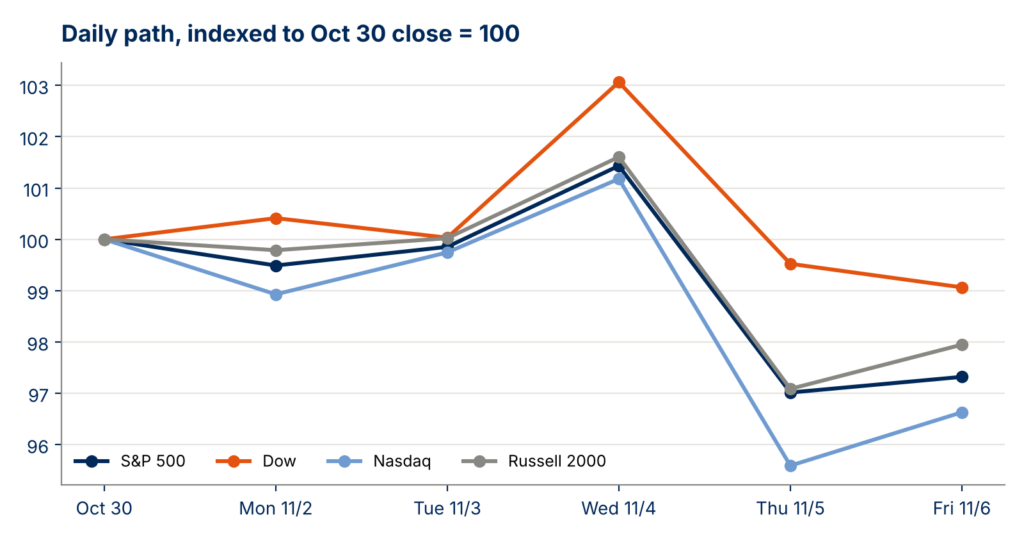
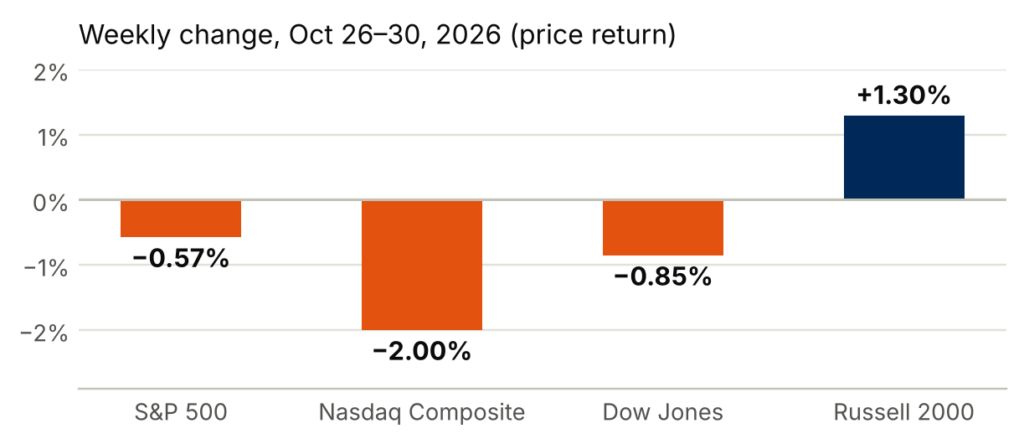
U.S. stocks climbed through Wednesday, then gave it all back. The S&P 500 slipped 0.6% and the Nasdaq fell 2.0%, each for a third straight weekly decline, and the Dow lost 0.9%. Small caps held up, with the Russell 2000 up 1.3%. The turn came after Alphabet and Amazon reported results that renewed doubts about the payoff from AI spending, and Intel’s warning sent its shares down nearly 29% on Friday. The Nasdaq fell 2.9% on Friday, its worst day since June 5. The Fed held, with two dissents for a hike. The policy rate stays at 3.75%–4.00% (10–2 vote). Traders price roughly a 76%–85% chance of a quarter-point hike on December 9. Big Tech spending drew a harsh verdict. Alphabet had its worst day in more than 20 years; Amazon’s trailing free cash flow turned to a record $42.4 billion outflow. Microsoft, helped by 48% Azure growth, held up.