WEEKLY MARKET REPORT · WEEK OF NOV 9–13, 2026
Stocks rally 2.5% for the week as the VIX falls, yet Treasury yields surge and tech slips Friday
The week in brief
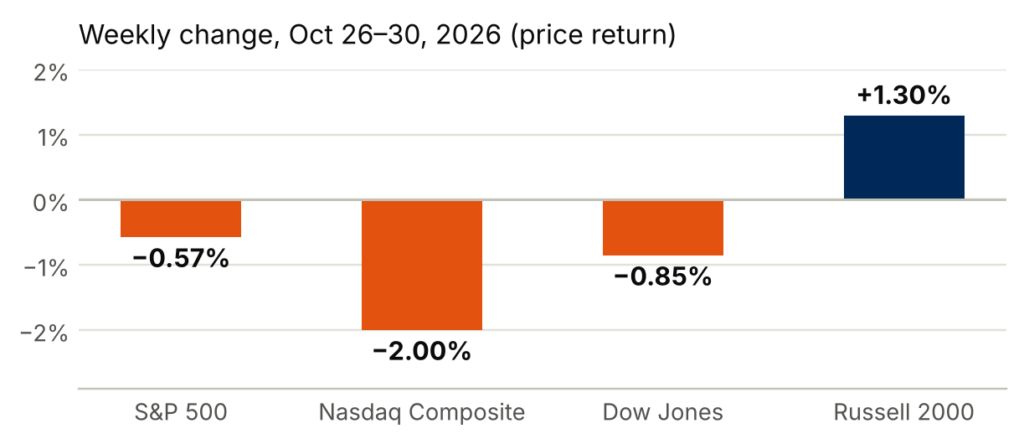
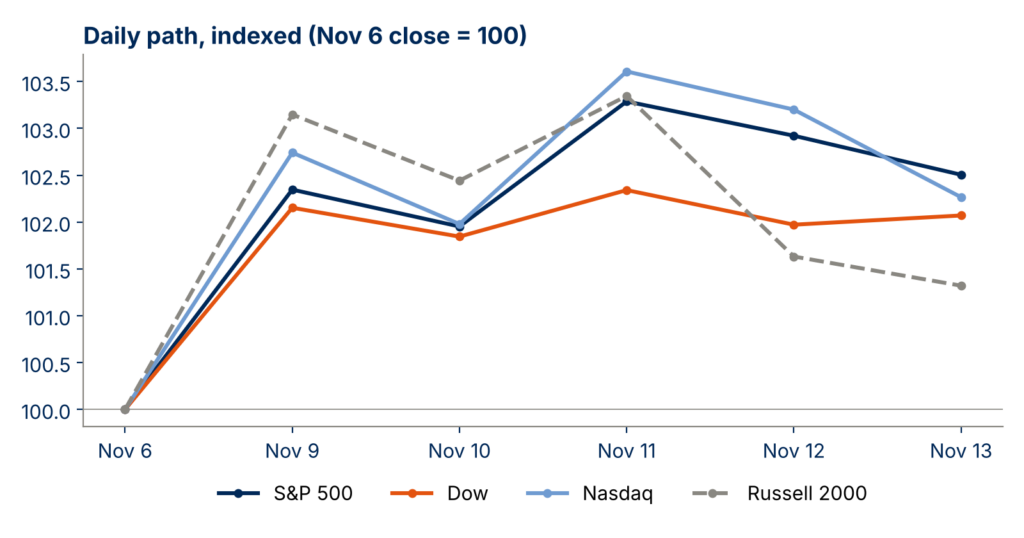
The S&P 500 gained 2.51% for the week to 7,561.67, snapping a four-week losing streak, while the Nasdaq Composite rose 2.27%, the Dow 2.07% (up 1,061.82 points) and the Russell 2000 1.32%. All eleven S&P 500 sectors finished higher, led by Energy (+5.42%), Industrials (+3.76%) and Communication Services (+3.72%).
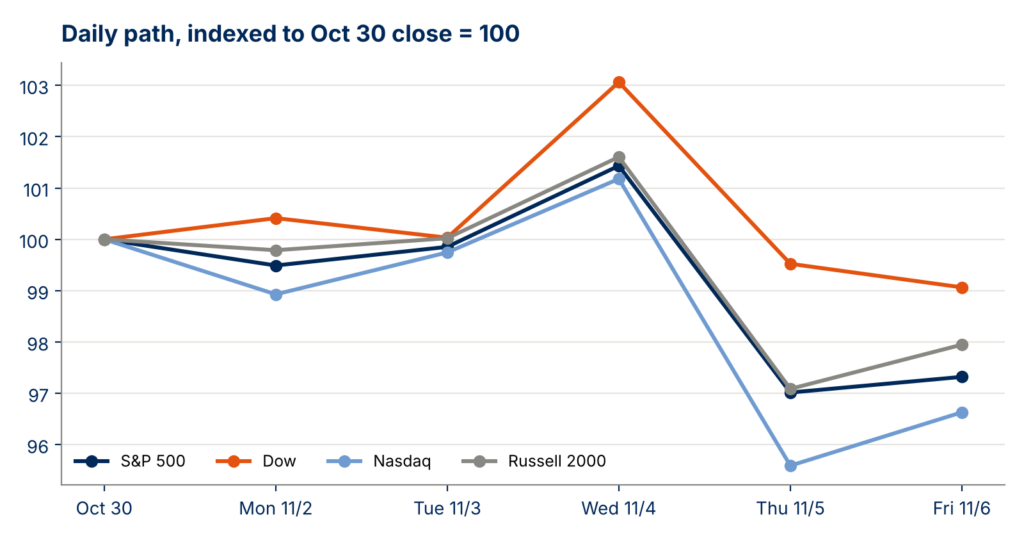
The week was front-loaded: Monday’s rally lifted the S&P 500 2.3% and the Dow 1,104 points, and the VIX dropped from 25.64 on Nov 6 to 19.92. By Friday, technology led the declines, with the Philadelphia Semiconductor Index down 3.4% and the Nasdaq-100 off 1.22%. The Dow was the only major index to rise on Friday. Two technology headlines also drew attention: Nvidia announced Jensen Huang’s resignation as CEO on Thursday, and a Microsoft 365 outage disrupted services worldwide from Thursday until Microsoft reported full restoration on Saturday.
Rates moved sharply. Treasury yields rose across the curve: the 2-year gained 36 basis points on the week to 4.89%, the 5-year 33 bp to 4.98%, the 10-year 29 bp to 5.15% and the 30-year 22 bp to 5.48%. October CPI (+0.4% m/m) and core CPI (+0.3%) both topped forecasts, and October PPI hit 6.5% year over year, the fastest since November 2022. Futures priced roughly an 88–92% chance of a 25 bp Fed hike on Dec. 8–9.
Gold fell 4.63% on the week to about $3,886, silver fell 5.18%, WTI fell 2.50% and Brent 2.52%, the dollar index climbed 1.1% to about 103.4, and Bitcoin slipped below $70,000, trading near $68,300. Next week’s focus: October retail sales and Nvidia earnings on Tuesday, Nov. 17, plus Fed speakers including Chair Kevin Warsh on Monday.
Index scorecard
Index Close Week YTD
S&P 500 7,561.67 +2.51% +10.5%
Dow 52,347.55 +2.07% +8.9%
Nasdaq 25,136.27 +2.27% +8.2%
Russell 2000 2,790.49 +1.32% +12.4%
2-yr 4.89% (+36 bp on the week), 5-yr 4.98% (+33), 10-yr 5.15% (+29), 30-yr 5.48% (+22). WTI ≈$88.56, Brent ≈$95.84, gold ≈$3,886, Bitcoin ≈$68,300. Weekly: gold -4.63%, silver -5.18%, WTI -2.50%, Brent -2.52%, dollar index +1.1%; Bitcoin ≈ -7% (approximate).
Key events
October CPI (released Nov. 10): +0.4% m/m vs. 0.3% expected; core +0.3% vs. 0.2% expected. No annual rate was reported for October because the BLS did not collect October 2025 prices during the government shutdown; the last annual reading (September) was 3.7%.
October PPI (Nov. 13): +0.3% m/m vs. +0.4% expected; +6.5% y/y, the largest annual rise since November 2022. Core PPI +0.3% m/m, in line.
NY Fed one-year inflation expectations: 3.91% vs. 3.79% forecast.
CoreWeave (CRWV) +24.71% on Wed.; Nebius (NBIS) -16.84% on Thu. (-9.92% Fri.).
Cisco (CSCO): revenue $18.5B (+24% y/y), EPS $1.40, FY27 revenue guidance raised to $74.8–75.8B; shares -6.24% Friday.
Applied Materials (AMAT): revenue $10.41B, EPS $4.16 vs. $4.05 expected, January-quarter sales guided to $11.1B; shares -2.74%.
Nvidia (NVDA): On Nov. 12 the company announced that Jensen Huang resigned as president, CEO and board member, effective immediately; the release gave no reason. CFO Colette Kress is interim CEO while remaining CFO, Harvey C. Jones was named the board’s first Board Chair, and the board is searching internally and externally for a permanent CEO. Shares fell 2.01% Friday, the stock’s sixth straight weekly decline. Nvidia still reports Tuesday, Nov. 17 after the close (consensus about $2.52/share).
Microsoft outage: Beginning around midday Thursday, Nov. 12 (U.S.), a Microsoft 365 outage hit Outlook, Teams, Copilot and Exchange Online worldwide; Downdetector logged reports from 74 countries and territories, and governments, courts, healthcare providers and businesses in several countries reported disruptions. Microsoft said it was “not related to cyber” activity and attributed it to a problem introduced during an earlier network capacity upgrade. Services were restored gradually, and Microsoft said on Saturday, Nov. 14 that they were fully restored.
Press reports on Friday said two oil tankers were hit by mines in the Strait of Hormuz; Saudi forces reportedly intercepted two Houthi drones. Kitco noted continued uncertainty around the Strait and U.S.-Iran tensions.
Week ahead
Sun, Nov 15: Japan Q3 GDP, first estimate (Reuters poll ≈ +0.1% q/q)
Mon, Nov 16: Empire State Manufacturing (prior 25.5); NY Fed’s John Williams 9:05 ET; Fed Chair Kevin Warsh 12:00 ET; earnings: Baidu, Tyson, Aramark
Mon, Nov 16: Weekly market call: 10:00 AM CST (9:00 AM Arizona)
Tue, Nov 17: October retail sales 8:30 ET; Nvidia earnings after close (≈$2.52 EPS est.)
Wed, Nov 18: Anthropic IPO expected to price ($70–$78/share range, per reports)
Thu, Nov 19: Anthropic expected to begin trading on Nasdaq as “ANT” (per reports)
Thu, Nov 19: President Trump, President Xi and President Putin are expected to hold a trilateral meeting
Investment advisory services offered through Foundations Investment Advisors, LLC (“FIA”), an SEC registered investment adviser. FIA’s Darren Leavitt authors this commentary which may include information and statistical data obtained from and/or prepared by third party sources that FIA deems reliable but in no way does FIA guarantee the accuracy or completeness. All such third-party information and statistical data contained herein is subject to change without notice. Nothing herein constitutes legal, tax or investment advice or any recommendation that any security, portfolio of securities, or investment strategy is suitable for any specific person. Personal investment advice can only be rendered after the engagement of FIA for services, execution of required documentation, including receipt of required disclosures. All investments involve risk and past performance is no guarantee of future results. For registration information on FIA, please go to https://adviserinfo.sec.gov/ and search by our firm name or by our CRD #175083. Advisory services are only offered to clients or prospective clients where FIA and its representatives are properly licensed or exempted.