Weekly Market Commentary

Markets pulled back this week as investors assessed hotter-than-anticipated inflation data. US Treasuries sold off across the curve as the higher-for-longer narrative strengthened ahead of the coming Federal Open Market Committee meeting.  Investors are not expecting a change to the policy rate on Wednesday.  However, they will be keenly focused on the new summary of economic projections that will show the Fed’s view of the future path of the monetary policy rate- also known as the dot plot.
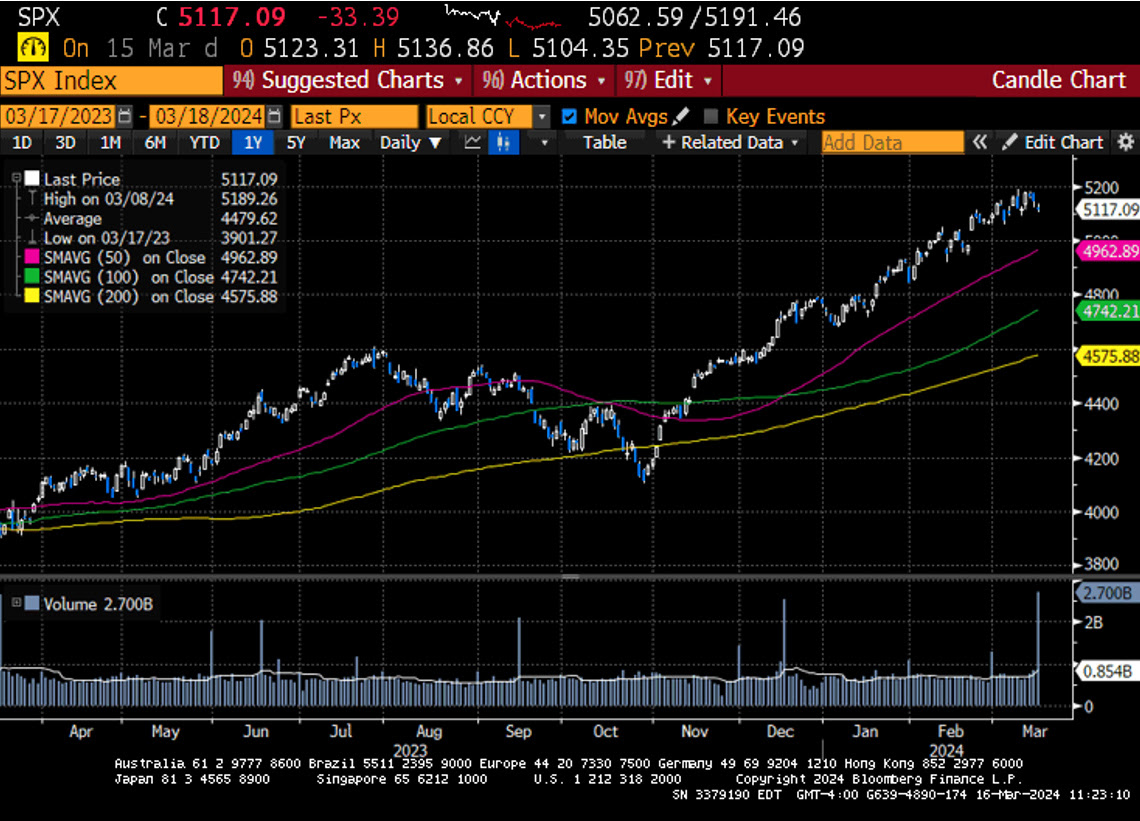
The S&P 500 fell by 0.1%, the Dow was unchanged, the NASDAQ declined by 0.7%, and the Russell 2000 lost 2.1%.  US Treasuries had a tough week.  The 2-year yield increased by twenty-three basis points to close at 4.72%, while the 10-year yield rose by twenty-one basis points to 4.30%.  Oil prices increased by $2.94 or 3.8% to $80.99 a barrel.  Gold prices declined by $25 to $2160.60 an Oz.  Copper prices jumped 5.9% as China’s top copper smelters agreed to production cuts.  Copper closed the week at $4.12 per Lb.  Bitcoin touched another all-time high before settling back to around $68k.  The US Dollar index gained 0.1% to 103.43.

The economic calendar was highlighted by the Consumer Price Index and the Producer Price Index.  Both readings came in hotter than expected.  Headline CPI increased by 0.4% versus the street expectation of a 0.3% increase.  On a year-over-year basis, the CPI increased by 3.2% in February versus a 3.1% gain in January.  The Core CPI, which excludes food and energy, rose by 0.4% versus an estimated 0.3% increase and was up 3.8% year-over-year, down from 3.9% in January.  Shelter costs continued to be sticky, gaining 0.4% in February.  Headline PPI came in at 0.6%, much higher than the anticipated 0.3% increase.  The year-over-year figure increased by 1.6% from January’s 0.9%.  The Core number was up 0.3%, slightly above the 0.2% consensus estimate, and came in at 2% year-over-year, unchanged from January.  Increased energy costs had a prominent influence on the headline number.  Goods inflation ticked higher at the producer level.  Retail sales got a nice bounce from January, rising 0.6%.  The Ex-Autos Retail sales figure came in at 0.3%.  The labor market continues to be tight as Initial Jobless claims fell by 1k to 209k.  Continuing Claims rose by 17k to 1.811m.  A preliminary look at the University of Michigan’s Consumer Sentiment index showed a decline of sentiment to 76.5 from 77.3 in February.

Investment advisory services offered through Foundations Investment Advisors, LLC (“FIA”), an SEC registered investment adviser. FIA’s Darren Leavitt authors this commentary which may include information and statistical data obtained from and/or prepared by third party sources that FIA deems reliable but in no way does FIA guarantee the accuracy or completeness.  All such third party information and statistical data contained herein is subject to change without notice.  Nothing herein constitutes legal, tax or investment advice or any recommendation that any security, portfolio of securities, or investment strategy is suitable for any specific person.  Personal investment advice can only be rendered after the engagement of FIA for services, execution of required documentation, including receipt of required disclosures.  All investments involve risk and past performance is no guarantee of future results. For registration information on FIA, please go to https://adviserinfo.sec.gov/ and search by our firm name or by our CRD #175083. Advisory services are only offered to clients or prospective clients where FIA and its representatives are properly licensed or exempted.
Share:

View the Latest Commentaries:

Weekly Market Commentary

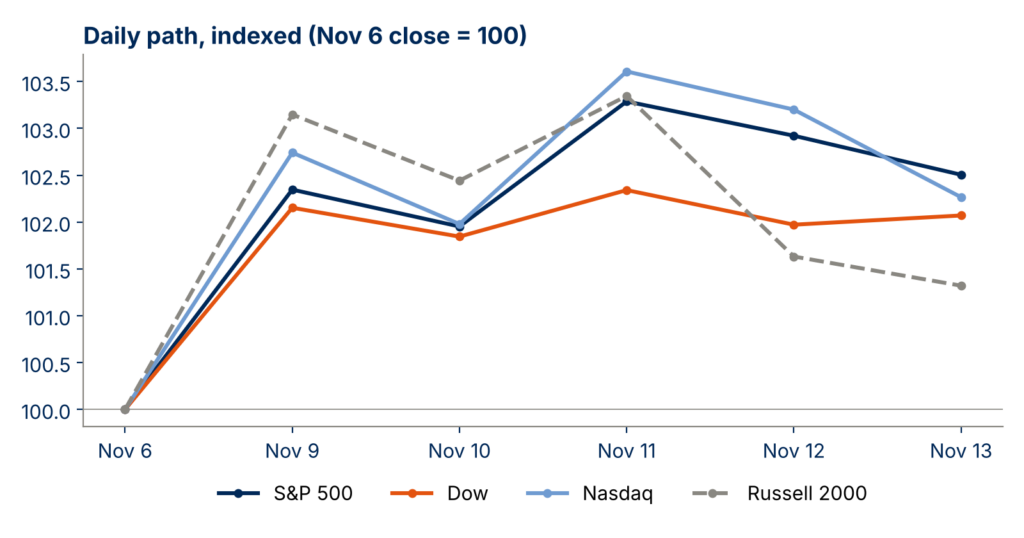
WEEKLY MARKET REPORT · WEEK OF NOV 9–13, 2026 Stocks rally 2.5% for the week as the VIX falls, yet Treasury yields surge and tech slips Friday The week in brief The S&P 500 gained 2.51% for the week to 7,561.67, snapping a four-week losing streak, while the Nasdaq Composite rose 2.27%, the Dow 2.07% (up 1,061.82 points) and the Russell 2000 1.32%. All eleven S&P 500 sectors finished higher, led by Energy (+5.42%), Industrials (+3.76%) and Communication Services (+3.72%). The week was front-loaded: Monday’s rally lifted the S&P 500 2.3% and the Dow 1,104 points, and the VIX dropped from 25.64 on Nov 6 to 19.92. By Friday, technology led the declines, with the Philadelphia Semiconductor Index down 3.4% and the Nasdaq-100 off 1.22%. The Dow was the only major index to rise on Friday. Two technology headlines also drew attention: Nvidia announced Jensen Huang’s resignation as CEO on

Weekly Market Commentary

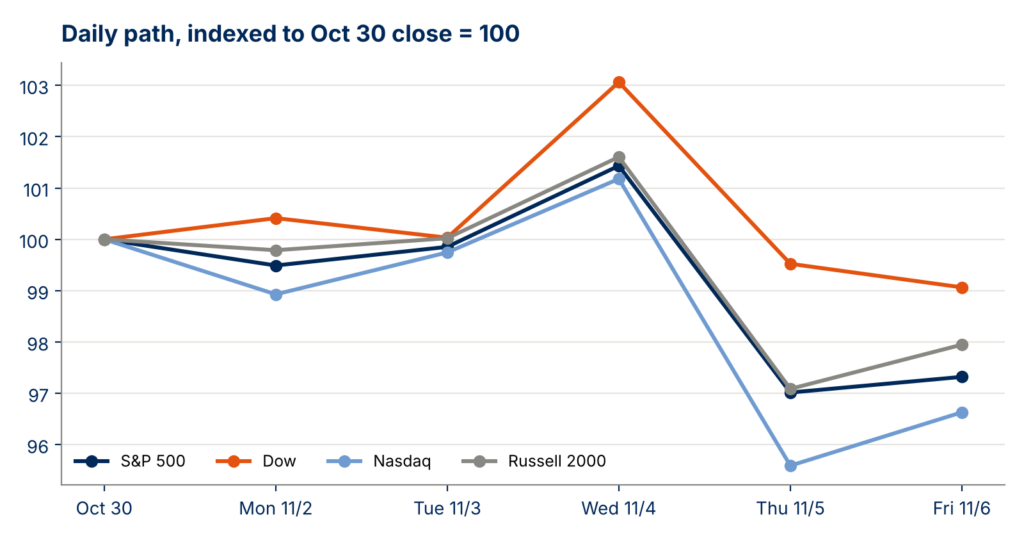
AI-chip selloff erases Wednesday’s rally; stocks log a fourth straight weekly decline The week in brief U.S. stocks ended the week lower after a volatile stretch. The S&P 500 fell 2.68% to 7,376.86, the Nasdaq Composite fell 3.37% to 24,579.42, the Dow fell 0.94% to 51,285.73 and the Russell 2000 fell 2.05% to 2,754.11. The Dow jumped 1,569 points on Wednesday, then dropped more than 1,800 points on Thursday as the S&P 500 fell 4.36% and the Nasdaq fell 5.52%; the PHLX Semiconductor Index fell 12.25% that day. Friday brought a partial rebound in the Nasdaq (+1.09%) and S&P 500 (+0.31%), while the Dow slipped 0.46%. The VIX closed at 25.64, up about 32% on the week. October payrolls rose 165,000, well above the roughly 59,000–65,000 expected, and Brent crude settled at $98.32 after its steepest weekly drop since 2020, per press reports. Treasury yields The 2-year Treasury yield fell

Weekly Market Commentary

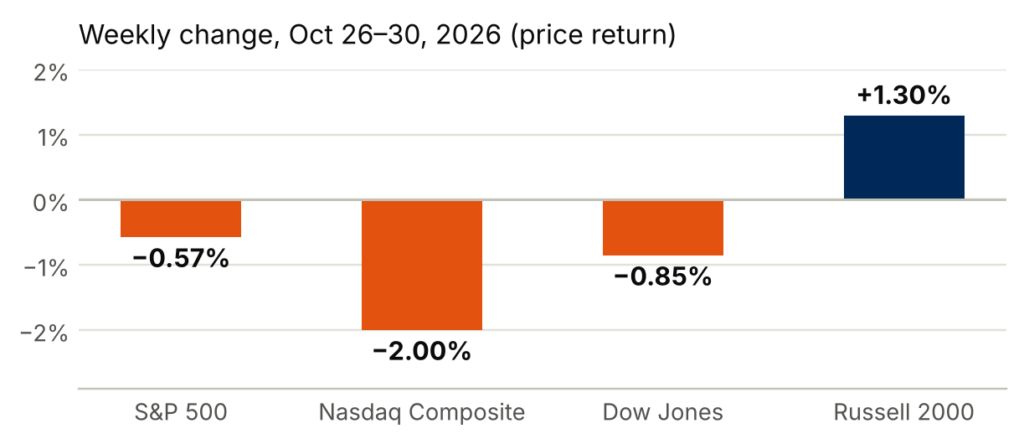
U.S. stocks climbed through Wednesday, then gave it all back. The S&P 500 slipped 0.6% and the Nasdaq fell 2.0%, each for a third straight weekly decline, and the Dow lost 0.9%. Small caps held up, with the Russell 2000 up 1.3%. The turn came after Alphabet and Amazon reported results that renewed doubts about the payoff from AI spending, and Intel’s warning sent its shares down nearly 29% on Friday. The Nasdaq fell 2.9% on Friday, its worst day since June 5. The Fed held, with two dissents for a hike. The policy rate stays at 3.75%–4.00% (10–2 vote). Traders price roughly a 76%–85% chance of a quarter-point hike on December 9. Big Tech spending drew a harsh verdict. Alphabet had its worst day in more than 20 years; Amazon’s trailing free cash flow turned to a record $42.4 billion outflow. Microsoft, helped by 48% Azure growth, held up.

Weekly Market Commentary

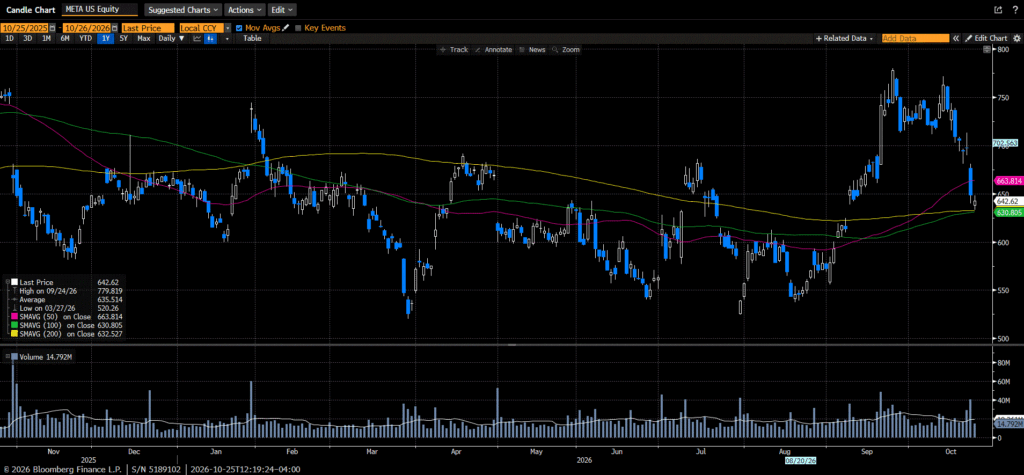
It was another volatile week on Wall Street, with US indices ending the week with mixed results.  Ongoing concerns about AI financing and its return on investment continued after Meta announced its 3rd-quarter results.  The company beat estimates and offered solid guidance.  However, its higher AI capital expenditures, lower margins, and negative free cash flow fueled a sell-off in AI infrastructure names.   Investors rotated into energy, staples, healthcare, and interest rate-sensitive sectors such as small-caps, real estate, and utilities.  According to FactSet, we are about a quarter of the way through 3rd-quarter earnings.  83% of the companies that reported have beaten earnings expectations, while 66% have beaten revenue expectations.  Earnings Per Share growth for the quarter is currently an impressive 29%.  Microsoft, Google, and Amazon are set to report earnings this week. Increased hostilities between the Houthis and Saudi Arabia, along with what appears to be an inevitable escalation in