




Financial markets were all over the place last week and ended with mixed results. The S&P 500 gained 0.8% and closed above 4400, a critical psychological level, but fell short of regaining the 50-day moving average of 4459. China’s economic woes continued to make headlines as investors were left unimpressed by the PBOC’s decision to cut their 1-year prime lending rate by just ten basis points to 3.45%. Global PMI data continued to show a contraction in manufacturing while European services fell into a contraction, and US services maintained a slight expansionary reading.
Mixed results from several retailers and stellar results from AI darling NVidia highlighted the tail end of Q2 earnings. Of note, NVidia traded higher for three days leading into earnings, gained nearly 10% after their earnings announcement, and then gave up some of those gains on Friday. This action could signify future weakness in the broader market that has relied on the performance of mega-cap technology issues for most of the year. Finally, the much anticipated Kansas City Fed Symposium at Jackson Hole yielded very little insight from Fed Chairman J Powell. The Chairman’s comments stuck very much to the script he has been going from since the last FOMC meeting. The Fed will continue to be data-dependent; inflation appears to be coming down but still at elevated levels above their 2% mandate, and no indication of future rate cuts.
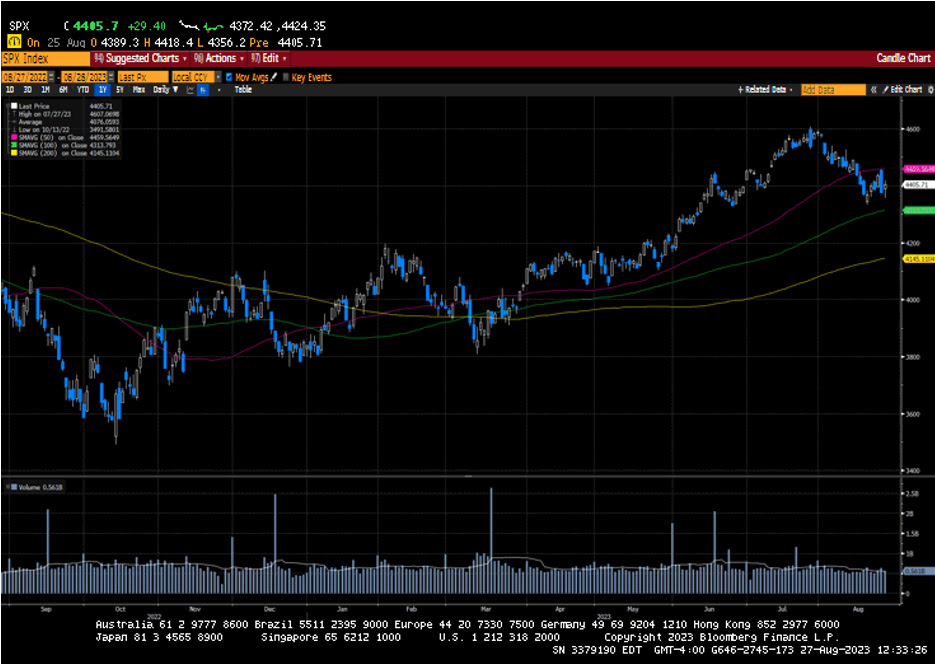
As I mentioned, the S&P 500 gained 0.8%, the Dow lost .04%, the NASDAQ rose 2.3%, and the Russell 2000 fell 0.3%. US Treasuries also traded in mixed fashion with longer-dated maturities, posting slight gains for the week while the front end of the curve took another beating. The 2-year yield rose by fourteen basis points to 5.05%, while the 10-year yield fell by one basis point to 4.24%. West Texas Intermediate crude fell $0.83 to $79.83 a barrel on a slower global economic narrative. Gold prices increased by $23.20 to close at 1939.90 an Oz. Copper prices increased by $0.06 to $3.76 a Lb.
The labor market continued to show resilience, with Initial Claims falling by 10k to 230k and Continuing Claims falling by 9k to 1.702 million. Durable Goods fell by 5%, well below the estimate of -4%. The Ex-auto reading showed a gain of 0.5% versus the forecast of 0.2%. Weekly Mortgage applications fell by -4.2%, down from last week’s reading of -0.8%. July New Home Sales topped expectations at 714k. US PMI data showed further contraction in manufacturing, with a reading of 47 from the prior reading of 49. Services remained expanding by a smaller margin, reaching 51 from 52.3. A reading above 50 indicates expansion, while a reading below 50 indicates contraction. The final results for August University of Michigan Consumer Sentiment came in at 69.5 versus the expected 71.5.
Investment advisory services offered through Foundations Investment Advisors, LLC (“FIA”), an SEC registered investment adviser. FIA’s Darren Leavitt authors this commentary which may include information and statistical data obtained from and/or prepared by third party sources that FIA deems reliable but in no way does FIA guarantee the accuracy or completeness. All such third party information and statistical data contained herein is subject to change without notice. Nothing herein constitutes legal, tax or investment advice or any recommendation that any security, portfolio of securities, or investment strategy is suitable for any specific person. Personal investment advice can only be rendered after the engagement of FIA for services, execution of required documentation, including receipt of required disclosures. All investments involve risk and past performance is no guarantee of future results. For registration information on FIA, please go to https://adviserinfo.sec.gov/ and search by our firm name or by our CRD #175083. Advisory services are only offered to clients or prospective clients where FIA and its representatives are properly licensed or exempted.