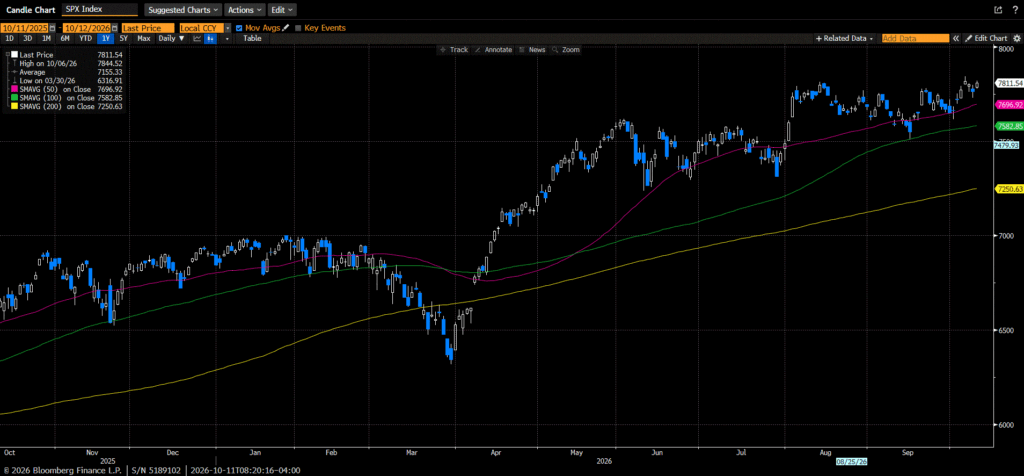


The S&P 500 closed above 4500 after inking its third consecutive weekly gain. Temperate economic data released over the last few months has elevated the idea of an economic soft landing and the idea that the Feds rate hike cycle is behind us. In Fact, Fed Funds Futures currently price 0% probability of another rate hike and have pushed up the timeline for a cut to May of 2024 from July. Fed Speak over the week was cautiously optimistic, with some officials concurring that rates have peaked while others pointed to inflation levels that are still well above the Feds mandate of 2%. The Government was able to avoid a shutdown with the passing of a stop-gap spending bill that will kick the final decision down the road.
President Biden and Chinese President Xi Jinping met in San Francisco at the APEC conference. Both leaders agreed to reengage military communications and to combat the trafficking of illegal drugs. Third Quarter earnings results highlighted several retailers. The results were mixed, with Target, Ross, and Macy’s announcing better-than-expected results, while Walmart and BJ Wholesale Foods showed disappointing results.

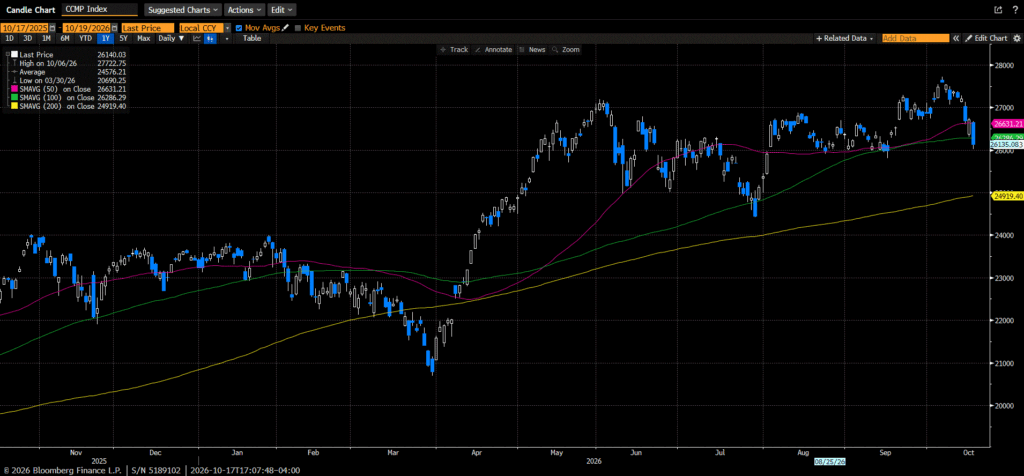
The S&P 500 advanced 2.2%, the Dow added 1.9%, the NASDAQ climbed 2.4%, and the Russell 2000 jumped 5.4%. The S&P 500 is up 9.6% over the last three weeks. A broadening out of the equity market returned this week. The market cap-weighted S&P 500 posted a 2.2% gain, while the equal weight index advanced 3.4%. The mega-cap growth ETF was up 2.1%.

US Treasuries advanced across the curve as the Core Aggregate Bond Index crossed into positive territory for the year. The 2-year yield fell by fifteen basis points to 4.90%, while the 10-year yield decreased by nineteen basis points to 4.44%.
Oil prices continued to be under pressure due to supply concerns in a softening global economy. Late in the week, there was speculation that OPEC may announce additional production cuts at their November meeting. WTI prices fell for the fourth straight week losing 1.6% to close at $76 a barrel. Gold prices increased by $45.40 to close at $1984.5 an Oz. Copper prices increased by $0.15 or 4% to $3.74 a Lb. The dollar index lost 1.8% on the week to close at 103.62 and is now flat for the year.

A weaker-than-expected Consumer Price Index report highlighted economic news. Headline CPI was flat in October and came in at 3.2% year-over-year, down from 3.7% in September. Core CPI came in at 0.2% versus the expectation of 0.3% and fell to 4% from 4.1% year-over-year. The results instantly put a bid into the equities and US Treasuries. Food prices were up 0.3%, and Shelter prices increased by 0.3%. Energy prices fell 2.5% over the month of October and were down 4.5% from the same time last year. The Producer Price Index also showed wholesale prices moderating. The headline number came in at -0.5% versus an expectation of 0.1%. Core PPI was flat versus the consensus estimate of 0.3%. Retail Sales fell less than expected at 0.1%, while the ex-auto figure was in line at 0.1%. Initial Claims ticked higher to 231k, while Continuing Claims increased by 32k to 1865k.
Investment advisory services offered through Foundations Investment Advisors, LLC (“FIA”), an SEC registered investment adviser. FIA’s Darren Leavitt authors this commentary which may include information and statistical data obtained from and/or prepared by third party sources that FIA deems reliable but in no way does FIA guarantee the accuracy or completeness. All such third party information and statistical data contained herein is subject to change without notice. Nothing herein constitutes legal, tax or investment advice or any recommendation that any security, portfolio of securities, or investment strategy is suitable for any specific person. Personal investment advice can only be rendered after the engagement of FIA for services, execution of required documentation, including receipt of required disclosures. All investments involve risk and past performance is no guarantee of future results. For registration information on FIA, please go to https://adviserinfo.sec.gov/ and search by our firm name or by our CRD #175083. Advisory services are only offered to clients or prospective clients where FIA and its representatives are properly licensed or exempted.