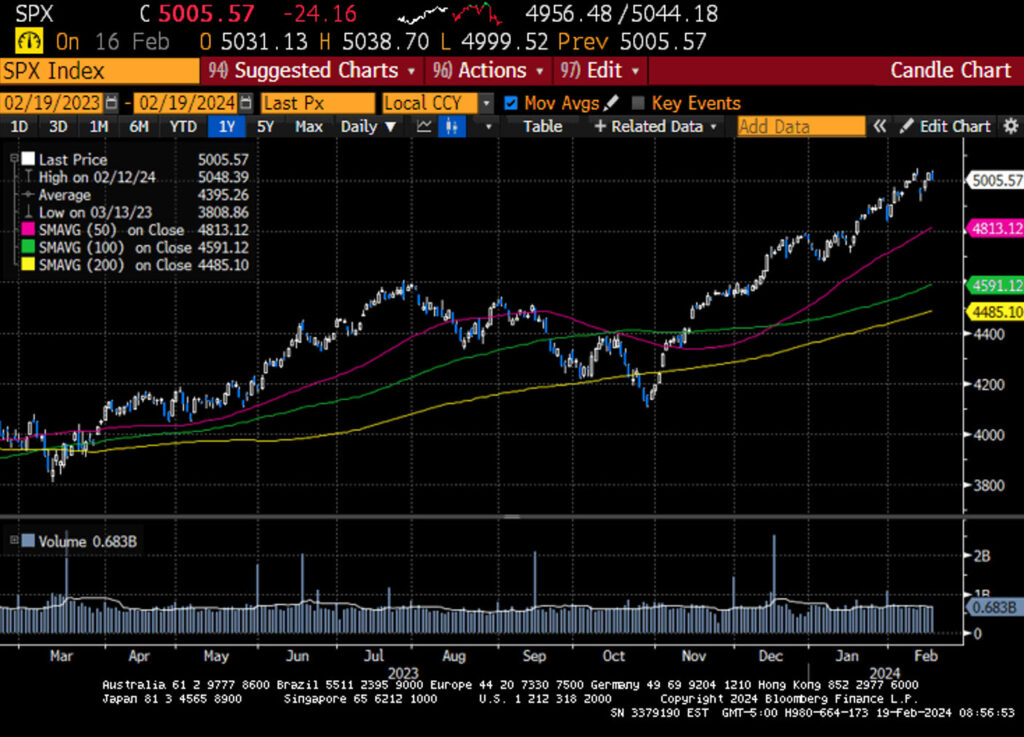
Wall Street took a breather last week as hotter-than-expected inflation data forced investors to recalibrate their expectations for rate cuts from the Federal Reserve. Mega-cap issues that have been responsible for most of the rally seen over the last year took a back seat as Microsoft and Amazon had notable declines. The market has been on a tear, and some, me included, think a pullback is warranted and could actually be healthy for the market. The fourth quarter earnings season has so far produced better-than-expected results. While some commentary from corporate leaders has been cautious, investment analysts are forecasting nearly 11% earnings growth for 2024. That said, valuations look stretched here, with the forward 12-month P/E ratio trading just over 20 times. According to Factset, the 5-year average forward 12-month P/E ratio is 19, while the 10-year average is 17.7.
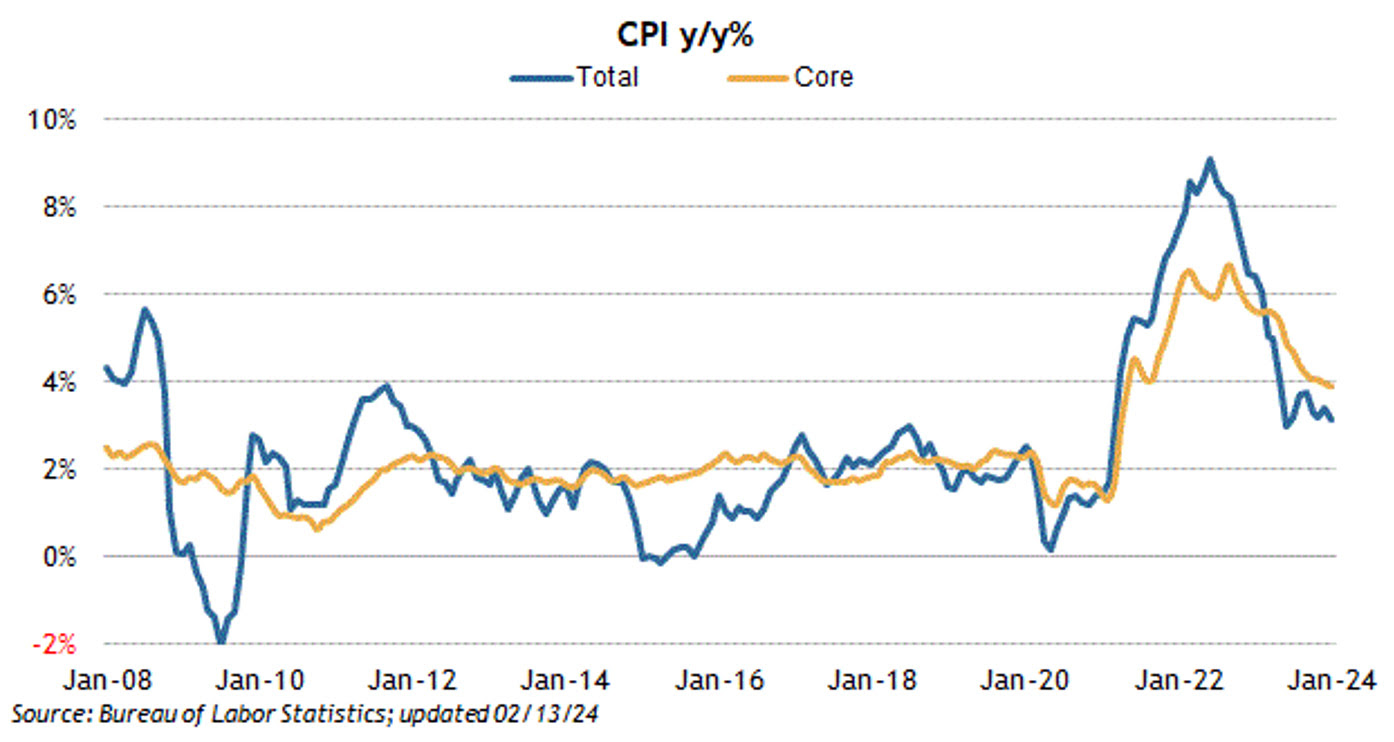
The Consumer Price Index and Producer Price Index highlighted the economic calendar with both coming in higher than expected. The CPI increased by 0.3% in January versus the expectation of 0.2%. On a year-over-year basis, the reading was up 3.1% relative to 3.4% in December. The core reading that excludes food and energy was up 0.4% in January versus the street estimate of 0.2 and was up 3.9% over last year, flat with the December reading. Headline PPI came in at 0.3%, above the forecast of 0.1%, while the core reading increased by 0.5%, well above the consensus estimate of 0.1%. On an annualized basis, the headline number was flat at 0.9%, while the core reading increased to 2% in January from 1.7% in December. Retail sales showed a tempered consumer. January sales were down 0.8% versus an estimate of -0.1%. Ex-autos sales were down 0.6% versus the street consensus of 0.2%. Initial claims fell by 8k to 212k, while Continuing Claims rose by 30k to 1.895M. Housing Starts and Building Permits were lower than expected coming in at 1.331M and 1.47M, respectively. The first look at the University of Michigan’s Consumer Sentiment index showed an increase of 79.6 from the prior reading of 79.3.
The S&P 500 declined by 0.4%, the Dow shed 0.1%, the NASDAQ lost 1.3%, and the Russell 2000 managed to gain 1.1%. US Treasury sold off across the curve, sending yields higher. The 2-year yield increased by fifteen basis points to 4.65%, while the 10-yield yield rose by eleven basis points to 4.30%. Interestingly, the probability of a rate cut in May has now fallen to 34.1%, and the likelihood of a rate cut by June sits at 75.4%.
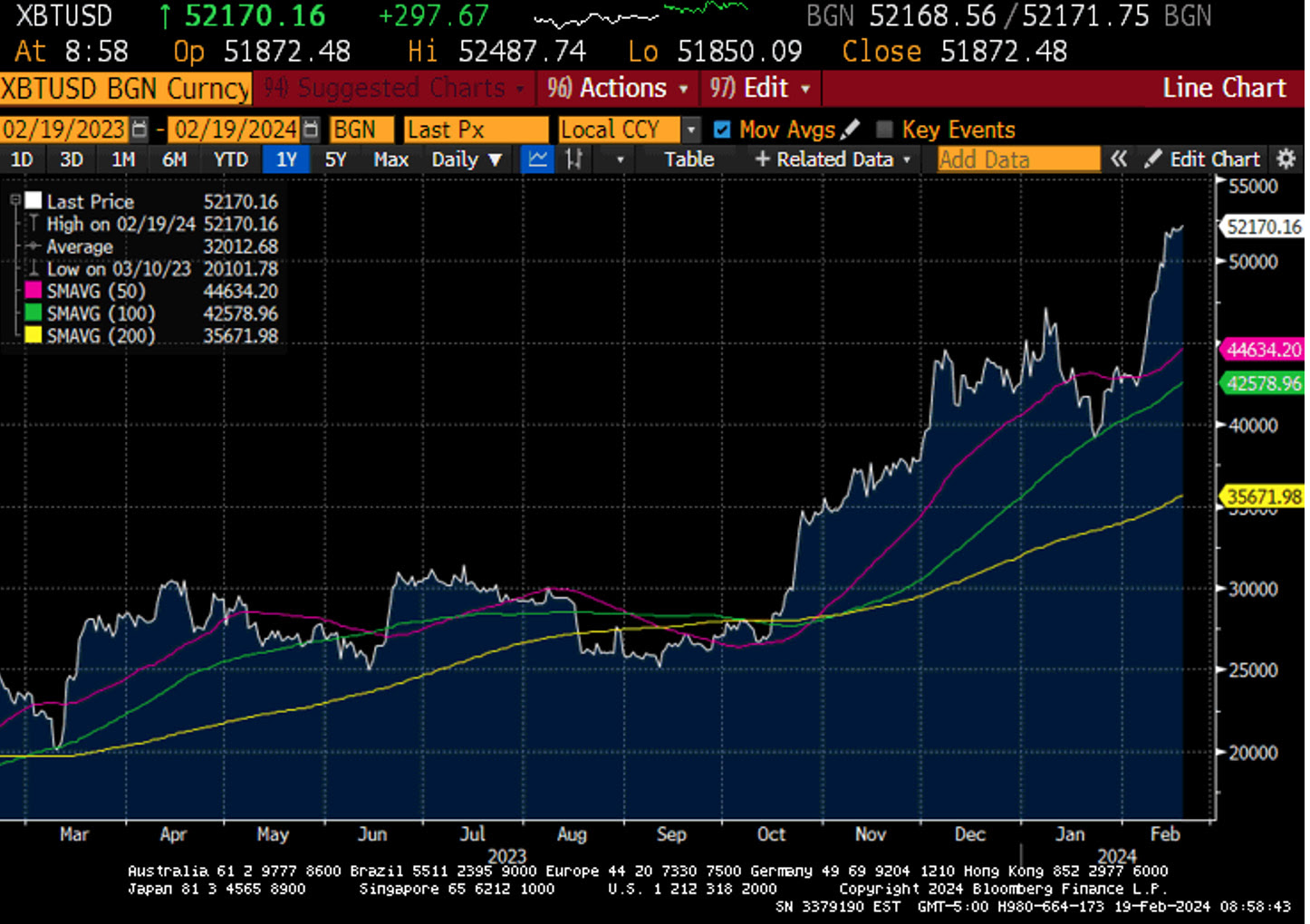
Oil prices increased by 2.1% or $1.62 with WTI closing at $78.44 a barrel. Gold prices fell by $14.20 to close at $2022.10 an Oz. Copper prices increased by 4% or $0.15 to $3.83 per Lb. The US Dollar index gained 0.2% to close at 104.28 with notable weakness in the Japanese Yen. Bitcoin traded north of $52k.
Investment advisory services offered through Foundations Investment Advisors, LLC (“FIA”), an SEC registered investment adviser. FIA’s Darren Leavitt authors this commentary which may include information and statistical data obtained from and/or prepared by third party sources that FIA deems reliable but in no way does FIA guarantee the accuracy or completeness. All such third party information and statistical data contained herein is subject to change without notice. Nothing herein constitutes legal, tax or investment advice or any recommendation that any security, portfolio of securities, or investment strategy is suitable for any specific person. Personal investment advice can only be rendered after the engagement of FIA for services, execution of required documentation, including receipt of required disclosures. All investments involve risk and past performance is no guarantee of future results. For registration information on FIA, please go to https://adviserinfo.sec.gov/ and search by our firm name or by our CRD #175083. Advisory services are only offered to clients or prospective clients where FIA and its representatives are properly licensed or exempted.