Weekly Market Commentary

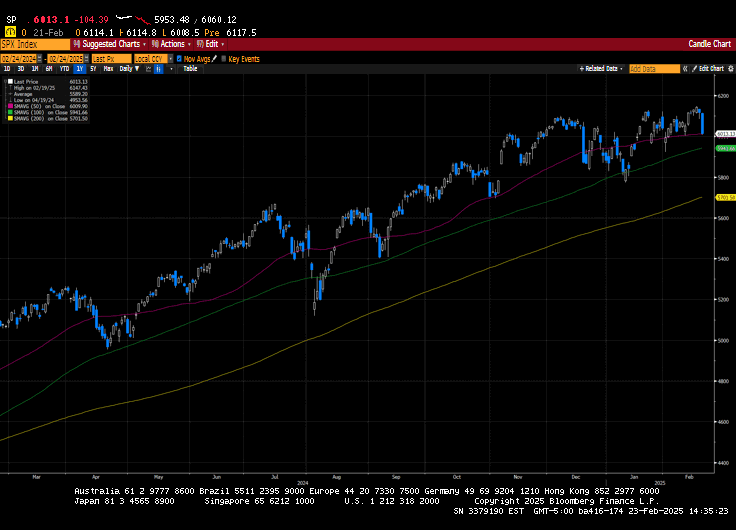
The holiday-shortened week saw the S&P 500 hit all-time highs, but late in the week, the move abruptly succumbed to consolidation pressure. Investors are worried about valuations, trade tensions, inflation, and declining consumer sentiment.

A call for European nations to spend more on defense hit European bond markets but catalyzed their equity markets—the German DAX has forged 17 new all-time highs this year while the Euro STOXX 50 continues to set new all-time highs as well. European markets were also likely bolstered by the beginning of negotiations that may end the war in Ukraine.  Fund flows have continued to pour into international developed and emerging markets.  China’s President Xi Jinping met with private sector leaders and endorsed several initiatives taken by several Chinese Technology companies, including Alibaba and Baidu.  The meeting signaled to global investors that the crackdown on the Chinese private sector could be ending. Alibaba’s recent rally continued on the back of the fastest revenue growth in over a year.  Japan’s market rallied on better-than-expected economic growth and fostered a further rally in the Japanese Yen.
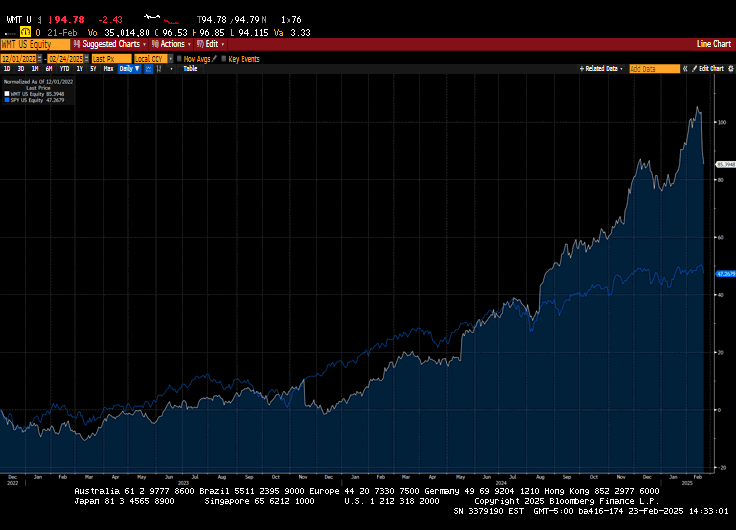
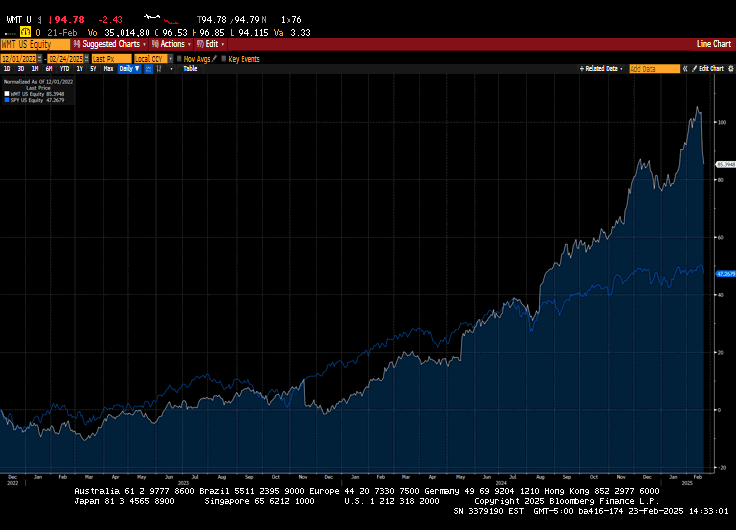
Fourth quarter earnings continued to roll in, with the quarter’s results showing EPS growth north of 14%.  That said, many management teams have taken the opportunity to dampen their guidance due to the uncertainties around tariffs and what they could mean for the cost of goods and, in turn, margins.  Over 8% of S&P 500 companies have lowered guidance, another factor weighing on US markets.  Walmart shares fell 6.5% in the aftermath of their disappointing earnings.  Worries over consumer spending behaviors, a weak global economic backdrop, and last week’s weak retail sales print moved investors to the sidelines. However, for context, Walmart’s share price had doubled since the beginning of December 2002, and shares were arguably due for some consolidation.  Super Micro Computer’s shares soared on better-than-expected earnings. Intel shares rallied on the idea of selling parts of the company and/or forming new partnerships with Taiwan Semiconductor and Qualcomm.  On Friday, United Healthcare shares were hammered on the news that the Department of Justice is investigating their Advantage Medicare billing practices.

The S&P 500 shed 1.7%, the Dow and NASDAQ fell by 2.5%, and the Russell 2000 lost 3.7%.  US Treasuries rallied across the curve as safe-haven assets were sought on the back of weaker economic data.  The 2-year yield fell by seven basis points to 4.19%, while the yield on the 10-year fell by five basis points to 4.42%.  Oil prices trended to the lowest levels seen this year.  WTI prices fell by $0.32 to close the week at $70.36 a barrel. Gold prices advanced for the seventh consecutive week, gaining $53.50 to close at $2953.40 an Oz.  Copper prices fell by twelve cents to $4.54 per Lb.  Bitcoin’s price fell by $2,500 to close at $94,900.  The US Dollar index fell by 0.1% to 106.59.
Economic data reported over the weak was generally weaker than expected and weighed on investor sentiment.  Housing starts fell by 9.8%, while building permits rose by 0.1%. Still, the data showed no growth in the single-family category and only stoked the idea of supply shortages in the market, which will likely lead to higher prices, making affordability less likely, especially in the current rate environment. February S&P Global Manufacturing PMI showed increased expansion with a print of 51.6 versus 51.2 in January.  However, the Services PMI showed contraction with a print of 49.7 versus the January print of 52.9.  The contraction in services is notable and definitely, something investors will be looking at in the coming months as a barometer of US economic health.  The final reading of the University of Michigan’s Consumer Sentiment index fell to 64.7, down from 67.8 in January and is down from 76.9 from a year ago.  All index cohorts cited concerns regarding price increases due to proposed tariffs.  Initial Claims increased by 5k to 219k, while Continuing Claims increased by 24k to 1.869M.
Investment advisory services offered through Foundations Investment Advisors, LLC (“FIA”), an SEC registered investment adviser. FIA’s Darren Leavitt authors this commentary which may include information and statistical data obtained from and/or prepared by third party sources that FIA deems reliable but in no way does FIA guarantee the accuracy or completeness.  All such third party information and statistical data contained herein is subject to change without notice.  Nothing herein constitutes legal, tax or investment advice or any recommendation that any security, portfolio of securities, or investment strategy is suitable for any specific person.  Personal investment advice can only be rendered after the engagement of FIA for services, execution of required documentation, including receipt of required disclosures.  All investments involve risk and past performance is no guarantee of future results. For registration information on FIA, please go to https://adviserinfo.sec.gov/ and search by our firm name or by our CRD #175083. Advisory services are only offered to clients or prospective clients where FIA and its representatives are properly licensed or exempted.

Share:

View the Latest Commentaries:

Weekly Market Commentary

WEEKLY MARKET REPORT · WEEK OF NOV 16–20, 2026 AI rout drives the S&P 500 down 8.6% into a correction and the Nasdaq down 10%; the VIX closes at 35.89 The week in brief The S&P 500 fell 8.61% for the week to 6,910.39, its worst weekly loss in more than 18 months, and closed Friday more than 10% below its Oct. 6 record high, a correction. The Nasdaq Composite lost 10.02% to 22,617.73 and is now down 2.7% for the year, the Dow fell 8.02% (4,200.22 points) to 48,147.33, and the Russell 2000 fell 7.48%. The S&P 500 closed lower every day and has now lost seven sessions in a row. Friday was the sharpest leg: the S&P 500 fell 3.70%, the Nasdaq 5.28%, the Dow 1.93% and the Russell 2000 2.76%. Technology fell 7.27% and Consumer Staples (+0.67%) was the only S&P 500 sector to rise. Nvidia fell

Weekly Market Commentary

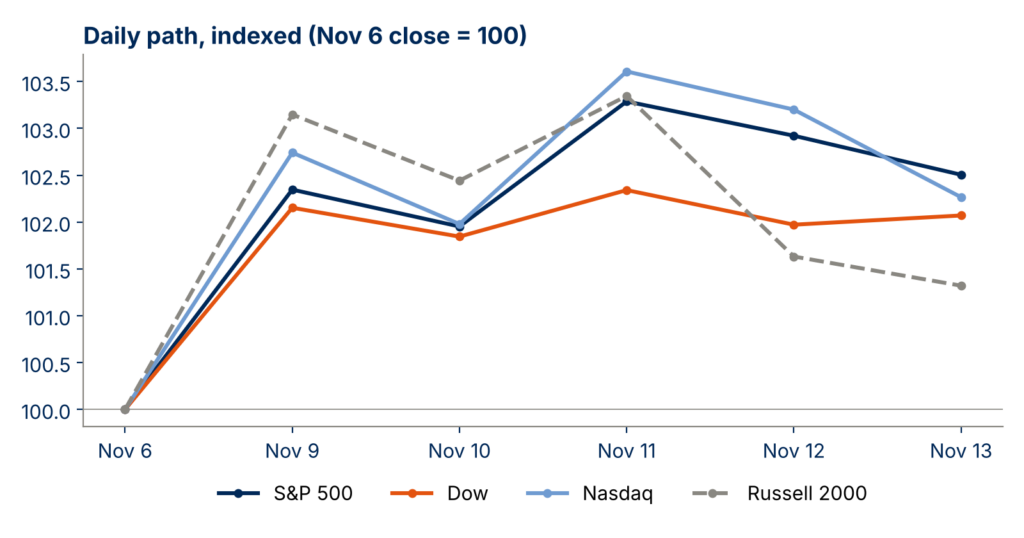
WEEKLY MARKET REPORT · WEEK OF NOV 9–13, 2026 Stocks rally 2.5% for the week as the VIX falls, yet Treasury yields surge and tech slips Friday The week in brief The S&P 500 gained 2.51% for the week to 7,561.67, snapping a four-week losing streak, while the Nasdaq Composite rose 2.27%, the Dow 2.07% (up 1,061.82 points) and the Russell 2000 1.32%. All eleven S&P 500 sectors finished higher, led by Energy (+5.42%), Industrials (+3.76%) and Communication Services (+3.72%). The week was front-loaded: Monday’s rally lifted the S&P 500 2.3% and the Dow 1,104 points, and the VIX dropped from 25.64 on Nov 6 to 19.92. By Friday, technology led the declines, with the Philadelphia Semiconductor Index down 3.4% and the Nasdaq-100 off 1.22%. The Dow was the only major index to rise on Friday. Two technology headlines also drew attention: Nvidia announced Jensen Huang’s resignation as CEO on

Weekly Market Commentary

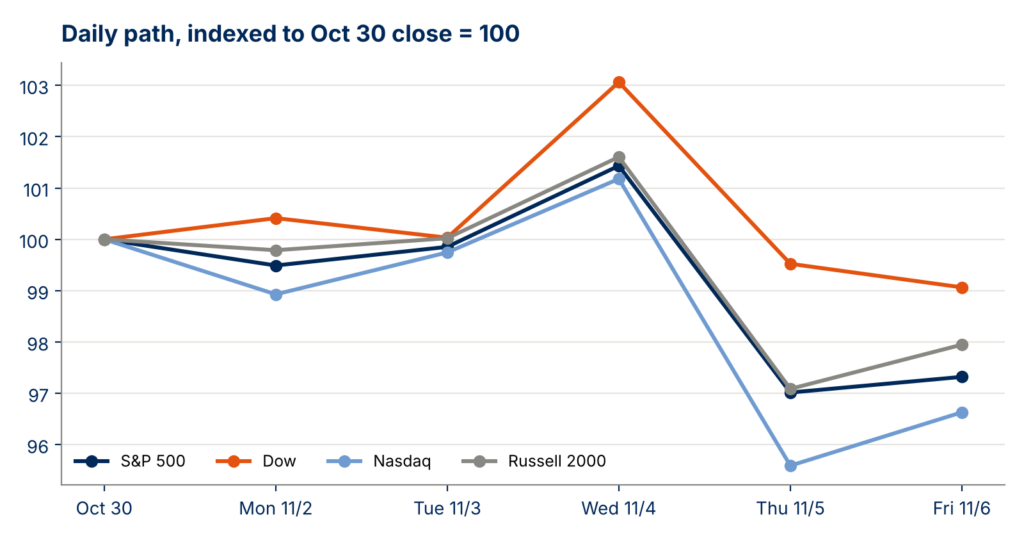
AI-chip selloff erases Wednesday’s rally; stocks log a fourth straight weekly decline The week in brief U.S. stocks ended the week lower after a volatile stretch. The S&P 500 fell 2.68% to 7,376.86, the Nasdaq Composite fell 3.37% to 24,579.42, the Dow fell 0.94% to 51,285.73 and the Russell 2000 fell 2.05% to 2,754.11. The Dow jumped 1,569 points on Wednesday, then dropped more than 1,800 points on Thursday as the S&P 500 fell 4.36% and the Nasdaq fell 5.52%; the PHLX Semiconductor Index fell 12.25% that day. Friday brought a partial rebound in the Nasdaq (+1.09%) and S&P 500 (+0.31%), while the Dow slipped 0.46%. The VIX closed at 25.64, up about 32% on the week. October payrolls rose 165,000, well above the roughly 59,000–65,000 expected, and Brent crude settled at $98.32 after its steepest weekly drop since 2020, per press reports. Treasury yields The 2-year Treasury yield fell

Weekly Market Commentary

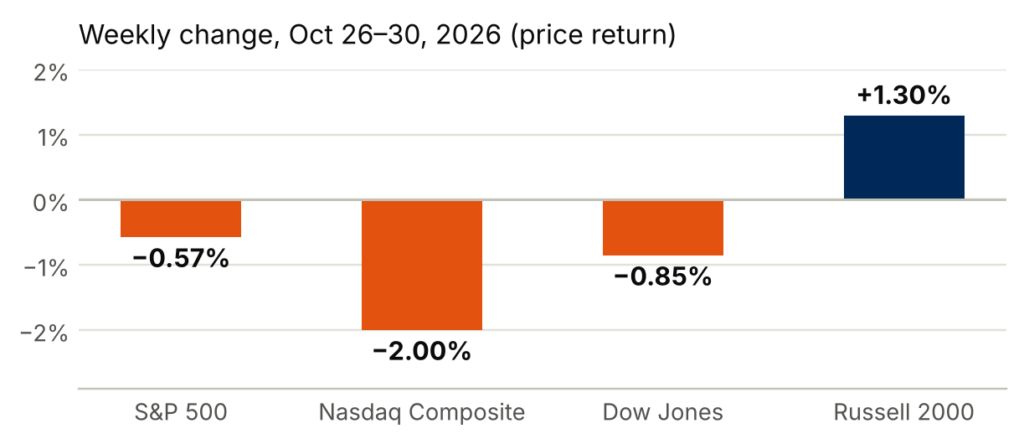
U.S. stocks climbed through Wednesday, then gave it all back. The S&P 500 slipped 0.6% and the Nasdaq fell 2.0%, each for a third straight weekly decline, and the Dow lost 0.9%. Small caps held up, with the Russell 2000 up 1.3%. The turn came after Alphabet and Amazon reported results that renewed doubts about the payoff from AI spending, and Intel’s warning sent its shares down nearly 29% on Friday. The Nasdaq fell 2.9% on Friday, its worst day since June 5. The Fed held, with two dissents for a hike. The policy rate stays at 3.75%–4.00% (10–2 vote). Traders price roughly a 76%–85% chance of a quarter-point hike on December 9. Big Tech spending drew a harsh verdict. Alphabet had its worst day in more than 20 years; Amazon’s trailing free cash flow turned to a record $42.4 billion outflow. Microsoft, helped by 48% Azure growth, held up.