US equity markets fell in the first full week of 2025 as investors recalibrated their Federal Reserve monetary policy expectations. Stronger labor data, a robust ISM Services print, and a weaker Consumer Sentiment report showing increased inflation expectations fueled losses across the US yield curve, where the 30-year yield eclipsed 5%. Swaps markets now have only one twenty-five basis point cut priced in for 2025. Trump’s suggestion that he would utilize an Economic Emergency declaration to impose tariffs stoked the inflation narrative. Trump also suggested strong sanction enforcement on Russian oil and those entities that ship the crude oil, which sent oil prices higher by 3%. The Fed’s December meeting minutes reinforced the idea that the Fed was in wait-and-see mode, with the next cut now expected to come in the second half of the year. The yield on the US 10-year has increased by over 100 basis points since the Federal Reserve started cutting rates in September, which is unusual in a rate-cutting cycle and has brought in concerns about where equity markets are headed.
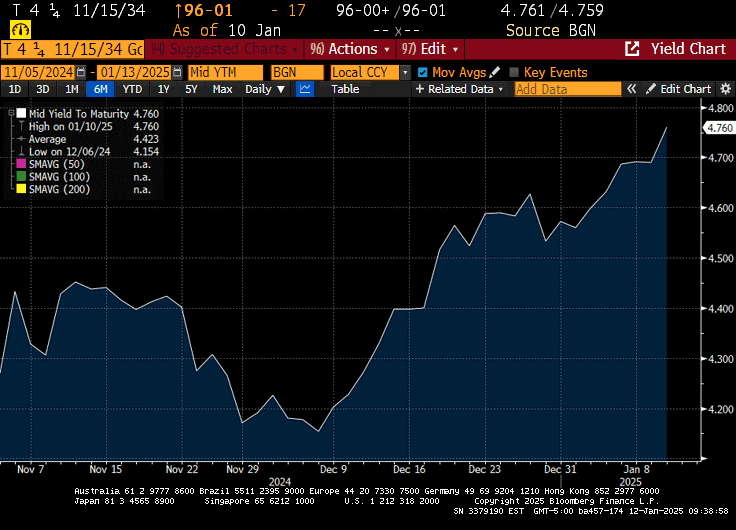
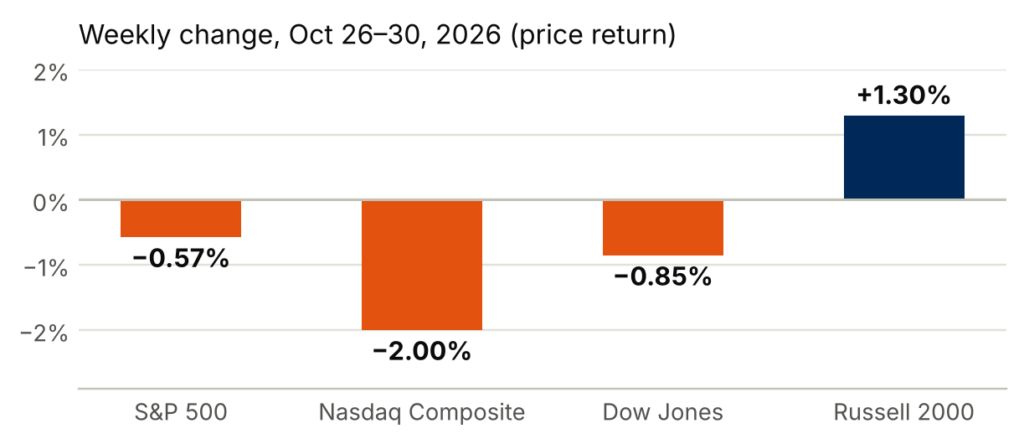
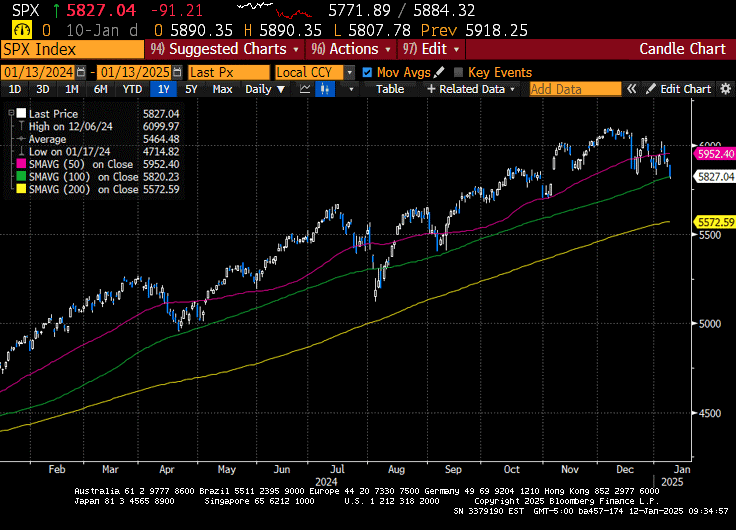
The S&P 500 and Dow fell by 1.9%, the NASDAQ lost 2.3%, and the Russell 2000 sank 3,5%. Notably, the S&P 500 could not hold above its 50-day moving average, which has now become a level of technical resistance. The yield on the 2-year climbed twelve basis points to 4.40%, while the 10-year yield increased by eighteen basis points to close at 4.78%. West Texas Intermediate Crude prices increased by $2.48, closing at $76.63 a barrel. Gold prices rose by 2.2% or $58.60 to $2713.70 an Oz. Copper prices increased by $0.23 to $4.30 per Lb. Bitcoin’s price fell by 3.54% to close at $94,287. The US dollar index gained 0.7% to close the week at 109.65.
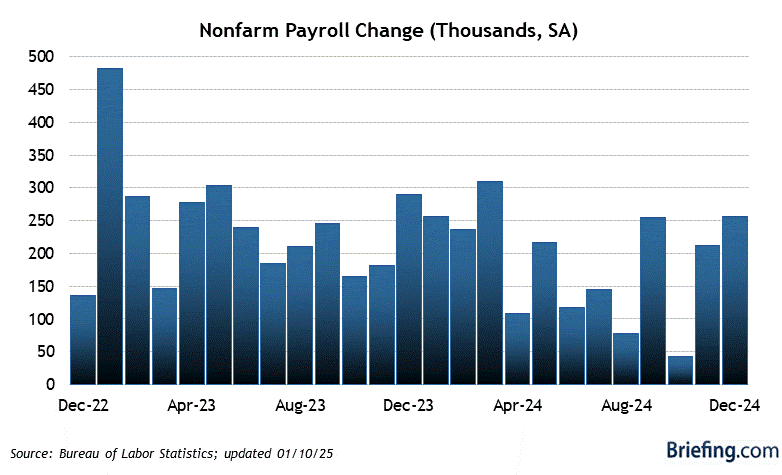
The Employment Situation report headlined the economic calendar. Non-farm payrolls increased by 256k, well above the consensus estimate of 154k. Private payrolls came in at 223k versus an estimated 140k. The unemployment rate fell from 4.1% to 4.2%. Average hourly earnings came in as expected at 0.3%, as did the Average work week at 34.3 hours. Earlier in the week, JOLTS data showed that job openings increased to 8.098m from the prior reading of 7.839m. ADP payrolls increased by 122k versus the consensus estimate of 134k. Initial Jobless Claims fell by 10k to 201k, while Continuing Claims increased by 23k to 1.867m. ISM Services showed the service sector expanding by 54.1%, up from the prior reading of 52.1%. The Prices Paid Index within the data increased to 64.4% from 58.2% and again catalyzed concerns on the inflation front. A preliminary look at the University of Michigan’s Consumer Sentiment fell from 74 in December to 73.2, attributed to increased inflation expectations.
Investment advisory services offered through Foundations Investment Advisors, LLC (“FIA”), an SEC registered investment adviser. FIA’s Darren Leavitt authors this commentary which may include information and statistical data obtained from and/or prepared by third party sources that FIA deems reliable but in no way does FIA guarantee the accuracy or completeness. All such third party information and statistical data contained herein is subject to change without notice. Nothing herein constitutes legal, tax or investment advice or any recommendation that any security, portfolio of securities, or investment strategy is suitable for any specific person. Personal investment advice can only be rendered after the engagement of FIA for services, execution of required documentation, including receipt of required disclosures. All investments involve risk and past performance is no guarantee of future results. For registration information on FIA, please go to https://adviserinfo.sec.gov/ and search by our firm name or by our CRD #175083. Advisory services are only offered to clients or prospective clients where FIA and its representatives are properly licensed or exempted.