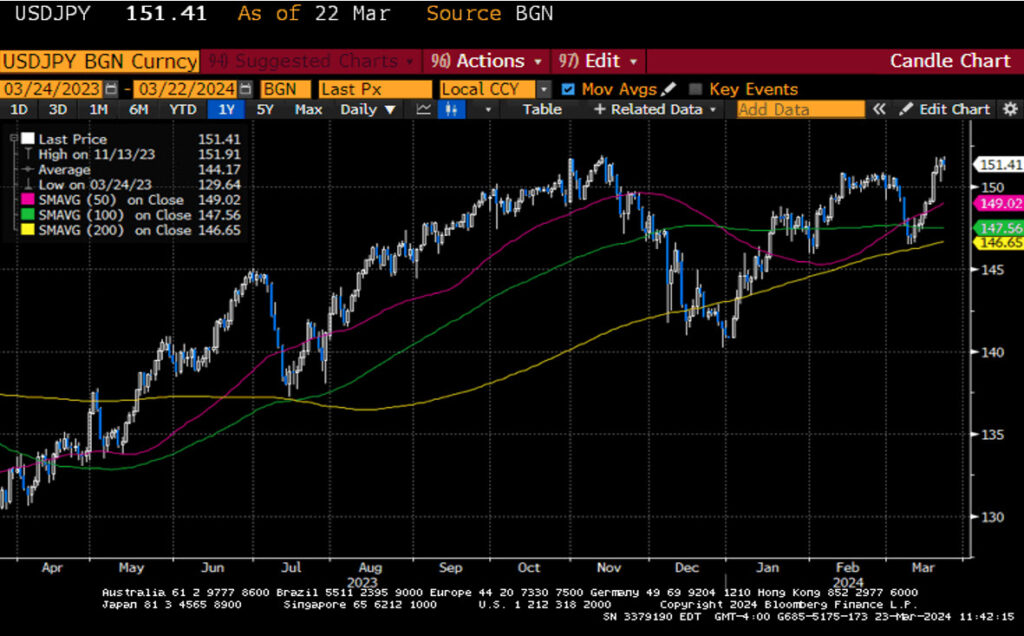
US equity markets forged another set of new highs in an extremely busy week on Wall Street. Global Central Banks took center stage, headlined by the Bank of Japan, the US Federal Reserve, and the Bank of England. The BOJ, as expected, moved away from its negative rate policy and raised its policy rate to a range of 0% to 0.1%. The bank also announced that it would stop purchasing ETFs and REITS. The BOJ remains very accommodative and that dovish stance induced a sell-off in the Yen/US Dollar cross and rallied the Japanese equity market. The Federal Reserve kept its policy rate range at 5.25% to 5.5%, and the Summary of Economic Projections showed that officials still expect three quarter-point rate cuts this year. A dovish tone from Chairman J. Powell in the post-statement Q&A fostered an asymmetric view that the Fed cares more about slowing economic growth than inflation concerns. Powell reiterated that the Fed would continue to monitor the economic data and formulate its policy accordingly. The Chair also acknowledged that it would soon be time to end its quantitative tightening measures to normalize the balance sheet. Investors loved what they heard and put a bid into equities, sending the S&P 500 above 5200 for the first time. The Bank of England also kept its policy rate at 5.25% in an 8 to 1 vote. Rhetoric from the BOE was also on the dovish side, and expectations shifted for the next move to be a cut rather than a rate hike.
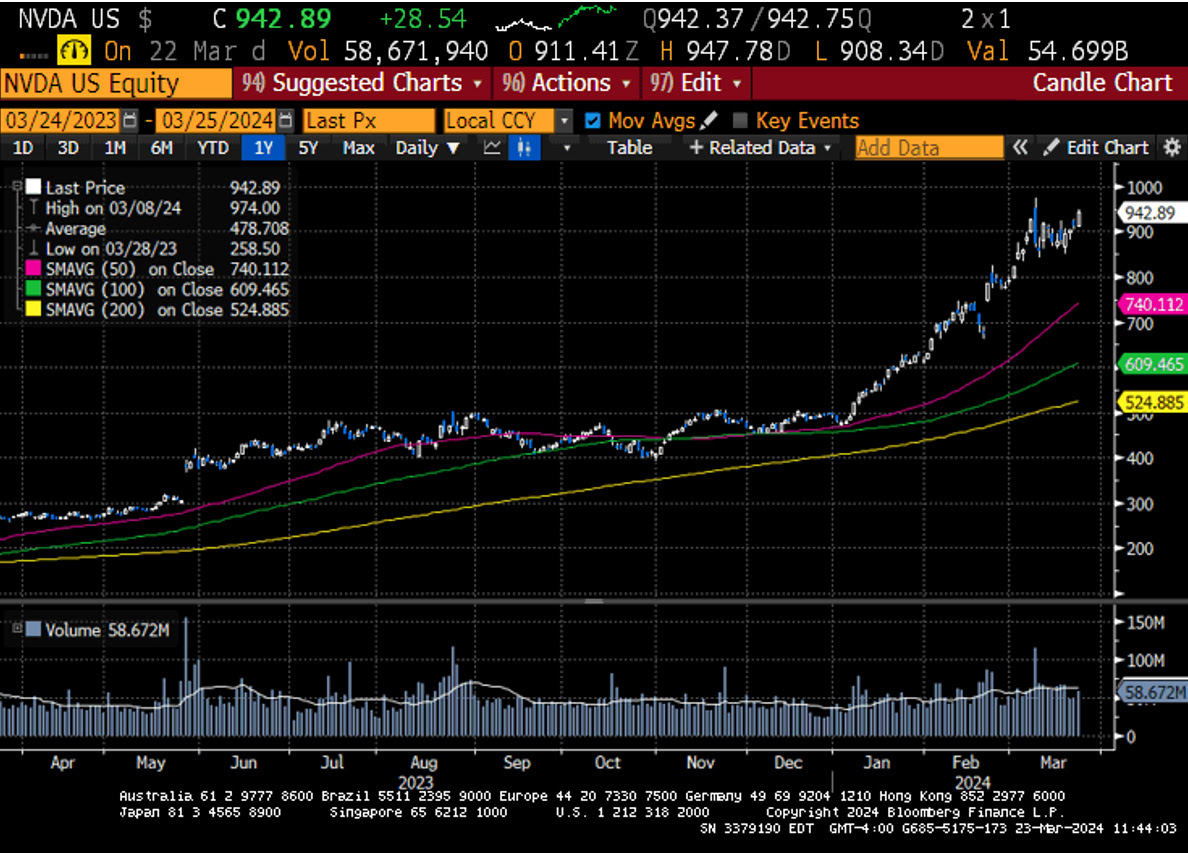
The week was also quite busy on the corporate front. It started with the announcement that Apple was considering using Google’s Gemini AI platform on the iPhone. Later in the week, the DOJ announced a lawsuit against Apple regarding antitrust concerns. High flier NVidia showcased its new Blackwell AI platform at its GTC conference. The event did not disappoint, propelling NVidia shares higher by over 7% on the week. The Reddit IPO was priced at $34 a share and gained 48% in its debut on the New York Stock Exchange. The company ended the week with a market cap of $9.5 billion. Federal Express and Micron Technology posted better-than-expected Q4 earnings results, which catalyzed their respective sub-sectors. On the other hand, consumer discretionary companies Lululemon and Nike posted disappointing earnings.
The economic calendar was relatively light but was highlighted by stronger housing data and a resilient labor market. Housing Starts increased by 10.7% in February with a seasonally adjusted 1.521m units. Building permits were up 1.9% month-over-month, coming in at 1.518M. February Existing Home Sales came in at 4.38M, well above the 3.92M consensus estimate. Initial Jobless claims fell by 2k to 210k, while Continuing Claims increased by 4k to 1.807m. A preliminary look at S&P Global Manufacturing and Services PMI indicated both sides of the economy are in expansion mode. However, the Services PMI showed its expansion moderating.
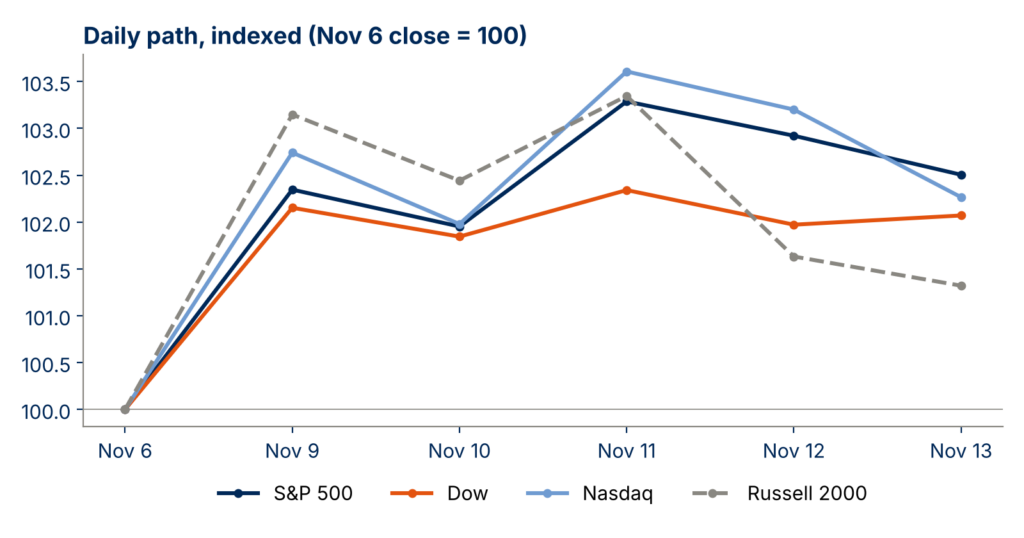
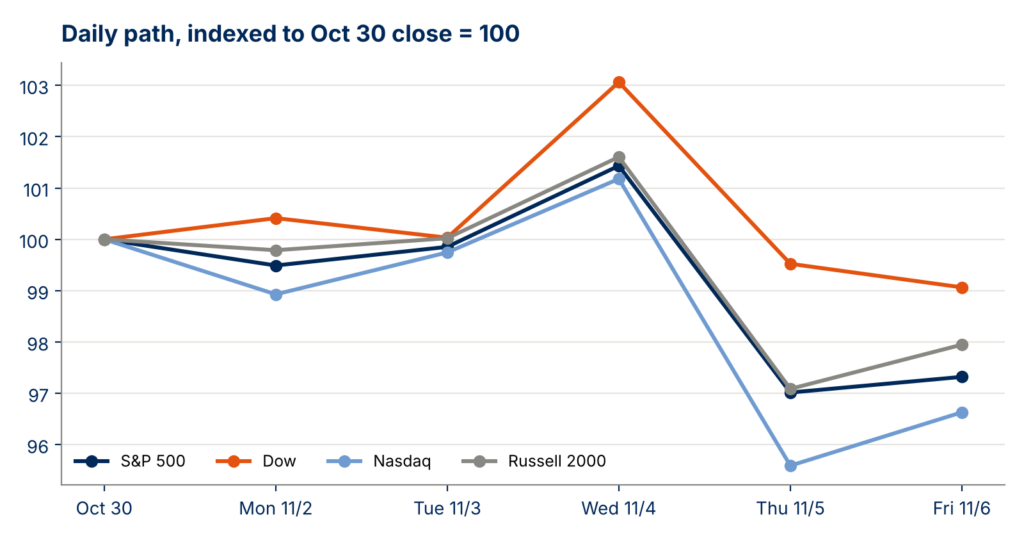
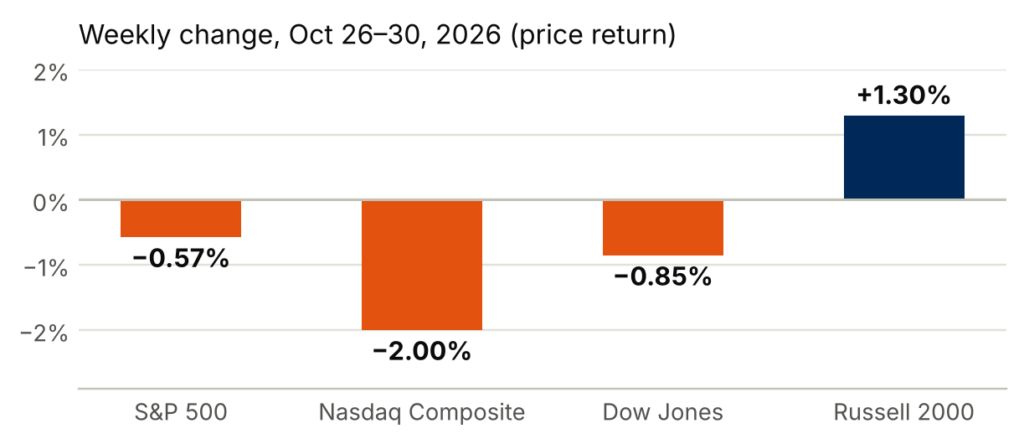
The S&P 500 advanced 2.3%, the Dow rose 2%, the NASDAQ increased 2.9%, and the Russell 2000 jumped 1.6%. The US yield curve steepened with shorter tenured paper yields decreasing more than longer duration yields. The 2-year yield fell by twelve basis points to 4.6%, while the 10-year yield fell by eight basis points to 4.22%. Oil prices changed a little during the week, with WTI closing lower by $0.34 to $80.65 a barrel. Gold prices barely moved on the week, losing $0.50 to close at $2160.20 an Oz. Copper prices digested some of its recent move by giving back $0.11 to close at $4.01 per Lb. The US Dollar rallied this week, with the Dollar index gaining 1% and closing at 104.46.
Investment advisory services offered through Foundations Investment Advisors, LLC (“FIA”), an SEC registered investment adviser. FIA’s Darren Leavitt authors this commentary which may include information and statistical data obtained from and/or prepared by third party sources that FIA deems reliable but in no way does FIA guarantee the accuracy or completeness. All such third party information and statistical data contained herein is subject to change without notice. Nothing herein constitutes legal, tax or investment advice or any recommendation that any security, portfolio of securities, or investment strategy is suitable for any specific person. Personal investment advice can only be rendered after the engagement of FIA for services, execution of required documentation, including receipt of required disclosures. All investments involve risk and past performance is no guarantee of future results. For registration information on FIA, please go to https://adviserinfo.sec.gov/ and search by our firm name or by our CRD #175083. Advisory services are only offered to clients or prospective clients where FIA and its representatives are properly licensed or exempted.