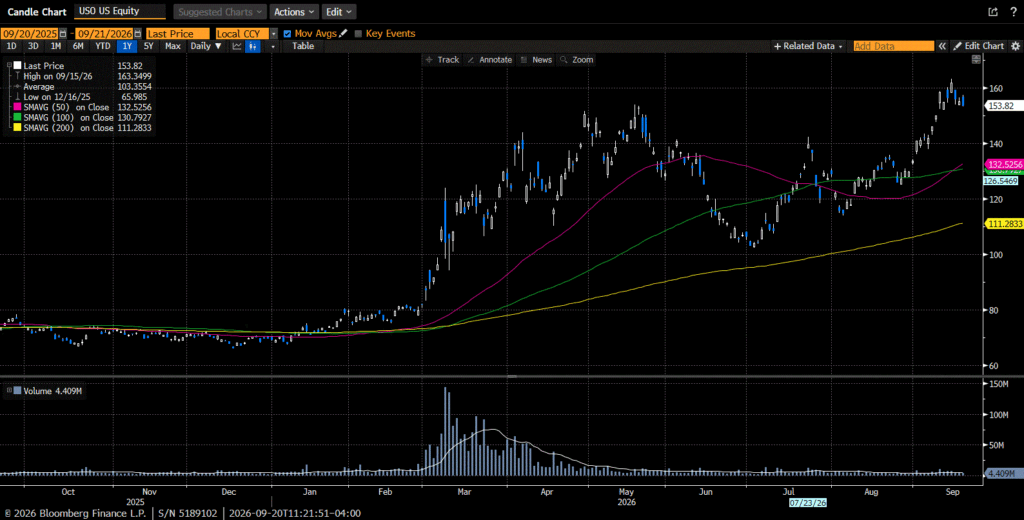
It was a volatile week on Wall Street as traders assessed monetary policy decisions from several central banks, including the Federal Reserve. The Fed did, as expected, raise its policy rate by 25 basis points to 3.75%-4.00%, but Fed Chairman Warsh’s very hawkish tone increased the likelihood of three more rate hikes starting later this year and in the first half of 2027. The Fed Chair offered no forward guidance but did provide the dot plot from the other committee members. The yield curve flattened on the announcement, with the front end of the curve selling off more than longer-duration Treasuries. Notably, the Bank of England kept its policy rate in place while the Bank of Japan raised its policy rate by 25 basis points. A more dovish signal from the BOJ’s president sent the Yen lower. Bottom line: the US economy is strong, employment looks stable, and inflation remains a concern. Much of the inflation concern comes from the conflict in the Middle East, where tensions between the US and Iran have driven oil prices up over $100 a barrel. Last week saw another spike in oil prices as a key Saudi pipeline was closed due to damage from a Houthi attack. The attack prompted Gulf States to postpone a meeting with Iran on opening up a passage through the Strait of Hormuz. Oil prices fell later in the week on news that the pipeline would reopen sooner than expected and on news that cargo continues to flow through the Strait of Hormuz, albeit at a fraction of what it was before the war.

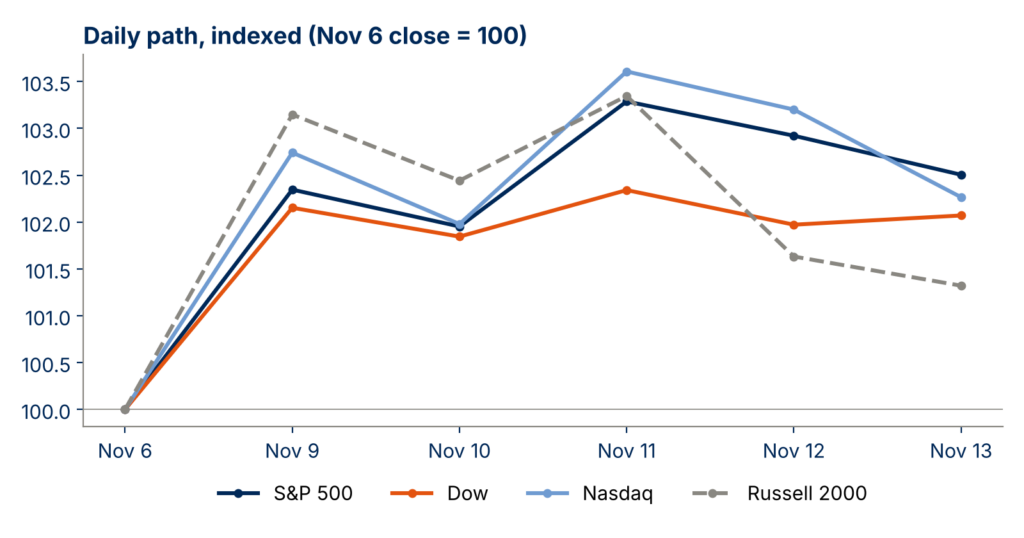
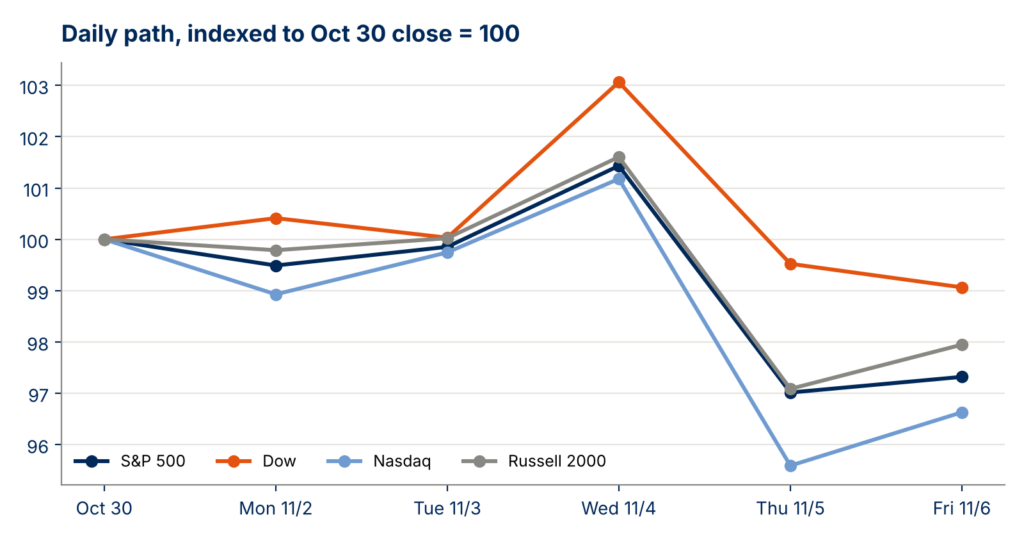
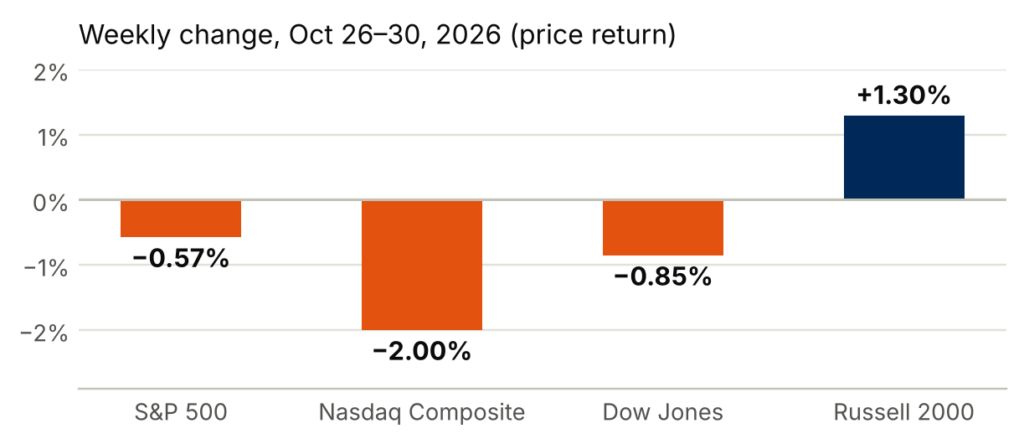
US indices finished the week mixed. The S&P 500 lost 0.06%, the Dow fell 1.65%, the NASDAQ advanced 0.73%, and the Russell 2000 shed 1.47%. The Information Technology sector helped buoy the market, along with influential mega-cap issues. Rate-sensitive parts of the market, such as Small-Caps, Utilities, and Real Estate, sold off. Financials also sold off on a flattening yield curve and cautious remarks from BofA and Goldman about trading revenues. Oil prices ended the week flat, with WTI closing at $100.24. Gold rose $16.20 to 4425.30 an ounce. Silver rose $1.96 to close the week at $67.15 per ounce. Copper prices advanced by $0.14 to close at $6.69 per Lb. Bitcoin’s price increased by $3,500, closing at $81,000. The US Dollar index gained 1.1% to close at 100.25.

The economic calendar featured a stronger-than-expected retail sales print, heavily influenced by gasoline prices. Headline Retail Sales for August increased by 1.2% versus the consensus estimate of 0.9%, while the Ex-Autos figure increased by 1.4% versus the estimated 0.5%. Housing Starts and Building Permits both came in weaker than expected at 1,275k and 1,394k, respectively. Initial Jobless Claims fell by 10k to 196k, while Continuing Claims fell by 39k to 1,730k. Industrial Production in August was flat, with Capacity Utilization coming in at 76.3, unchanged from July.

Investment advisory services offered through Foundations Investment Advisors, LLC (“FIA”), an SEC registered investment adviser. FIA’s Darren Leavitt authors this commentary which may include information and statistical data obtained from and/or prepared by third party sources that FIA deems reliable but in no way does FIA guarantee the accuracy or completeness. All such third party information and statistical data contained herein is subject to change without notice. Nothing herein constitutes legal, tax or investment advice or any recommendation that any security, portfolio of securities, or investment strategy is suitable for any specific person. Personal investment advice can only be rendered after the engagement of FIA for services, execution of required documentation, including receipt of required disclosures. All investments involve risk and past performance is no guarantee of future results. For registration information on FIA, please go to https://adviserinfo.sec.gov/ and search by our firm name or by our CRD #175083. Advisory services are only offered to clients or prospective clients where FIA and its representatives are properly licensed or exempted.