Weekly Market Commentary

US markets rallied on the notion that the economy may be able to execute a soft landing as inflation wanes and employment continues to hold up.  Inflation data reported during the week showed moderating prices at the consumer and wholesale levels.  Q2 earnings season kicked off with better-than-expected earnings from financials: JP Morgan, Citibank, and Wells Fargo.  United Healthcare, Delta Airlines, and Pepsi also beat their earnings expectations.  China announced new stimulus efforts, while Sweden got the nod to become a NATO member.
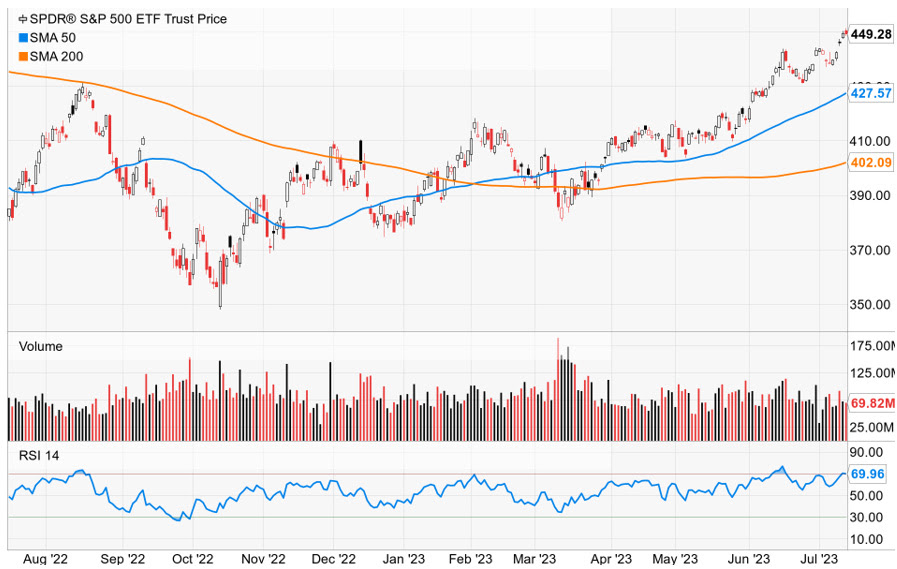
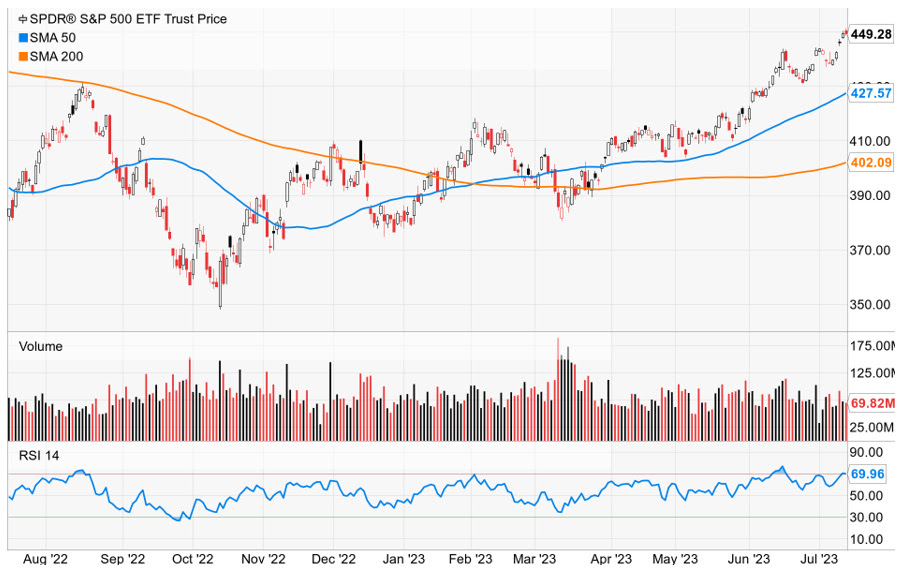
A broad-based rally saw the S&P 500 gain 2.4% on the week.  The Dow added 2.3%, the NASDAQ advanced 3.3%, and the Russell 2000 jumped 3.6%.  US Treasuries rallied on the weaker inflation data, with the 2-year yield coming down twenty-one basis points to 4.73%.  The 10-year yield fell by twenty-three basis points to close at 3.82%.  A perceived divergence in the path of central bank policies hit the US dollar index, which fell by 2.4% over the week.  Fed rhetoric during the week was skewed to more tightening, and while Fed Fund Futures project a near certainly of a July 25 basis point hike, the projections of another hike fell on this week’s pricing data.
Oil prices increased by 2% or $1.55, with WTI closing at $75.40 a barrel.  Gold prices jumped by 1.5% or $30.7 to 1964.40 an Oz.  Copper prices increased by 4% to close at 3.93 a Lb.

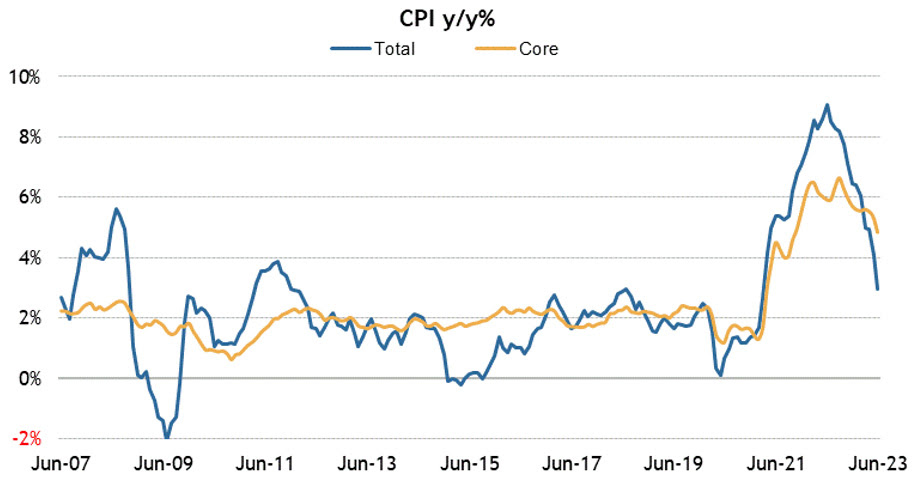
The Consumer Price Index highlighted economic data for the week.  The headline CPI and Core CPI for June came in at 0.1% less than the expected 0.2%.  On a year-over-year basis, CPI came in at 3%, down from 4% in May.  The Core year-over-year reading decreased to 4.8% from 5.3% in May.  Wholesale prices tracked by the Producer Price Index also saw prices moderating. Headline PPI came in at 0.1% versus the expected 0.2% and was up just 0.1% on a year-over-year basis, down from May’s increase of 1%.  Core PPI increased by 0.1% in June and fell to 2.4% from 2.6% in May year-over-year. Export prices fell by 0.9%.  Initial Unemployment Claims came in below estimates at 237k, while Continuing Claims came in at 1729k, up slightly from the prior week’s reading of 1718k.  The University of Michigan’s preliminary read on the July Consumer Sentiment came in better-than-expected at 72.6 versus the consensus expectation of 66.

Investment advisory services offered through Foundations Investment Advisors, LLC (“FIA”), an SEC registered investment adviser. FIA’s Darren Leavitt authors this commentary which may include information and statistical data obtained from and/or prepared by third party sources that FIA deems reliable but in no way does FIA guarantee the accuracy or completeness.  All such third party information and statistical data contained herein is subject to change without notice.  Nothing herein constitutes legal, tax or investment advice or any recommendation that any security, portfolio of securities, or investment strategy is suitable for any specific person.  Personal investment advice can only be rendered after the engagement of FIA for services, execution of required documentation, including receipt of required disclosures.  All investments involve risk and past performance is no guarantee of future results. For registration information on FIA, please go to https://adviserinfo.sec.gov/ and search by our firm name or by our CRD #175083. Advisory services are only offered to clients or prospective clients where FIA and its representatives are properly licensed or exempted.
Share:

View the Latest Commentaries:

Weekly Market Commentary

As we move from the third quarter into the fourth, investors have a lot to consider in this crazy market.  US equities finished the week mixed in volatile trade.  A standstill in negotiations between the US and Iran pushed oil prices higher early in the week, but the realization that oil moving through the Strait of Hormuz is now at pre-war levels, along with news that the G7 would release 100 million gallons of oil and diesel from reserves, pushed oil prices lower.  This comes as the Pentagon is considering deploying 10,000 more troops and an additional aircraft carrier to the Gulf.  Elevated oil prices have kept inflation concerns front and center, but a cooler-than-expected PCE report, a weaker-than-anticipated Employment Situation report, and dovish remarks from Fed President Williams and Vice Chair Jefferson moved the probability of a rate hike in October from over 70% to less than 25%.  Interestingly,

Weekly Market Commentary

Markets finished the week mixed as interest rates increased across the yield curve.  Oil prices swung significantly during the week as reports suggested the US and Iran were close to a deal to reopen the Strait of Hormuz.  This weekend, President Trump rejected the proposed deal, with reports suggesting the US will resume more aggressive military operations after the Midterms.  This is likely to send oil prices higher on Monday and, with it, increase inflation expectations.  President Trump’s meeting with Chinese leader Xi offered little change to the current political stance.  The two countries delayed increasing tariffs until January 2027, and the two leaders are scheduled to meet two more times before year-end.   Additionally, the two leaders appear to be on the same page on AI development and pushed back on slowing it but agreed that safeguards should be put in place.  Debate continues over AI development and its safeguards. 

Weekly Market Commentary

It was a volatile week on Wall Street as traders assessed monetary policy decisions from several central banks, including the Federal Reserve.  The Fed did, as expected, raise its policy rate by 25 basis points to 3.75%-4.00%, but Fed Chairman Warsh’s very hawkish tone increased the likelihood of three more rate hikes starting later this year and in the first half of 2027.  The Fed Chair offered no forward guidance but did provide the dot plot from the other committee members.  The yield curve flattened on the announcement, with the front end of the curve selling off more than longer-duration Treasuries. Notably, the Bank of England kept its policy rate in place while the Bank of Japan raised its policy rate by 25 basis points.  A more dovish signal from the BOJ’s president sent the Yen lower.  Bottom line: the US economy is strong, employment looks stable, and inflation remains

Weekly Market Commentary

US equity markets fell in the holiday-shortened week as oil prices surpassed $100 a barrel, raising inflation concerns and pushing interest rates higher.  Additionally, elevated inflation data announced during the week increased the likelihood that the Federal Reserve would raise its policy rate by 25 basis points.  Several Gulf nations announced Friday that they would meet with Iranian officials this weekend to ease tensions, and on Sunday Tehran announced it would decide whether to open part of the Strait of Hormuz, but details of the opening were limited.  This followed Saudi Arabia’s announcement that it had shut down the oil pipeline used to circumvent the Strait. The S&P 500 fell 0.78%, the Dow gave back 1.56%, the NASDAQ declined 0.64%, and the Russell 2000 decreased by 2.39%.  US Treasuries suffered losses across the curve, with the front end of the curve getting hit hardest.  The 2-year yield increased by twenty-six